French Artists in 1899 Envisioned What Life Would Look Like in the Year 2000
Title: When Imagination Soared: How French Artists in 1899 Envisioned the Year 2000
Meta Description: Discover the whimsical, bold, and surprisingly accurate predictions French illustrators made about life in the year 2000. Explore the 1899 “En L’An 2000” series and its legacy.
Introduction: A Leap into the Future from the Belle Époque
At the brink of the 20th century, the world was buzzing with innovation. The Industrial Revolution had reshaped cities, electricity was transforming daily life, and the Eiffel Tower—a symbol of modern engineering—dominated the Paris skyline. Against this backdrop, a group of French artists and illustrators dared to dream bigger. Commissioned for the 1900 World Exhibition in Paris, a series of futuristic illustrations titled En L’An 2000 (“In the Year 2000”) offered a dazzling glimpse into the imagined world of the next century. Over 120 years later, these visions reveal as much about 1899’s hopes and anxieties as they do about our own reality.
The Birth of En L’An 2000: Art Meets Ambition
The illustrations, often attributed to artists like Jean-Marc Côté and Villemard, were originally printed as cigarette cards or postcards. They blended the optimism of France’s Belle Époque (“Beautiful Era”) with wild speculative fiction. These artworks weren’t just flights of fancy—they were rooted in the era’s breakthroughs:
- Technological Euphoria: From streetlights to telephones, rapid advancements made anything seem possible.
- Science Fiction’s Rise: Jules Verne’s novels (like 20,000 Leagues Under the Sea) popularized futuristic storytelling.
- World Expo Mania: The 1900 Paris Expo showcased cutting-edge inventions, inspiring visions of tomorrow.
6 Bold Predictions by 19th-Century French Futurists
Let’s dive into the most striking illustrations and how they stack up against our 21st-century world:
1. Flying Cars (and Flying Everything Else)
- Prediction: Artists sketched airborne firefighters, aerial buses, and personal winged vehicles zipping between skyscrapers.
- Reality: While flying cars remain niche (e.g., drones, prototypes), air travel and helicopters fulfill parts of this vision.
2. Robot Labor Replaces Humans
- Prediction: Automated tailors, mechanical barbers, and robot chefs handle repetitive tasks, freeing humans for leisure.
- Reality: AI and robotics have automated factories and service jobs, but with complex societal impacts unimagined in 1899.
3. Underwater Cities & Submarine Adventures
- Prediction: Elegant submersibles ferry tourists to domed underwater hotels and schools.
- Reality: While submersibles exist (see: luxury submarines), underwater habitats are limited to research labs.
4. Instant Meals & Food Tech
- Prediction: Machines deliver pre-cooked meals via tubes directly to dining rooms.
- Reality: Meal delivery apps (Uber Eats) and microwave dinners make this eerily prescient—minus the pneumatic tubes.
5. Battle Machines & Sky Warfare
- Prediction: Bird-like aircraft and armored tanks clash in mid-air duels.
- Reality: Drones and fighter jets align with this martial vision, though warfare has become more digital than theatrical.
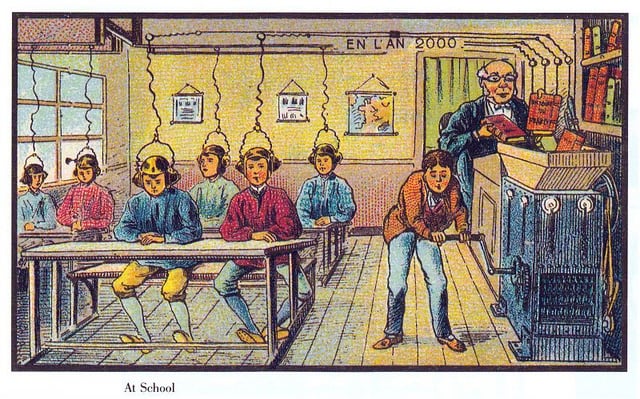
6. Video Calls & Virtual Learning
- Prediction: Teachers broadcast lessons via live video to students’ home screens.
- Reality: Zoom and online learning platforms nailed this forecast—down to the screen-based isolation!
Why Did They Get Some Things So Wrong (or So Right)?
The En L’An 2000 series hit the mark on communication and automation but missed on social dynamics, environmental challenges, and the digital revolution. Key reasons:
- Linear Extrapolation: Artists assumed 1900s trends (like steam power) would evolve, not be replaced by microchips.
- Elitist Visions: Many scenes depicted wealthy Europeans—ignoring globalization and social equity.
- Mechanical Over Digital: They imagined gears and levers, not code and silicon.
Legacy: How These Visions Shape Our Future Today
The En L’An 2000 cards are more than quirky relics—they’re cultural touchstones:
- Retro-Futurism Aesthetic: Their Art Nouveau-meets-steampunk style influences movies (Hugo, Metropolis) and design.
- Innovation Fuel: Modern creators cite these artworks as inspiration for tackling today’s challenges, from climate tech to AI ethics.
- Humbling Perspective: Their mix of accuracy and naivety reminds us that predicting the future remains as much art as science.
Conclusion: Dreaming Tomorrow, Understanding Today
The French artists of 1899 envisioned the year 2000 with boundless creativity, technical curiosity, and a dash of whimsy. While their winged policemen and robotic farmers may seem quaint, their core message endures: progress is shaped by human ingenuity—and our ability to adapt when reality outpaces imagination. As we now envision our year 2100, these century-old postcards urge us to dream boldly… and stay humble.
Keywords for SEO:
French futurism, En L’An 2000, 19th-century predictions, retro-futuristic art, Belle Époque technology, 1900 World Expo, Villemard illustrations, flying cars history, robot labor prediction, vintage futurism.
Image Alt Text Suggestion:
“Colorful 1899 French illustration depicting a futuristic flying machine over Paris, from the En L’An 2000 series.”
Engagement Prompt: Which 1899 prediction fascinates you most? Share your thoughts—and your own visions for 2100—below!