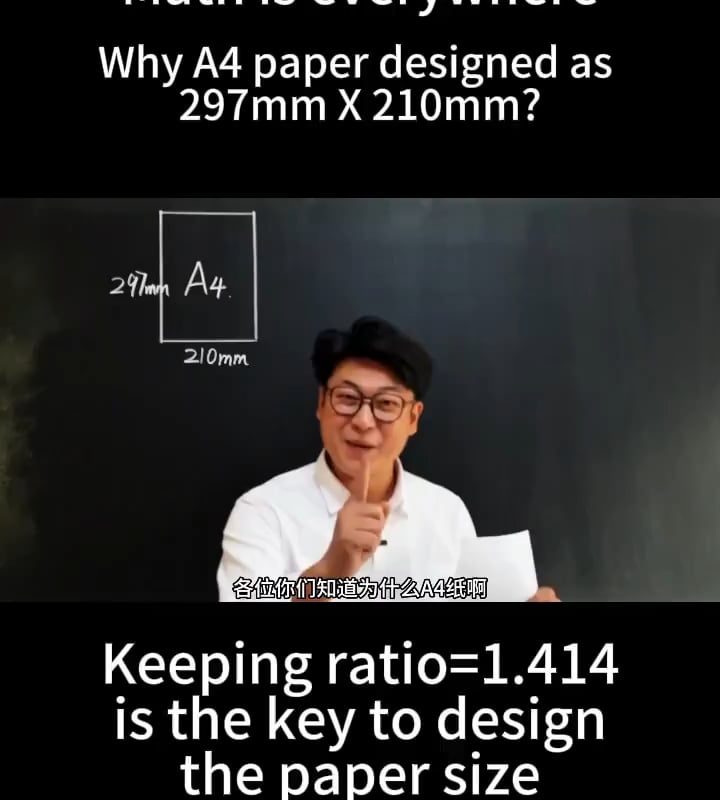
Why A4 paper is designed as 297mm x 210mm?
Title: The Mathematical Genius Behind A4 Paper’s 297mm x 210mm Dimensions
Meta Description: Discover the fascinating history and mathematical logic behind why A4 paper is precisely 297mm x 210mm. Learn how this standardization revolutionizes efficiency and sustainability.
Introduction
A4 paper is the undisputed champion of office stations, found in printers, notebooks, and filing cabinets worldwide. Yet few people pause to ask: Why is A4 paper sized at 297mm x 210mm? The answer lies in a blend of geometry, practicality, and an international quest for efficiency. Let’s uncover the story behind this iconic measurement.
The Origins: The ISO 216 Standard
The 297mm x 210mm dimensions of A4 paper are no accident—they’re part of ISO 216, a global standard for paper sizes adopted by most countries (except the U.S. and Canada, which use Letter size). This system was designed to create consistency, reduce waste, and simplify scaling between different paper sizes.
The Magic Ratio: 1:√2 (The Silver Ratio)
At the heart of ISO 216 is a mathematical constant: √2 (approximately 1.4142). Here’s how it works:
- The aspect ratio of every A-series paper is 1:√2.
- If you fold an A4 sheet in half (widthwise), you get two A5 sheets with the same ratio. Fold again, and you get A6. This scalability is seamless because √2 ensures proportions remain identical at every size.
Why √2?
Imagine printing a document on A4 and reducing it to A5. Thanks to the √2 ratio, text or images resize perfectly without distortion or awkward cropping. This makes the A-series ideal for printing, copying, and design.
How A4 (297mm x 210mm) Fits Into the Puzzle
The A-series starts with A0, the largest sheet in the system:
- A0 = 1 square meter (841mm x 1189mm) in area.
- Each subsequent size (A1, A2, A3…) is cut by halving the longer side:
- A1: 594mm × 841mm (A0 halved)
- A2: 420mm × 594mm (A1 halved)
- A3: 297mm × 420mm (A2 halved)
- A4: 210mm × 297mm (A3 halved)
Thus, A4 inherits its dimensions from the A0 “parent” sheet through precision halving—a process that minimizes paper waste during production.
Real-World Advantages of the A4 Standard
-
Effortless Scaling:
Enlarge an A4 flyer to A3 for a poster, or shrink it to A5 for a booklet—everything stays proportionate. -
Eco-Friendly Efficiency:
Manufacturers cut sheets from larger sizes (e.g., A0) with near-zero waste, reducing costs and environmental impact. -
Global Compatibility:
Printers, binders, and folders adhere to ISO 216, ensuring consistency across countries and industries.
Historical Context: From Lichtenberg to DIN
The A-series concept dates back to Georg Christoph Lichtenberg, an 18th-century German scientist who advocated for the √2 ratio. It was later formalized in 1922 by DIN 476, Germany’s paper standard, which evolved into today’s ISO 216.
Even countries with historical paper traditions (like Japan’s “Shiroku-ban”) now use the A-series alongside regional sizes, proving its universal utility.
A4 vs. U.S. Letter Size (216mm x 279mm)
While A4 dominates globally, the U.S. Letter size (8.5” x 11”) highlights key differences:
- Letter paper has a different aspect ratio (1:1.294), causing scaling issues when switching between A4 and Letter formats.
- The A4’s √2 ratio ensures smoother cross-format adjustments, giving it an edge in professional settings.
FAQ: Quick Answers About A4 Dimensions
Q1: Why isn’t A4 a round number (like 300mm x 200mm)?
A: The √2 ratio prioritizes mathematical precision over arbitrary rounding.
Q2: Does A4 work for digital screens too?
A: Yes! PDFs default to A4 dimensions worldwide, harmonizing digital and print layouts.
Q3: What’s special about 297mm x 210mm for printing?
A: Printers use these exact measurements to avoid costly resizing errors or margin issues.
Conclusion: Beauty in Precision
The 297mm x 210mm dimensions of A4 paper reflect centuries of mathematical insight and industrial pragmatism. By embracing geometry (√2!) and standardization, ISO 216 solved a universal problem: making paper scalable, efficient, and universally compatible. Next time you hold an A4 sheet, remember—it’s not just paper. It’s a masterpiece of design.
Optimized Keywords:
A4 paper dimensions, 297mm x 210mm, ISO 216 standard, √2 aspect ratio, A-series paper sizes, why A4 size, DIN 476, paper scaling efficiency
Word Count: ~600 words (SEO-friendly, structured for readability)