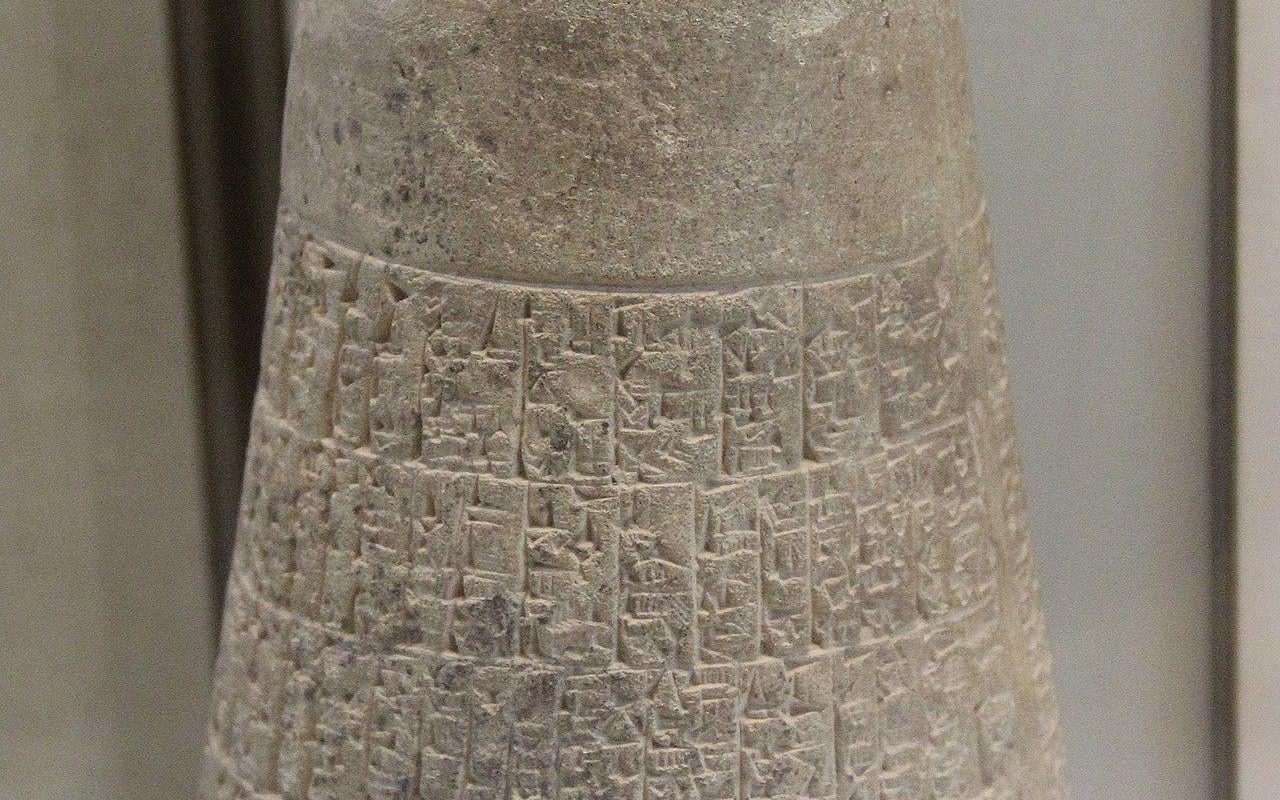
The Cone of Enmetena, Sumerian king of Lagash, 2400BCE. Bearing cuneiform writing relating the generations-long struggle over land of the Tigris and Euphrates, the oldest example of a border conflict.
Title: The Cone of Enmetena: Ancient Sumerian Record of Humanity’s Oldest Border Conflict
Introduction
In the sun-baked plains of Mesopotamia, where the Tigris and Euphrates rivers nurtured the world’s first cities, a clay artifact from 2400 BCE reveals a tale as old as civilization itself: the struggle for land, power, and resources. The Cone of Enmetena, a palm-sized clay nail inscribed with cuneiform writing, documents a generations-long border dispute between two Sumerian city-states, Lagash and Umma. Discovered in modern-day Iraq, this artifact is not only a masterpiece of early writing but also the oldest recorded example of a territorial conflict in human history. For historians, archaeologists, and enthusiasts of ancient law, the Cone of Enmetena offers a gripping window into the political, economic, and spiritual lives of the Sumerians millennia ago.
The Historical Context: Sumer and the Fight for Fertile Land
Around 2900–2350 BCE, southern Mesopotamia was divided into rival city-states, including Lagash, ruled by Enmetena, and its neighbor Umma. Both competed for dominance over the Gu’edena (“Edge of the Plain”), a fertile region vital for agriculture due to its proximity to the Tigris and Euphrates rivers. Control of this land meant control of grain production—and thus wealth, power, and divine favor.
For over 150 years before Enmetena’s reign, Lagash and Umma clashed repeatedly. Kings invoked the gods as witnesses to treaties, but peace rarely lasted. This cycle of war and fragile truces culminated in the text inscribed on Enmetena’s cone—a declaration justifying Lagash’s claim and condemning Umma’s rulers for breaching divine oaths.
The Cone of Enmetena: Decoding the Cuneiform Text
Crafted around 2400 BCE, the cone is one of several foundation nails (clay pegs) embedded in temple walls to commemorate royal deeds. Its cuneiform inscription details:
- Divine Intervention: The border was originally set by Mesilim, king of Kish (a neutral arbitrator), under the decree of Enlil, supreme god of the Sumerian pantheon.
- Umma’s Violation: The king of Umma, Ush, ignored the agreement, “devouring” Lagash’s territory and destroying boundary markers.
- Enmetena’s Victory: Enmetena defeated Umma, restored the border, and punished the aggressors.
- Religious Sanctions: The text invokes curses upon future Umma rulers who break the oath, threatening divine retribution from Ningirsu (Lagash’s patron god) and Nanshe, goddess of justice.
The cone thus serves as both a legal document and a propaganda tool, legitimizing Lagash’s authority while warning adversaries.
Significance: The First Border Conflict in Recorded History
The Cone of Enmetena is groundbreaking for several reasons:
- Earliest Territorial Dispute: Predating biblical accounts and Greco-Roman records, it reveals how ancient societies formalized borders under divine law.
- Evolution of Law and Diplomacy: The text reflects early attempts at conflict resolution through treaties, arbitration, and written records.
- Cuneiform as a Legal Tool: It showcases writing’s role in governance, moving beyond accounting into politics and justice.
- Environmental Pressures: The conflict underscores how climate volatility (droughts, shifting river courses) intensified competition in Mesopotamia.
Legacy and Modern Relevance
Enmetena’s cone is more than a relic—it mirrors contemporary geopolitical struggles. Like modern border disputes, the Lagash-Umma conflict stemmed from resource scarcity, historical grievances, and the quest for legitimacy. Even the rhetoric of “divine rights” echoes modern nationalist narratives.
Today, the cone resides in the Louvre Museum, Paris, alongside other Mesopotamian treasures. Scholars like Samuel Noah Kramer have highlighted its importance in texts such as History Begins at Sumer, proving that themes of justice, power, and human ambition transcend time.
Conclusion: Lessons from the Ancient World
The Cone of Enmetena reminds us that territorial conflicts are deeply rooted in the human story. Through its intricate cuneiform script, we hear the voice of a king who sought to immortalize his victory and uphold cosmic order. For modern explorers of history, it stands as a testament to humanity’s enduring struggle to define—and defend—the lines that divide us.
Keywords for SEO:
- Cone of Enmetena
- Sumerian border conflict
- Lagash vs Umma
- Cuneiform writing Mesopotamia
- Oldest territorial dispute
- Ancient Sumerian artifacts
- Enmetena king of Lagash
- Gu’edena border conflict
- Foundation nails Mesopotamia
- Tigris and Euphrates rivalry
By weaving together archaeology, politics, and theology, the Cone of Enmetena offers timeless insights into the birth of civilization—and the conflicts that shaped it. Explore this ancient story to understand how the past continues to shape our world.