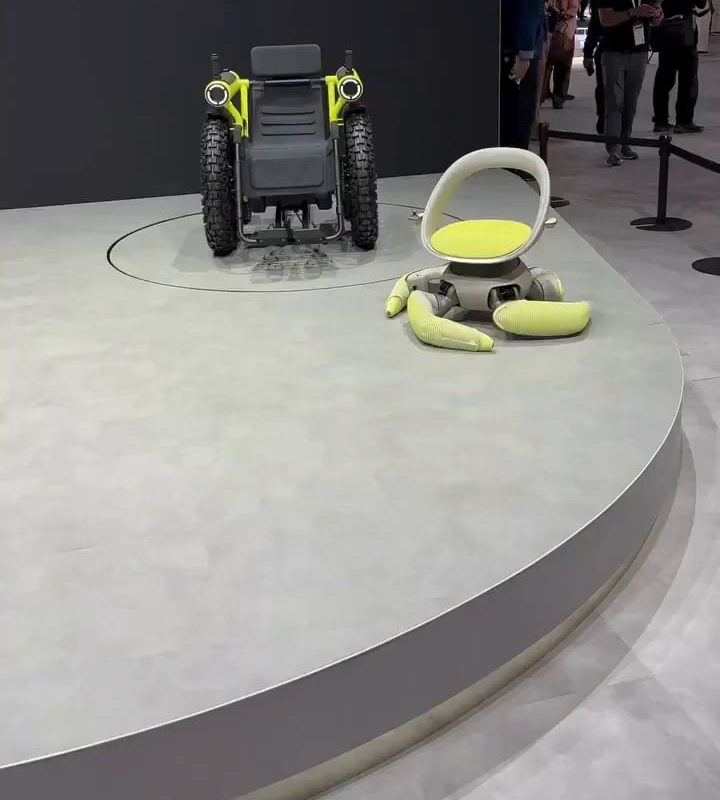
During Japan Mobility Show 2025, Toyota revealed the “Walk Me,” a concept autonomous wheelchair with foldable tentacle legs that can climb stairs and sit on the floor. The wheelchair should help people with reduced mobility to move around places where traditional wheelchairs aren’t able to reach.
Toyota Unveils “Walk Me”: Autonomous Wheelchair with Tentacle Legs Redefines Mobility at Japan Mobility Show 2025
The future of accessibility took a giant leap forward at the Japan Mobility Show 2025, where Toyota stunned the world with its groundbreaking “Walk Me” autonomous wheelchair concept. Designed to conquer environments where traditional wheelchairs falter—like stairs, uneven terrain, or tight spaces—this revolutionary mobility aid combines biomechanical engineering with AI-powered autonomy. With foldable “tentacle legs” inspired by organic movement, the Walk Me blurs the line between assistive device and robotic companion, promising unparalleled freedom for users with limited mobility.
Breaking Barriers: The Walk Me Concept
Toyota’s Walk Me isn’t just a wheelchair—it’s a mobility transformer. Gone are the rigid wheels limited to flat surfaces. Instead, the Walk Me uses six modular, multi-jointed legs that fold compactly when not in use. These lightweight, carbon-fiber limbs mimic natural motion, allowing the wheelchair to:
- Climb stairs smoothly and securely, adjusting grip on each step.
- Sit directly on the floor (e.g., tatami mats in traditional Japanese rooms).
- Navigate tight corners, cobblestones, or gravel paths with stability.
- Autonomously return to a charging dock when idle.
Powered by Toyota’s proprietary AI, the Walk Me learns user habits and optimizes routes in real time. Sensors detect obstacles, while voice or app-based controls let users customize settings like speed, seat height, or leg deployment.
Key Features Revolutionizing Mobility
-
Stair-Climbing Tentacle Legs:
Each leg operates independently, using pressure sensors to grip surfaces. Whether ascending stairs or traversing slopes, the Walk Me maintains balance, ensuring user safety. -
Autonomous Navigation:
GPS and LiDAR map surroundings, enabling hands-free “follow mode” in crowded areas like airports or shopping centers. Users can summon the Walk Me via smartphone. -
Floor-Level Seating:
Traditional wheelchairs sit higher than floor seating, isolating users in social settings. The Walk Me lowers smoothly to ground level, fostering inclusivity. -
Compact Portability:
Legs fold into the chassis, shrinking the device for car trunk storage—no specialized vehicle required.
A New Era of Accessibility
For the 75 million global wheelchair users, the Walk Me addresses persistent pain points:
- Urban Accessibility: Only 23% of Tokyo’s train stations are wheelchair-friendly. Tentacle legs bypass this infrastructural gap.
- Home Independence: Users can access raised showers, narrow hallways, or multi-level homes without assistance.
- Social Equality: Floor-level seating lets users participate in cultural activities (e.g., tea ceremonies) on equal footing.
“Mobility is a human right,” said Toyota’s Chief Engineer, Akira Nakamura, during the reveal. “Walk Me isn’t about replacing wheels—it’s about expanding possibilities.”
The Road Ahead
While still a concept, Toyota aims to launch Walk Me pilot programs in Japanese hospitals and elderly care centers by 2027. Challenges remain—regulatory approvals, battery life optimization, and cost reduction—but the automaker envisions a subscription-based model for affordability. Collaborations with cities to integrate Walk Me into public transit are also underway.
Conclusion: Mobility Without Limits
Toyota’s Walk Me epitomizes the Japan Mobility Show 2025’s theme—“Imagine a World Where Everyone Moves Freely.” By blending robotics, AI, and empathetic design, Toyota isn’t just innovating; it’s pioneering a future where physical limitations no longer dictate freedom. As prototypes evolve, the Walk Me could redefine accessibility standards worldwide, ensuring no one is left behind—whether on stairs, uneven paths, or life’s journey.
Stay tuned for updates by following Toyota’s official channels—the Walk Me might just walk into reality sooner than expected.
Keywords for SEO: Toyota Walk Me, autonomous wheelchair 2025, stair-climbing wheelchair, Japan Mobility Show 2025, AI mobility aid, foldable tentacle legs, assistive technology, accessible robotics, Toyota concept vehicle, mobility innovation.


![[Highlight] Mike Conley swishes the open three and then hits 10 consecutive unique handshakes as he heads to the bench](https://www.smartplusmedia.com/wp-content/uploads/2025/12/Highlight-Mike-Conley-swishes-the-open-three-and-then-hits-445x265.jpeg)
