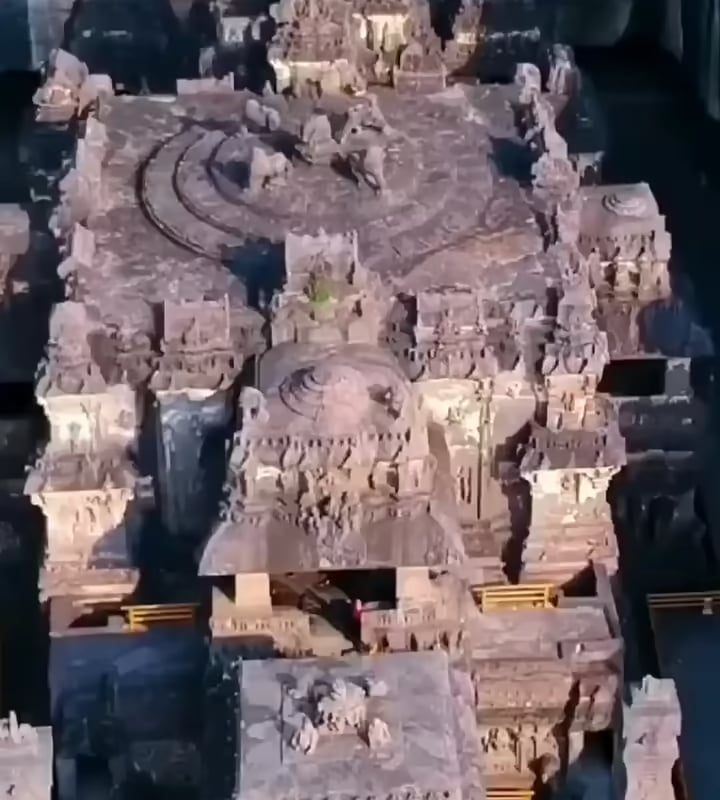
This temple wasn’t built ….. it was carved top-down from a mountain
Title: The Kailasa Temple: A Monument Carved From the Top Down, Not Built Up
Meta Description: Discover the astonishing Kailasa Temple in India, a breathtaking UNESCO World Heritage Site sculpted entirely from a single mountain rock—carved top-down like a colossal 3D sculpture.
Imagine a temple so grand that its construction defies logic—not built brick by brick, but carved downward from solid mountain rock. Welcome to the Kailasa Temple (Cave 16) in Ellora, Maharashtra, India: an ancient engineering marvel that proves human ingenuity knew no limits over 1,200 years ago.
The Astonishing Top-Down Technique
Unlike traditional construction, where builders stack materials upward, artisans sculpted the Kailasa Temple by removing 200,000 tons of volcanic basalt rock from the top of the mountain downward—like peeling layers of an onion. This “subtractive architecture” required precision so advanced that a single mistake could have doomed the entire project.
- Vertical Excavation: Workers dug three massive trenches into the mountain to form the temple’s frame, then chiseled outward to create pillars, halls, deities, and intricate reliefs.
- Scale: The temple stands over 100 feet tall, covers double the area of Greece’s Parthenon, and features bridges, multi-story towers, and life-sized elephant sculptures—all from one rock.
Why Was This Done?
Built in the 8th century CE under King Krishna I of the Rashtrakuta Dynasty, the Kailasa Temple honors Lord Shiva. Legends claim it was commissioned as an act of devotion—or even to fulfill a queen’s vow after a healing miracle. By carving the temple top-down, architects mimicked Shiva’s celestial abode, Mount Kailash, aiming to create heaven on Earth.
The Impossible Feats of Ancient Engineering
- Zero Mistakes: No structural corrections were needed; the entire plan was executed perfectly from day one.
- Symmetry & Detail: Its galleries and courtyards align astronomically, hosting over 30 chambers filled with carvings of Shiva, Vishnu, and epic tales like the Ramayana.
- Mystery Tools: Experts still debate how builders achieved this without modern tools or blueprints. Some theorize wooden scaffolds or a “master template” etched into the rock face.
Why Modern Minds Are Baffled
The Kailasa Temple challenges everything we know about ancient labor and technology:
- Timeframe: Estimated to take 18 years (other theories say decades), but that’s shockingly fast for hand tools alone.
- Resource Paradox: Where did 200,000 tons of rubble go? No debris piles exist nearby.
- Cultural Impact: This UNESCO World Heritage Site remains an active place of worship, proving its legacy is as enduring as its stone.
Visit the Kailasa Temple Today
Ellora’s cave complex (a 3-hour drive from Mumbai) draws pilgrims and travelers alike. Pro tips:
- Best time to visit: November–February (cool weather).
- Don’t miss: The evening light-and-sound show highlighting the temple’s myths.
- Pair with: Ajanta Caves’ frescoes (100 km away) for a full ancient-art immersion.
Final Thought: The Kailasa Temple isn’t just architecture—it’s a testament to human devotion and imagination. In a world obsessed with upward growth, it reminds us that greatness sometimes comes from digging deeper.
Keywords for SEO: Kailasa Temple, UNESCO World Heritage Site, Ellora Caves, top-down carving, rock-cut architecture, ancient engineering marvel, Lord Shiva temple, Rashtrakuta Dynasty, subtractive architecture, Maharashtra tourism.
Call to Action:
Unlock ancient secrets! Share your thoughts on the Kailasa Temple below or plan your trip to Ellora today. 🕉️✨