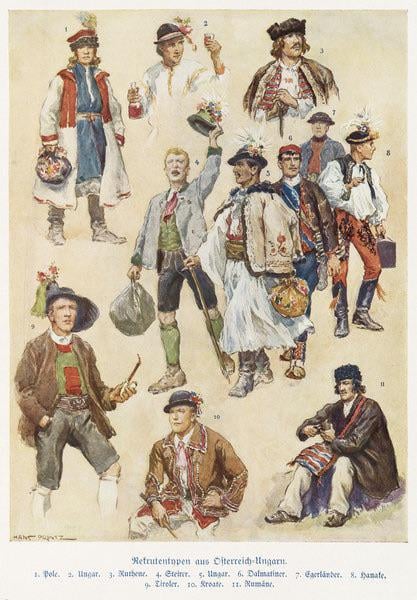
Early 20th century Austrian leaflet celebrating the ethnic diversity within the Austro-Hungarian Empire
Title: “Unity in Mosaic: How the Austro-Hungarian Empire Celebrated Ethnic Diversity Through Propaganda Leaflets”
Meta Description: Explore the fascinating early 20th-century Austrian leaflets that glorified the Austro-Hungarian Empire’s ethnic diversity. Learn how propaganda shaped unity in Europe’s fading “multinational experiment.”
Introduction: A Propaganda Tapestry of Empire
At the dawn of the 20th century, the Austro-Hungarian Empire stood as a sprawling multicultural entity—home to Germans, Hungarians, Czechs, Slovaks, Poles, Ukrainians, Romanians, Croats, Serbs, Italians, and more. As nationalist tensions simmered beneath the surface, the Habsburg monarchy doubled down on campaigns celebrating its diversity as a strength. One striking artifact from this era survives: a vividly illustrated Austrian propaganda leaflet praising the empire’s ethnic mosaic. This piece of ephemera offers a window into how the state framed unity amid impending collapse.
The Historical Context: Diversity as Strength (or Survival Strategy)
By 1900, the Austro-Hungarian Empire was a tottering giant. Its Dual Monarchy structure (shared between Austria and Hungary after 1867) failed to quell demands for autonomy from Slavic and other minority groups. In response, imperial authorities leaned on soft propaganda to reinforce loyalty. Leaflets, posters, and textbooks depicted the empire as a harmonious family of nations, bound by shared history, economic interdependence, and allegiance to Emperor Franz Joseph I.
The early 20th-century leaflet in question—likely printed between 1900–1914—served a dual purpose:
- Counter Nationalism: By emphasizing unity, it aimed to dilute separatist movements.
- Boost Morale: As political fractures widened, it presented the empire as resilient and inclusive.
Dissecting the Leaflet: Symbols of Unity in Ink and Color
While few originals survive today, descriptions and reproductions reveal common themes in these leaflets:
1. Visual Parade of Ethnic Costumes
Central to the design was a patchwork of figures in traditional dress: a Hungarian horseman, a Polish farmer, a Viennese burgher, a Tyrolean mountaineer, and a Bosnian Muslim, among others. Each was rendered in meticulous detail, celebrating cultural distinctiveness while visually stitching them into a single imperial tapestry.
2. Maps as Political Tools
The leaflet often featured a map of the empire color-coded by ethnicity—ironically mirroring the same divisive “us vs. them” mentalities Habsburg rulers hoped to suppress. Yet the accompanying text spun this diversity as a virtue: “One Land, Many Voices—All Hail the Emperor!”
3. Imperial Iconography
Crowns, double-headed eagles, and Habsburg heraldry framed the imagery, reinforcing dynastic authority. Slogans like “Strength Through Brotherhood” or “United in Diversity” (predating the EU’s motto by a century!) tied loyalty to coexistence.
4. Economic Interdependence
Text blocks highlighted how each region contributed to the empire’s prosperity: Bohemian industry, Galician grain, Dalmatian ports, and Viennese culture.
Between Ideal and Reality: The Propaganda’s Hidden Tensions
These leaflets were aspirational, not reflective. Beneath the colorful surface lay unresolved contradictions:
- Language Barriers: While German dominated administration, the empire recognized over a dozen official languages—yet education policies often marginalized minority tongues.
- Political Inequality: Hungary wielded disproportionate power, while Slavs (nearly half the population) were underrepresented.
- Suppressed Dissent: The same state distributing unity pamphlets jailed nationalist activists and censored anti-imperial media.
The leaflets scrubbed these tensions clean, offering a utopian vision of Habsburg multiculturalism that ignored rising ethnic hatreds—hatreds that would erupt in World War I and shatter the empire by 1918.
Legacy: A Blueprint for Multicultural Propaganda
Though the Austro-Hungarian Empire dissolved, its propaganda tactics endure:
- State-Branded Diversity: Modern nations like Canada or Singapore promote pluralism to foster civic pride—minus imperial coercion.
- Lessons in Fragility: The leaflets remind us that celebrating diversity works only if paired with political equity.
- Cultural Time Capsules: Today, these artifacts are prized by historians and collectors, symbolizing a lost era when Vienna dreamed of uniting Europe’s tribes.
Conclusion: When Empire Wore a Many-Colored Cloak
The early 20th-century Austrian leaflets lauding ethnic diversity remain haunting relics of a collapsing giant’s final act. They reveal not just Habsburg ingenuity in visual propaganda, but also the tragic gap between myth and reality in one of history’s last multinational empires. For scholars and history buffs, they are a testament to a bold, flawed vision of unity—one whose echoes still resonate in debates about identity and coexistence today.
Keywords for SEO: Austro-Hungarian Empire ethnic diversity | Habsburg multiculturalism | Austrian Empire propaganda | early 20th century leaflet | Habsburg monarchy | Austro-Hungarian Empire history | European ethnic groups | multinational empires | Franz Joseph I | WWI propaganda | historical ephemera