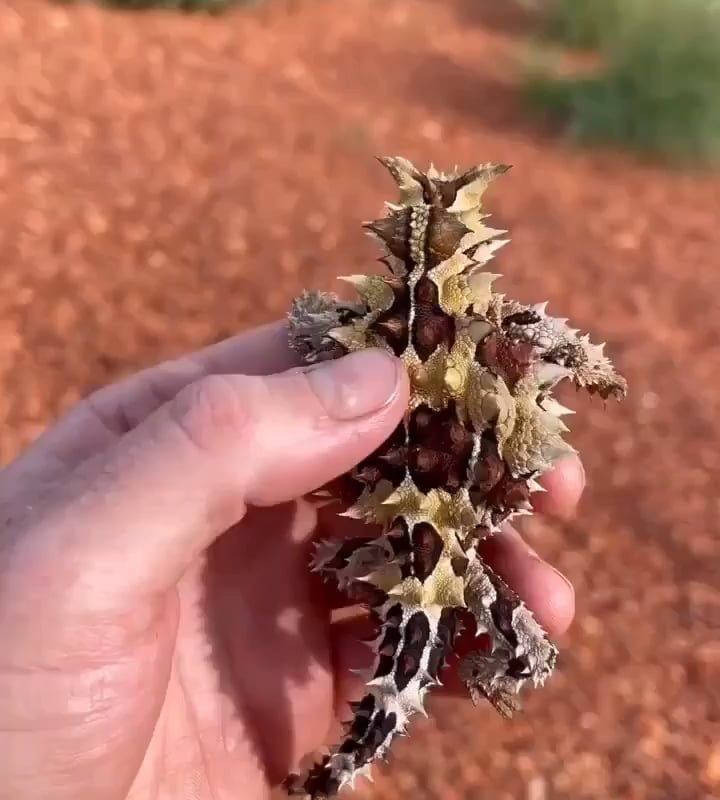
Thorny devil also (Moloch horridus) found in desert regions of Australia.
The Thorny Devil: Australia’s Spiny Desert Survivor
Deep in the arid deserts of Australia, an extraordinary creature thrives amid scorching sands and scarce resources—the thorny devil (Moloch horridus). Named for its fearsome appearance, this small lizard is a masterclass in desert adaptation, boasting a suite of unique traits that allow it to survive in one of Earth’s harshest environments. Let’s delve into the fascinating world of Australia’s thorny devil.
Appearance: Nature’s Armored Wonder
The thorny devil’s most striking feature is its body covered in conical spines, giving it a dragon-like appearance. These spines aren’t just for show—they serve multiple purposes:
- Camouflage: Its sandy, red-and-brown coloration blends seamlessly with the desert terrain.
- Defense: The sharp spines deter predators like birds and goannas. If threatened, the lizard tucks its head between its legs, presenting a spiky shield.
- Water Collection: Microscopic grooves between the spines channel dew and rainwater toward the corners of its mouth—a vital survival trick in dry habitats.
Reaching just 15–20 cm (6–8 inches) in length, this slow-moving lizard relies on stealth rather than speed to evade danger.
Habitat & Range: Life in the Australian Desert
The thorny devil inhabits the arid and semi-arid regions of Western Australia, South Australia, the Northern Territory, and parts of Queensland. It favors sandy deserts, scrublands, and dunes where its cryptic coloring provides perfect camouflage. Unlike many reptiles, thorny devils are solitary and territorial, often occupying a home range of up to 10 hectares.
Diet & Hydration: Mastering Desert Resources
Despite its fierce looks, the thorny devil feeds exclusively on small black ants—particularly Iridomyrmex species. An adult can consume up to 5,000 ants in a single day! Its sticky tongue flicks rapidly to capture prey, while its spiky exterior protects it from ant bites.
To stay hydrated in an environment where water is scarce, thorny devils employ a genius adaptation:
- Capillary Action: Rainwater or dew collected on their skin is channeled through grooves to their mouth.
- Sand Absorption: They press their belly against damp sand, absorbing moisture through their skin.
Behavior & Survival Strategies
- Thermoregulation: Like all desert reptiles, thorny devils bask in the morning sun to warm up and retreat to shade or burrows during peak heat.
- “False Head” Display: When threatened, they dip their real head and present a false “head” knob on their neck to confuse predators.
- Slow Movement: Their deliberate gait minimizes energy expenditure and leaves distinctive zigzag tracks in the sand.
Reproduction: The Next Generation
Thorny devils breed in late summer. Males engage in ritualistic head-bobbing displays to attract females. After mating, females lay 3–10 eggs in burrows up to 30 cm deep, ensuring safety from heat and predators. Hatchlings emerge after 3–4 months, measuring just 2–3 cm long—and already sporting their iconic armor!
Conservation Status: Secure but Vulnerable
Currently listed as Least Concern by the IUCN, thorny devils face threats from habitat degradation caused by invasive species (e.g., feral cats and foxes) and climate change altering desert ecosystems. Thankfully, their remote habitats provide some protection, and they are fully protected under Australian law.
Cultural Significance
The thorny devil holds a special place in Indigenous Australian culture, often appearing in Dreamtime stories as a symbol of resilience and adaptability. Its unique biology also inspires scientists studying water-efficient technologies and biomimicry.
Why the Thorny Devil Matters
This miniature desert dragon exemplifies evolution’s ingenuity. From its rainwater-harvesting skin to its ant-specialized diet, the thorny devil is a testament to nature’s ability to thrive against the odds. For wildlife enthusiasts visiting Australia’s outback, spotting one of these cryptic creatures—slowly trudging across the dunes—is a truly unforgettable experience.
SEO Keywords:
Thorny devil lizard, Moloch horridus, Australian desert animals, thorny devil adaptations, desert reptile Australia, spiny lizard facts, unique Australian wildlife, how thorny devils drink water.
Discover more about Australia’s incredible desert ecosystems—home to some of the planet’s most remarkable survivors!