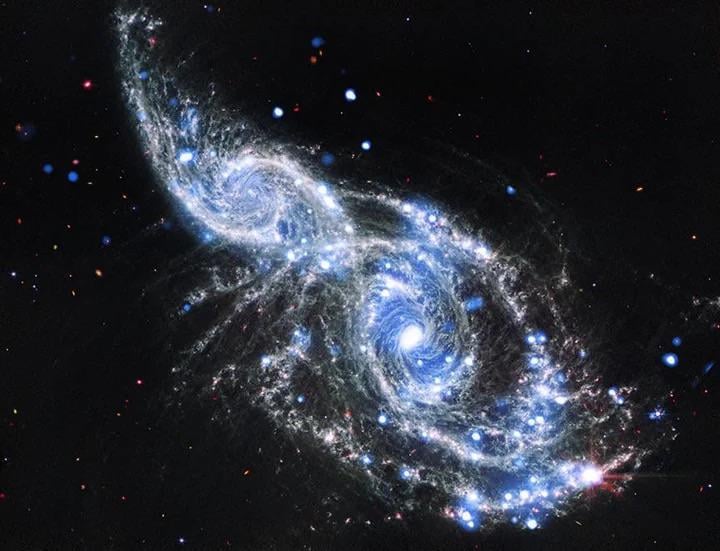
James Webb captures two galaxies, NGC 2207 and IC 2163, in the middle of a cosmic collision.
Title: Cosmic Clash Captured: James Webb Telescope Reveals Galaxies NGC 2207 and IC 2163 in Stunning Collision
Introduction
The James Webb Space Telescope (JWST) has done it again—unveiling the universe’s hidden dramas in breathtaking detail. Its latest triumph? A striking image of the interacting galaxy duo NGC 2207 and IC 2163, locked in a slow-motion collision 130 million light-years away in the constellation Canis Major. This cosmic dance, once shrouded in dust, now shines in unprecedented clarity thanks to JWST’s infrared vision. Discover the science, spectacle, and significance behind this celestial merger.
The Cosmic Collision: NGC 2207 vs. IC 2163
Galactic collisions are among the most violent yet beautiful events in the universe. While past telescopes like Hubble captured hints of this pair’s interaction, JWST’s infrared capabilities pierce through veils of cosmic dust to expose the full story. Here’s what we know:
- NGC 2207, the larger spiral galaxy, is pulling its smaller neighbor IC 2163 apart with immense gravitational forces.
- The encounter has ignited waves of star formation, visible as crimson “stellar nurseries” in JWST’s image.
- Stretching across the frame are tidal tails—streams of stars and gas ejected by the gravitational tug-of-war.
These galactic mergers are not rare; our own Milky Way will collide with Andromeda in 4 billion years. But witnessing NGC 2207 and IC 2163 offers a front-row seat to understand how such events shape galactic evolution.
Why JWST’s View Is Revolutionary
Unlike Hubble’s optical snapshots, JWST’s Near-Infrared Camera (NIRCam) and Mid-Infrared Instrument (MIRI) reveal hidden structures. Key discoveries include:
- Dust-Penetrating Detail: Infrared light exposes newborn stars and gas clouds hidden behind dust.
- Starburst Activity: Bright clusters of young stars confirm rapid star birth triggered by the collision.
- Chaotic Core Dynamics: Gas and stars swirl chaotically near the galaxies’ centers, hinting at future black hole activity.
The Science Behind the Spectacle
What happens when galaxies collide? Despite the seeming violence, stars rarely crash due to vast distances. Instead:
- Gravitational Shockwaves compress gas clouds, sparking intense star formation (called “starburst” phases).
- Tidal Forces warp galaxy shapes, shredding spiral arms into streams.
- Supernova Surges: Newborn massive stars explode quickly, enriching space with heavy elements.
For astronomers, NGC 2207 and IC 2163 act as a lab for studying:
- Dark matter’s role in galactic interactions.
- How mergers feed supermassive black holes.
- The future of systems like the Milky Way and Andromeda.
Hubble vs. Webb: A Comparison
Hubble’s 1999 image of this pair showed elegant spiral structures but missed the fiery core of star birth. JWST’s infrared view transforms the scene:
- Hubble: Highlighted visible light, emphasizing dust lanes as dark streaks.
- JWST: Exposes glowing gas, young stars, and intricate dust filaments in vibrant red and gold.
Why This Discovery Matters
“Galactic mergers drive cosmic evolution,” says Dr. Jane Rigby, JWST senior scientist. “Webb’s data lets us see how gas transforms into stars and how black holes awaken during these encounters.”
- Educational Impact: The image inspires public awe and STEM engagement.
- Future Insights: Teams will monitor the pair to track changes over decades.
Key Takeaways
- ✅ JWST captured the merging galaxies NGC 2207 and IC 2163 in Canis Major.
- ✅ Infrared imaging revealed hidden star-forming regions and tidal debris.
- ✅ Collisions trigger starbursts but rarely destroy stars.
- ✅ Data aids models of the Milky Way’s eventual fate.
Conclusion: A Window into Cosmic Evolution
The James Webb Space Telescope’s portrait of NGC 2207 and IC 2163 isn’t just a pretty picture—it’s a time machine showing how galaxies grow, collide, and rebirth across eons. As JWST peers deeper into the cosmos, each discovery reminds us: even in destruction, the universe creates.
Follow #JWST on social media for more cosmic revelations!
SEO Meta-Description:
Discover how NASA’s James Webb Telescope captured galaxies NGC 2207 and IC 2163 colliding! Explore tidal tails, starbursts, and JWST’s infrared insights in this deep dive.