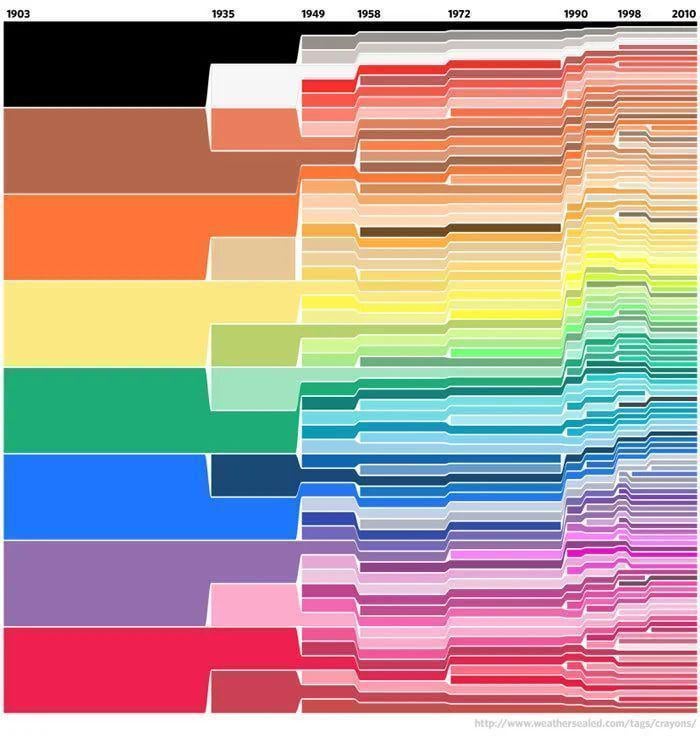
Evolution of Crayola crayon colours from 1903 to 2010
The Evolution of Crayola Crayon Colors: A Colorful Journey from 1903 to 2010
From classroom desks to kitchen tables, Crayola crayons have been a staple of childhood creativity for over a century. But did you know that the vibrant palette we know today has undergone dramatic transformations? Dive into the fascinating history of Crayola crayons and discover how societal trends, educational demands, and even environmental concerns reshaped the iconic box of colors between 1903 and 2010.
1903: The Humble Beginnings – 8 Colors
Crayola’s origin story began with a modest box of eight non-toxic wax crayons, designed as a safe alternative to toxic art supplies. The original colors, priced at 5 cents, included:
- Black, Brown, Blue, Red, Purple, Orange, Yellow, and Green.
These basics laid the foundation for creative play, though names like “Prussian Blue” (later renamed “Midnight Blue”) hinted at historical influences soon to evolve.
The 1930s–1950s: Expansion & Innovation
As Crayola grew in popularity, so did its color range. Key milestones:
- 1930s: Introduction of 16- and 24-count boxes, adding pastels like Carnation Pink and Sky Blue.
- 1949: The 48-count box debuted, introducing bold hues like Magenta and Cornflower.
- 1958: 64 colors arrived with the legendary built-in sharpener, including fan favorites like Timberwolf and Periwinkle.
This era also saw politically motivated changes: “Prussian Blue” became “Midnight Blue” (amid post-WWII sentiments), and “Flesh” (criticized for excluding diverse skin tones) was renamed “Peach” in 1962.
The Environmental Shift (1990s)
Environmental concerns reshaped Crayola’s lineup in the early ’90s:
- 1990: Eight colors retired due to crude oil dependence, including Orange-Red, Green-Blue, and Lemon Yellow.
- Replacements like Wild Strawberry, Cerulean, and Fuchsia leaned into vivid, synthetic dyes.
- 1993: The first “Multicultural” set launched with hues like Mahogany, Burnt Sienna, and Sepia to celebrate diverse skin tones.
Retired Colors & Fan Backlash (2000–2010)
The new millennium brought controversy as Crayola phased out nostalgic shades:
- 2003: “Blizzard Blue,” “Teal Blue,” and “Mulberry” exited to make room for modern hues like “Inchworm,” “Jazzberry Jam,” and “Mango Tango.”
- 2006: “Thistle” (a lavender-gray classic) was cut, sparking outcry from adult collectors.
However, Crayola balanced removals with fan engagement. In 1993, children voted to rename “Indian Red” (linked to Indigenous blood pigments) to “Chestnut,” and in 2009, a scent-naming poll birthed “Scarlet” (formerly “Orange-Yellow”).
Cultural Evolution in Color Names
Crayola’s renaming strategy mirrored societal progress:
- Early 1900s: Eurocentric names like “Prussian Blue” or “Flesh.”
- 1960s–1990s: Shift to nature-inspired titles (“Fern,” “Tumbleweed”) and inclusivity (“Peach”).
- 2000s: Playful, kid-friendly names (“Unmellow Yellow,” “Screamin’ Green”) dominated.
Timeline of Key Milestones
| Year | Event |
|---|---|
| 1903 | Debut: 8 colors |
| 1949 | 48-color box introduced |
| 1958 | First 64-color box |
| 1990 | Retired 8 oil-based colors |
| 1992 | Multicultural set launched |
| 2003 | “Mango Tango” replaces classic blues |
| 2010 | 120+ named colors in production |
Conclusion: A Legacy of Creativity
From wartime renames to eco-friendly reforms, Crayola’s color evolution reflects more than artistic trends—it’s a mirror of cultural change. Today’s 120+ colors honor both nostalgia and progress, ensuring every child (and adult) can find a crayon that speaks to them. Whether you miss “Thistle” or love “Atomic Tangerine,” Crayola’s rainbow reminds us that creativity, like history, is always evolving.
SEO Keywords: Crayola history, crayon color evolution, vintage Crayola colors, Crayola timeline, retired crayon colors, Multicultural crayons, Crayola environmental changes, classic Crayola names.
Did You Know?
Crayola once produced a black-and-white TV crayon set in 1962 to “colorize” television screens—a short-lived flop!