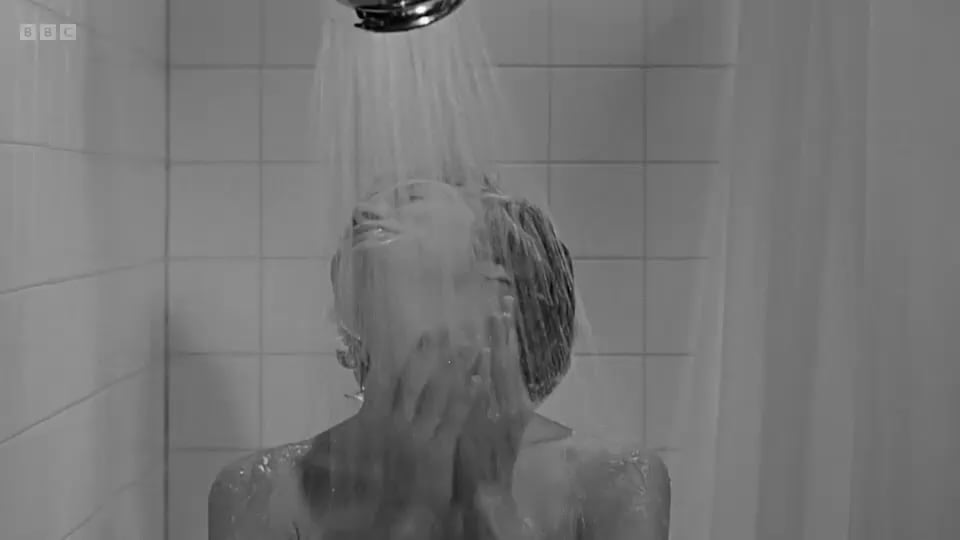
Charles Hazlewood and the BBC concert orchestra break down the score to the shower scene in Alfred Hitchcock’s Psycho. (BBC/2006).
Title: Decoding Terror: Charles Hazlewood & the BBC Concert Orchestra Explore Psycho’s Iconic Shower Scene Score
Meta Description: Discover how conductor Charles Hazlewood and the BBC Concert Orchestra dissected Bernard Herrmann’s chilling score for Psycho‘s shower scene in 2006. A masterclass in film music suspense.
Unmasking the Music of Madness: The Psycho Shower Scene Score Revisited
In 2006, the BBC unveiled a gripping musical analysis of one of cinema’s most infamous moments: the shower scene from Alfred Hitchcock’s Psycho (1960). Conducted by Charles Hazlewood and performed by the BBC Concert Orchestra, the special segment broke down Bernard Herrmann’s revolutionary score, revealing how a string orchestra weaponized sound to evoke primal terror.
Why This Scene—and Score—Changed Film History
The shower scene, where Marion Crane (Janet Leigh) meets her gruesome end, revolutionized horror cinematography. But Hitchcock’s visual genius was amplified tenfold by Bernard Herrmann’s score. Initially, Hitchcock planned the scene to unfold in silence, but Herrmann’s insistence transformed it into a symphony of dread. As Hazlewood notes, “It’s not the knife that kills Marion—it’s the music.”
Charles Hazlewood & the BBC Orchestra’s Breakdown
In the BBC feature, Hazlewood deconstructs Herrmann’s techniques with surgical precision, while the orchestra demonstrates each layer:
- The “Slashing” Strings: Violins and violas play screeching staccato clusters in E minor and G♯ minor, mimicking the knife’s violent thrusts.
- Rhythmic Savagery: Irregular, pulsing rhythms defy predictability, mirroring the attacker’s chaotic movements.
- Dissonance as Drama: Jarring harmonies and unresolved notes create psychological unease, leaving listeners subconsciously on edge.
Hazlewood emphasizes how Herrmann’s minimalism—using only strings—intensified the horror. “By stripping back to violins, violas, and cellos, Herrmann turned the orchestra into a unified weapon,” he explains.
Legacy of Herrmann’s Score
The BBC analysis highlights how this 45-second piece reshaped film scoring:
- Emotional Manipulation: Herrmann proved music could override visuals to dictate audience emotion.
- The Power of Restraint: Limited instrumentation (no brass, percussion) built tension through scarcity.
- Timeless Influence: Modern horror scores, from Jaws to Halloween, owe debts to Herrmann’s jagged string motifs.
Where to Watch the BBC Feature
Though originally aired in 2006, clips of Hazlewood’s breakdown circulate on platforms like YouTube and BBC Archives. Search terms like BBC Psycho score Hazlewood or BBC Concert Orchestra shower scene yield snippets of this masterclass.
Why This Breakdown Matters Now
For composers, filmmakers, and cinephiles, Hazlewood’s analysis isn’t just a history lesson—it’s a toolkit for understanding how music manipulates fear. In an era saturated with jump scares, Herrmann’s genius reminds us that true horror lies in the unseen: the mind’s ear.
Final Takeaway:
The BBC Concert Orchestra’s dissection of the Psycho shower scene score, led by Charles Hazlewood, remains a gold standard for exploring film music’s dark alchemy. Herrmann’s work teaches us that sometimes, the most terrifying monsters aren’t onscreen—they’re in the orchestra pit.
Keywords for SEO:
Charles Hazlewood, BBC Concert Orchestra, Psycho shower scene score, Bernard Herrmann, Alfred Hitchcock, film score analysis, BBC 2006, horror movie music, orchestral breakdown, string orchestra terror.
Search for “BBC Psycho Score Breakdown” or visit the BBC Archive to witness this chilling musical autopsy firsthand.