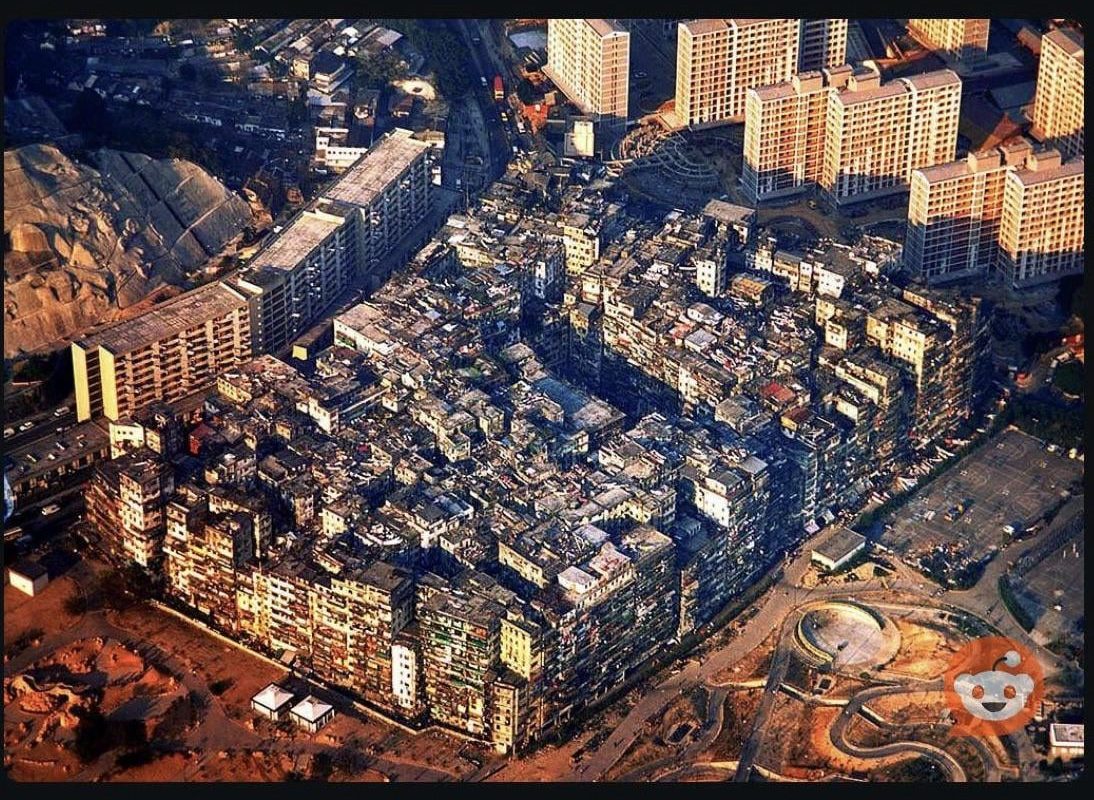
This is a photo of the Kowloon Walled City in Hong Kong, 1989. This ungoverned metropolis was only 6.4 acres in size but home to 50,000 residents, and featured alleyways between buildings just 3 to 7 feet wide.
Title: Kowloon Walled City, Hong Kong (1989): The Dense, Ungoverned Metropolis That Defied Reality
Meta Description: Explore the story of Kowloon Walled City in 1989—an ungoverned urban phenomenon housing 50,000 people in just 6.4 acres, with alleyways as narrow as 3 feet. Discover its history, daily life, and legacy.
Kowloon Walled City in 1989: A Vertical Maze of Humanity
In 1989, as Hong Kong surged toward modernity, the infamous Kowloon Walled City stood defiantly as a relic of chaos—a self-sustaining, lawless enclave where 50,000 residents squeezed into a labyrinth of decaying high-rises on a plot smaller than three football fields (6.4 acres). Alleyways slithered between buildings like veins, some barely 3 to 7 feet wide, plunging residents into perpetual twilight. This is the story of the world’s densest urban jungle and its improbable community.
A Brief History: From Military Fortress to Anarchic Enclave
Originally a Qing dynasty military outpost, Kowloon Walled City morphed into a political anomaly after China leased Hong Kong to Britain in 1898. Neither British nor Chinese authorities governed it, sparking a vacuum that attracted refugees, squatters, and outlaws after WWII. By the 1980s, the site had exploded into a dystopian marvel—a hive of 300 interconnected high-rises built haphazardly without architects, engineers, or safety codes. Residents navigated a web of neon-lit corridors, vertical staircases, and improvised plumbing, earning it nicknames like the “City of Darkness.”
Life Inside the Wall: Organized Chaos
Despite its reputation, Kowloon Walled City wasn’t lawless—it was self-governed. Triads ran underground gambling and opium dens, but most residents were working-class families, dentists, butchers, and factory workers who forged a thriving micro-economy.
- Density Beyond Imagination: At its peak, the city averaged 1.92 million people per square mile—the highest population density in human history. Entire families lived in 100-square-foot rooms.
- Communal Ingenuity: Residents shared electricity pirated from Hong Kong’s grid and water from communal wells. Factories churned out fish balls and textiles in cramped basements.
- Narrow Alleyways: Sunlight rarely reached the ground; pedestrians navigated claustrophobic paths flanked by dripping pipes and dangling wires. A single misstep could lead to a dead-end or a secret gambling den.
The Architecture of Survival
Kowloon Walled City’s makeshift towers grew organically—up to 14 stories tall—without foundations or elevators. Buildings leaned on each other for support, creating a surreal sky-blocking canopy.
- No Blueprints, No Limits: Additions were welded atop roofs or cantilevered over alleys. Roofs became gardens, playgrounds, and poultry farms.
- Urban Ecosystem: Doctors, bakeries, and temples operated mere feet apart. A single alley might house a noodle stall, a metalworker, and an unlicensed dentist.
The End of an Era
By 1987, Kowloon Walled City’s squalor and crime drew international attention. After years of negotiations, China and Britain agreed to demolish it. Evictions began in 1991, and by 1994, the site was replaced by a tranquil park—a stark contrast to its frenetic past.
- A Time Capsule of Photos: The 1989 photograph mentioned in the query is one of the last glimpses of the city in its anarchic prime. Explorers and historians documented its final years, capturing peeling walls, cluttered balconies, and resilient faces.
Legacy: Why Kowloon Walled City Still Matters
Kowloon Walled City endures as a symbol of human adaptability. Urban planners study it as a paradox—a nightmare of density that fostered unexpected community.
- Cultural Icon: Films like Batman Begins and video games like Call of Duty and Stray drew inspiration from its cyberpunk aesthetic.
- Lessons for the Future: In an age of megacities, Kowloon’s story warns of inequality while romanticizing grassroots resilience.
Conclusion: The Unforgitable “City of Anarchy”
Kowloon Walled City in 1989 was more than a slum—it was a sociological experiment, a hive of survival, and a living protest against authority. Today, its memory lives on in stories, photos, and the Kowloon Walled City Park, where artifacts and scale models immortalize its tangled legacy.
Call to Action: Want to see the infamous photo of Kowloon Walled City in 1989? [Explore our gallery] or dive into documentaries like City of Darkness to witness history’s most improbable metropolis.
Keywords: Kowloon Walled City 1989, City of Darkness, Hong Kong history, urban density, Kowloon Walled City photos, ungoverned city, Kowloon architecture, urban exploration.