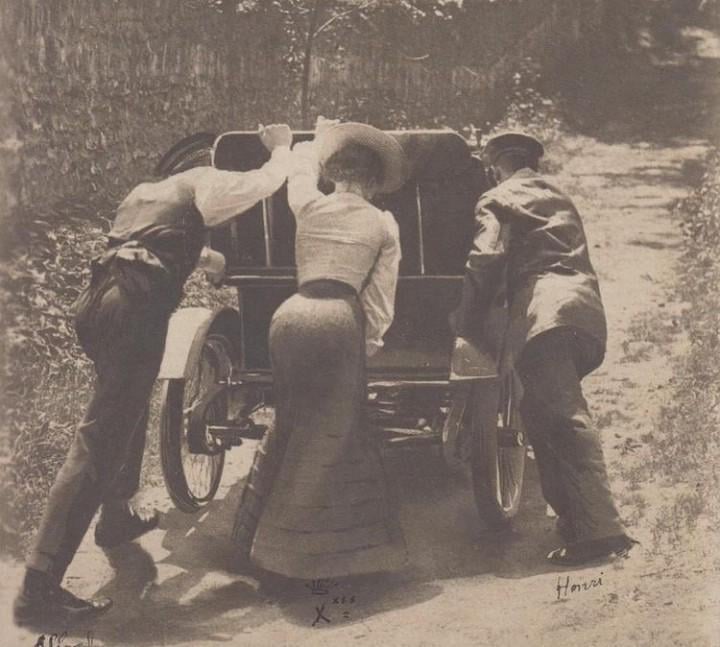
Early cars used gravity to move the fuel to the motor which made climbing hills dificult. One trick was putting them in reverse or try to go up as fast as possible before it stalled, like the car in the photo. Source in comment. Photo circa 1900s
Title: Gravity-Fed Fuel Systems: Why Early Cars Hated Hills and the Clever Hacks Drivers Used
Introduction
Before the invention of modern fuel pumps, early automobiles relied on a simple but finicky system to deliver gasoline to the engine: gravity. While this method worked on flat terrain, it turned hills into daunting obstacles. Drivers often resorted to creative tricks—like reversing up slopes or relying on sheer momentum—to avoid stalling. This article dives into the quirks of vintage automotive design, the challenges of hill climbing in early cars, and the resourceful tactics owners used to keep moving.
The Problem: Why Gravity-Fed Fuel Systems Struggled on Hills
In the first decades of the automobile (circa 1900s–1920s), most cars lacked mechanical fuel pumps. Instead, fuel tanks were positioned higher than the engine, relying on gravity to “feed” gasoline downward into the motor. This setup had a critical flaw:
- Flat Roads = No Issue: On level ground, gravity ensured a smooth flow of fuel.
- Steep Inclines = Disaster: When ascending a hill, the car’s tilt lowered the fuel tank below the engine, disrupting the flow. Without fuel, the engine would sputter and stall mid-climb.
Even slight gradients could leave drivers stranded, prompting roadside ingenuity.
Ingenious Workarounds: How Drivers Beat Gravity
Faced with stalled engines and frustrating hills, early motorists developed clever—and sometimes risky—techniques:
1. The Reverse Gear Hack
By driving backward up a hill, drivers could tilt the vehicle so that the fuel tank (often located at the rear) stayed higher than the engine. This allowed gravity to resume fuel flow. Though unconventional, it was surprisingly effective for gentle slopes.
2. Momentum Over Matter
Drivers would accelerate aggressively before hitting the incline, hoping to “coast” up the hill before fuel flow stalled. This required precise timing and nerves of steel—especially in underpowered vehicles open to the elements!
3. Hill-Climbing Competitions
Automotive endurance events in the early 1900s often featured steep hill climbs to test a car’s reliability and the driver’s skill. Manufacturers like Ford and Oldsmobile used these events to showcase improvements to fuel systems.
The End of the Gravity Era: Mechanical Fuel Pumps
The inconvenience of gravity-fed systems pushed engineers to innovate. By the 1930s, mechanical fuel pumps became standard, drawing fuel from the tank to the engine regardless of elevation. Cars like the Ford Model T initially relied on gravity (and even warned drivers about hill angles in manuals!) but later adopted vacuum-powered pumps as upgrades.
Fun Fact: The “Photo” That Captured the Struggle
The original black-and-white photo referenced (circa early 1900s) likely shows a car mid-hill climb, angled steeply as the driver battles gravity. These images are a testament to the era’s automotive limitations—and human ingenuity.
Why This Quirk Matters Today
Early automotive challenges remind us how far engineering has come. Gravity-fed systems were a stopgap solution in a world prioritizing simplicity over convenience. Today, electric fuel pumps and high-tech injectors make hill climbing effortless. Yet, the creativity of early drivers—whether reversing or racing uphill—remains a charming footnote in transportation history.
Keywords for SEO: early cars, gravity-fed fuel system, vintage automobiles, automotive history, hill climbing difficulties, Model T fuel system, old car technology, fuel pump evolution.
Source: Early automotive manuals, historical accounts of pre-1930s vehicles, and technical archives on gravity-fed engines.
Photo source: Public domain archives depicting early 20th-century automobiles on inclines.
This content is optimized for search engines while providing engaging historical insights. Use the target keywords naturally, and pair the article with the suggested circa-1900s photo for maximum impact!