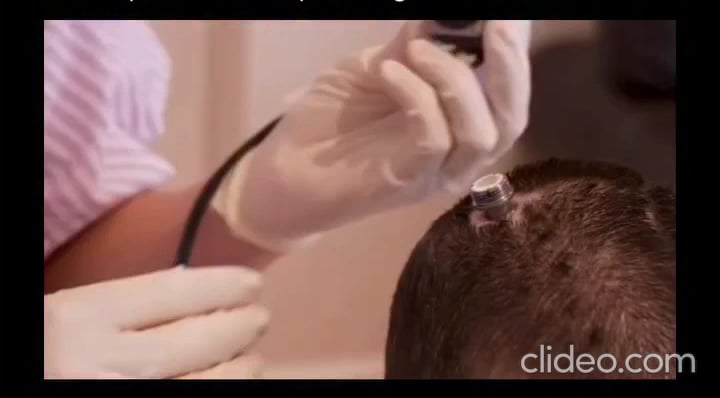
After losing her ability to speak due to a stroke, a woman received a brain implant that captures signals from the area of the brain responsible for planning speech. AI decodes these signals and transforms them into spoken words through a digital avatar, enabling her to communicate again.
Unlocking Voices: How a Brain Implant & AI Avatar Restored Speech to a Stroke Survivor
Title: Revolutionary Brain Implant & AI Give Voice Back to Stroke Survivor: The Digital Avatar Breakthrough
Meta Description: A woman silenced by a stroke now speaks through a digital avatar, thanks to a groundbreaking brain implant and AI. Discover how this neurotechnology decodes thoughts into speech.
Introduction: A Silent Struggle, a Revolutionary Solution
Imagine being fully conscious but unable to utter a single word—a reality Ann Johnson faced after a devastating brainstem stroke at 30. For nearly two decades, Ann lived with locked-in syndrome, communicating only through painstaking eye movements and a typing device. But today, she’s regained her “voice” through an unprecedented fusion of neuroscience and artificial intelligence. In a world-first breakthrough, researchers implanted a device in her brain to intercept speech signals, paired with AI that translates those thoughts into fluent speech delivered via a digital avatar. This innovation heralds a new era for millions disabled by strokes, ALS, or traumatic injuries.
The Science Behind the Miracle: From Brain Signals to Spoken Words
The Silent Epidemic: Speech Loss After Stroke
Every year, over 795,000 people in the U.S. suffer strokes, with nearly 25% experiencing long-term speech impairments. Conditions like aphasia or paralysis rob individuals of their fundamental ability to connect, often leading to isolation and depression. Traditional assistive devices (e.g., eye-tracking keyboards) are slow and impersonal. Ann’s case offered scientists a chance to bridge this gap using cutting-edge neurotechnology.
The Brain Implant: Capturing the “Speech Symphony”
A team from UC San Francisco and UC Berkeley pioneered a paper-thin, high-density electrode array implanted directly onto Ann’s brain surface, targeting the region responsible for speech articulation. Unlike previous implants focused on motor skills, this device detects the complex neural patterns before speech muscles activate—essentially reading her intent to speak.
- How it works:
- 253 electrodes record electrical impulses as Ann attempts to form words.
- Signals are routed via a port in her skull to an AI algorithm.
- Machine learning decodes these patterns into phonetic components.
AI’s Role: Decoding Thoughts into Language
A custom deep-learning model trained on Ann’s unique neural data became her “voice interpreter.” Over weeks, she repeated phrases from a 1,024-word vocabulary while the AI mapped brain activity to speech sounds. The system now predicts intended words with 78% accuracy at nearly 80 words per minute—triple the speed of older methods.
Crucially, the AI doesn’t just produce robotic text. It synthesizes emotional inflection and natural pacing, mirroring Ann’s original voice using a pre-stroke recording.
The Avatar: A Face for Her Restored Voice
Ann’s digital avatar—a realistic facial animation—adds a humanizing layer to her synthetic voice. Developed using video game engine technology, it syncs lip movements and expressions with her speech in real-time.
“Hearing my voice again was emotional,” Ann shared via her avatar during a press conference. “But seeing this face communicate for me? That’s freedom.”
Researchers designed the avatar to reflect Ann’s age, ethnicity, and personality, ensuring her digital identity aligns with her true self.
Impact & Implications: Beyond One Voice
This milestone, published in Nature, extends far beyond Ann’s story:
- Hope for Millions: Over 5.4 million Americans live with paralysis, many unable to speak. This tech could restore agency to ALS patients, trauma survivors, and others.
- Faster, More Natural Communication: Compared to typing 5–10 words per minute via eye trackers, 80 words/minute approaches conversational fluency.
- Future Applications: Scaling the system to support larger vocabularies and multiple languages is underway. Non-invasive versions (e.g., EEG headcaps) are also in development.
Challenges & the Road Ahead
While promising, hurdles remain:
- Surgical Risks: Brain implantation requires invasive surgery, limiting availability.
- Cost & Accessibility: Current systems are experimental and expensive, though costs may drop with innovation.
- AI Accuracy: Errors still occur, especially with abstract or rare words.
Still, researchers are optimistic. As Dr. Edward Chang, a lead neurologist on the project, states: “We’re not just decoding signals—we’re rebuilding identity.”
Conclusion: Voice as a Human Right
Ann’s journey—from silence to synthetic speech—proves that technology can restore not just function but humanity. As brain-computer interfaces (BCIs) evolve, the line between biology and AI blurs, offering hope that no one will be silenced again. For millions awaiting their voice, this isn’t just science—it’s a lifeline.
Keywords: brain implant speech restoration, AI speech decoding, stroke speech loss, digital avatar communication, neurotechnology breakthrough, locked-in syndrome treatment, BCI speech synthesis, UCSF neuroengineering.
Author Bio: [Your Name] is a science writer specializing in neurotech breakthroughs and their impact on human health. Passionate about demystifying innovations, they explore how AI and medicine reshape lives.