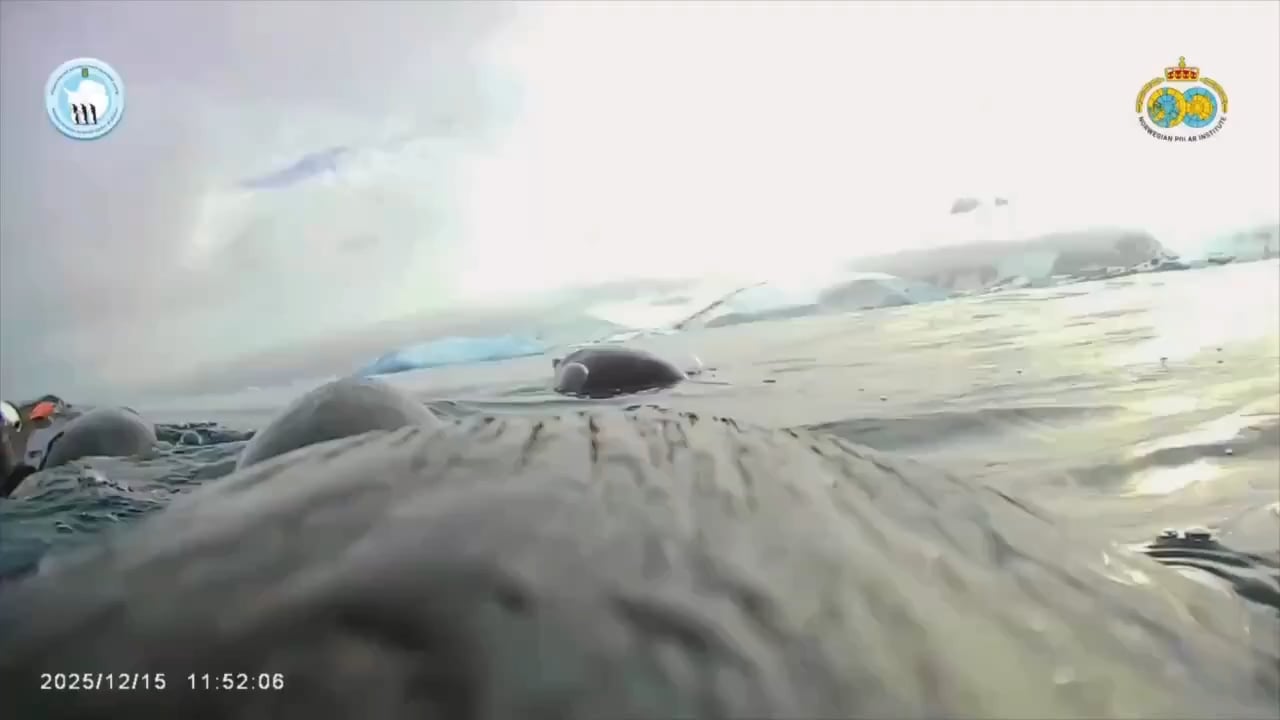
First-person underwater footage of a penguin in Antarctica. Ukrainian scientists from the Vernadsky Station in Antarctica put a GPS tracker and a tiny camera on the bird to get a better impression of their natural behavior.
Title: Penguin’s-Eye View: Ukrainian Scientists Capture First-Ever Underwater Footage From an Antarctica Penguin with GPS & Camera
Meta Description: Dive into groundbreaking underwater footage captured from a penguin’s perspective! Ukrainian researchers at Antarctica’s Vernadsky Station attached a GPS tracker and camera to reveal wild penguin behavior like never before.
A Penguin’s Journey: Ukrainian Scientists Unveil Antarctica’s Secret Wildlife Footage
Imagine seeing Antarctica’s icy waters through the eyes of a penguin — gliding past krill, darting through kelp forests, and hunting fish at depths humans rarely witness. Thanks to Ukrainian scientists stationed in Antarctica, this incredible “first-person” perspective is now a reality. Researchers at the Vernadsky Research Base recently attached a miniature camera and GPS tracker to a wild penguin, offering unprecedented insights into the hidden lives of these iconic birds.
The Vernadsky Station Project: Studying Penguins Without Disturbance
The Vernadsky Station, a Ukrainian research hub on Galindez Island in Antarctica, has long studied the impacts of climate change and human activity on the continent’s fragile ecosystems. Home to a thriving colony of gentoo penguins, the station’s team sought to observe the birds’ natural behaviors without disrupting their routines. Traditional observation methods—like human tracking or boat-based cameras—often alter penguin behavior due to noise or proximity. The solution? Let the penguins film themselves.
Using a lightweight, waterproof camera and a GPS tracker, scientists temporarily affixed the devices to a penguin’s back using non-invasive, animal-safe adhesive. The setup weighed less than 100 grams, ensuring minimal impact on the bird’s movement. After several hours of diving, feeding, and socializing, the camera automatically detached and floated to the surface for retrieval.
Cutting-Edge Technology Meets Antarctic Wildlife
The tiny camera, designed to withstand subzero temperatures and extreme pressure, captured HD footage of the penguin’s underwater activities, including:
- Deep dives reaching over 200 meters in search of fish and squid.
- Coordinated hunting strategies with other penguins.
- Rapid maneuvering through ice formations and underwater terrain.
- Close encounters with Antarctic krill swarms and leopard seals.
Meanwhile, the GPS tracker mapped the penguin’s route, speed, and dive frequency — data critical to understanding how climate-driven changes (like shrinking sea ice) alter foraging patterns.
What the Footage Reveals: A Penguin’s Hidden World
The video offers a mesmerizing glimpse into Antarctica’s underwater realm:
- Speed & Precision: Penguins rocket through the water at 35 km/h, using their flippers like wings to “fly” beneath the surface.
- Social Dynamics: Footage shows penguins hunting in groups, herding prey to maximize efficiency.
- Survival Tactics: The camera captured near-misses with predators like leopard seals, showcasing penguins’ evasive agility.
Scientists also noted surprising adaptability in the penguin’s foraging routes. “These birds traverse far greater distances than we expected,” said Dr. Oleksandr Polishchuk, a marine biologist at Vernadsky Station. “The data helps us pinpoint critical feeding zones needing protection.”
Why This Research Matters for Conservation
Antarctic penguin populations face escalating threats, including rising temperatures, overfishing of krill (their primary food), and tourism pressures. This innovative project provides three key advantages for conservation:
- Behavioral Accuracy: Remote cameras eliminate human interference, revealing true natural behaviors.
- Habitat Mapping: GPS tracks identify vital feeding grounds for marine protected areas.
- Public Engagement: Stunning footage humanizes conservation efforts, rallying global support.
“When people see Antarctica through the eyes of a penguin, they connect emotionally,” said researcher Mariia Pavlovska. “That connection is vital for saving this ecosystem.”
The Future of Wildlife Monitoring in Antarctica
The success of this experiment opens doors for broader applications. The Vernadsky team plans to deploy cameras on other species, including seals and skuas, to build a comprehensive picture of Antarctica’s food web. Future designs could include livestream capabilities or AI-driven analysis to track behavioral shifts in real time.
Final Thoughts: A New Era of Animal-Centric Research
Ukrainian scientists at Vernadsky Station have redefined wildlife observation by handing the camera to the subject itself. This groundbreaking footage not only advances ecological research—it reminds us that penguins, as masters of their environment, have stories only they can tell. For now, the world watches in awe as these resilient birds navigate a changing Antarctic wilderness, one dive at a time.
Target Keywords: Antarctica penguin camera footage, underwater penguin perspective, Vernadsky Station research, penguin GPS tracker study, Ukrainian scientists Antarctica, penguin natural behavior.
Internal/External Linking Opportunities:
- Link to Vernadsky Station’s official wildlife studies.
- Embed the original footage (if publicly released).
- Reference UN reports on Antarctic conservation.
Engagement Hook: “Wondering what it’s like to swim with penguins? Watch Antarctica’s waters come alive — without getting wet!”