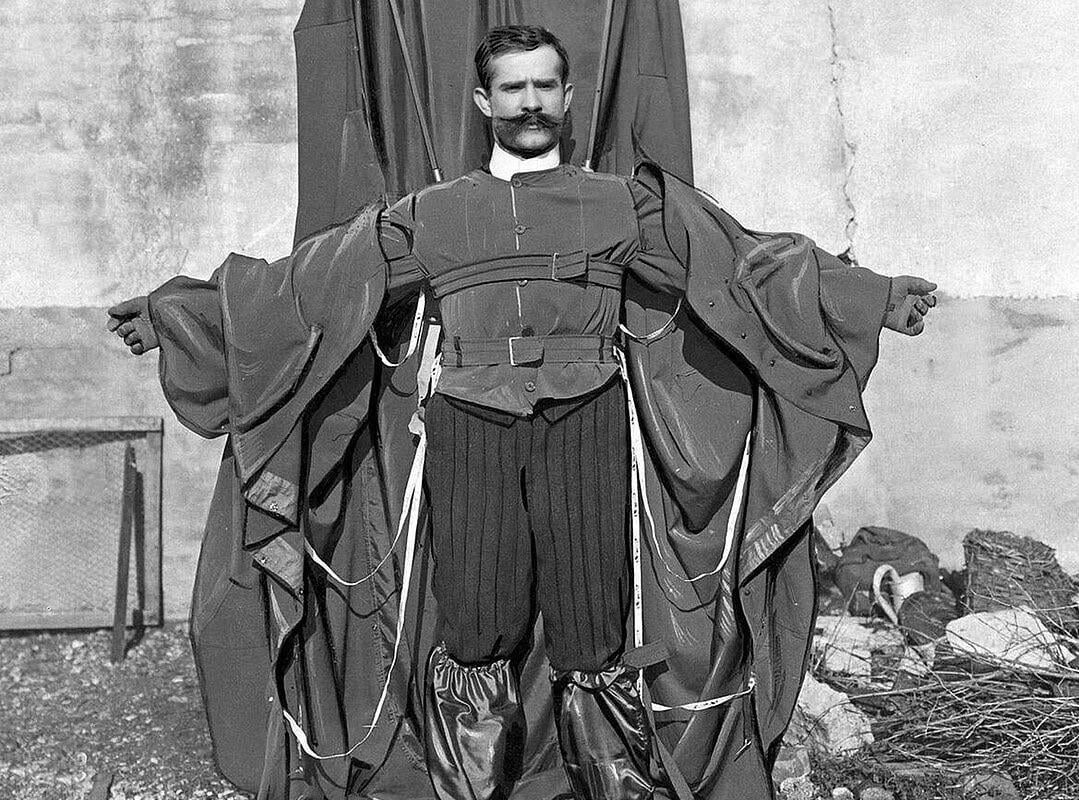
On February 4th, 1912, Franz Reichelt tested his new design for a compact wearable parachute by jumping from the Eiffel Tower. His parachute failed to deploy, and he fell 57 meters to his death.
Title: The Fatal Fall of Franz Reichelt: The Day the “Flying Tailor” Jumped from the Eiffel Tower
Meta Description: On February 4, 1912, Franz Reichelt leaped from the Eiffel Tower to test his wearable parachute—a tragic experiment that ended in disaster. Discover the full story behind this doomed innovation.
Introduction
On February 4, 1912, crowds gathered beneath the Eiffel Tower to witness an audacious experiment: Austrian-born inventor Franz Reichelt, dubbed the “Flying Tailor,” planned to prove his revolutionary wearable parachute design by jumping from the tower’s first platform. What followed became one of history’s most chilling examples of ambition outpacing engineering—and a cautionary tale of innovation gone fatally wrong.
The Man Behind the Myth
Franz Reichelt wasn’t a trained engineer but a Paris-based tailor who specialized in creating overcoats. Fascinated by early aviation, he pivoted to designing a wearable parachute suit to save pilots during emergencies. His vision was compact—unlike bulky parachutes of the era—and integrated into a single garment. Despite skepticism from peers and failed preliminary tests (using dummies), Reichelt believed a dramatic live demonstration would secure funding and fame.
The Flawed Design
Reichelt’s parachute suit weighed approximately 20 pounds and featured a silk canopy stitched into an oversized coat. It was meant to deploy like an umbrella upon free-fall, slowing descent. Tragically, the design suffered from critical flaws:
- Minimal Surface Area: The canopy measured barely 12m²—far too small to slow a human’s fall from 57m (187 ft).
- Rigid Frame: Heavy rods in the fabric prevented rapid inflation, a fatal miscalculation.
- Untested Theory: Early tests from 5–10 meter heights failed, but Reichelt ignored warnings, blaming dummies’ “lifelessness.”
The Fatal Jump
At 8:30 AM on February 4th, Reichelt arrived at the Eiffel Tower. Initially planning to use a dummy, he shocked onlookers—and even police—by announcing he would jump instead. After hesitating for nearly 40 minutes, he climbed the railing… and plunged.
What Went Wrong?
The parachute tangled instantly, collapsing like a deflated balloon. Reichelt hit the frozen ground in less than 3 seconds, creating a 6-inch crater. Autopsy reports noted fatal injuries to his skull, spine, and limbs.
Aftermath and Legacy
The tragedy made global headlines. Newsreels of the jump (still viewable today) horrified viewers, while critics accused Reichelt of recklessness. Yet his story endures as a poignant lesson:
- Innovation Requires Iteration: Reichelt skipped rigorous testing in favor of spectacle.
- Risk vs. Reward: His obsession overshadowed safety, a dilemma still relevant in tech today.
- The Human Cost: Ironically, Reichelt’s failure accelerated parachute research, leading to safer designs used in WWI.
Myths Debunked
- Identity Confusion: Reichelt is often mistaken for Frederick Rodman Law, who survived a 1912 Statue of Liberty jump using a parachute.
- The “Mad Inventor” Trope: Some accounts suggest Reichelt was suicidal, but his final words—”I intend to prove the worth of my invention”—reflect unwavering conviction, not despair.
Why Franz Reichelt’s Story Still Matters
Reichelt’s leap symbolizes humanity’s relentless drive to conquer the skies. While tragic, his experiment underscores the importance of humility in innovation—a lesson echoed in modern engineering ethics. Today, parachutes save thousands of lives, their evolution built on both triumphs and sacrifices like his.
Conclusion
Franz Reichelt’s fatal jump from the Eiffel Tower remains a haunting milestone in aviation history. His courage—and catastrophic miscalculation—serve as a powerful reminder that progress demands not just vision, but vigilance. As we reach for new heights, his story urges us to temper ambition with wisdom.
SEO Keywords: Franz Reichelt parachute, Eiffel Tower jump 1912, invention failure, Franz Reichelt death, wearable parachute suit, history of parachutes, aviation disasters.
Call to Action:
Curious to see footage of the jump? Search for “Franz Reichelt Eiffel Tower video” to witness this pivotal moment in tech history—but consider its sobering message before chasing your own “leap of faith.”