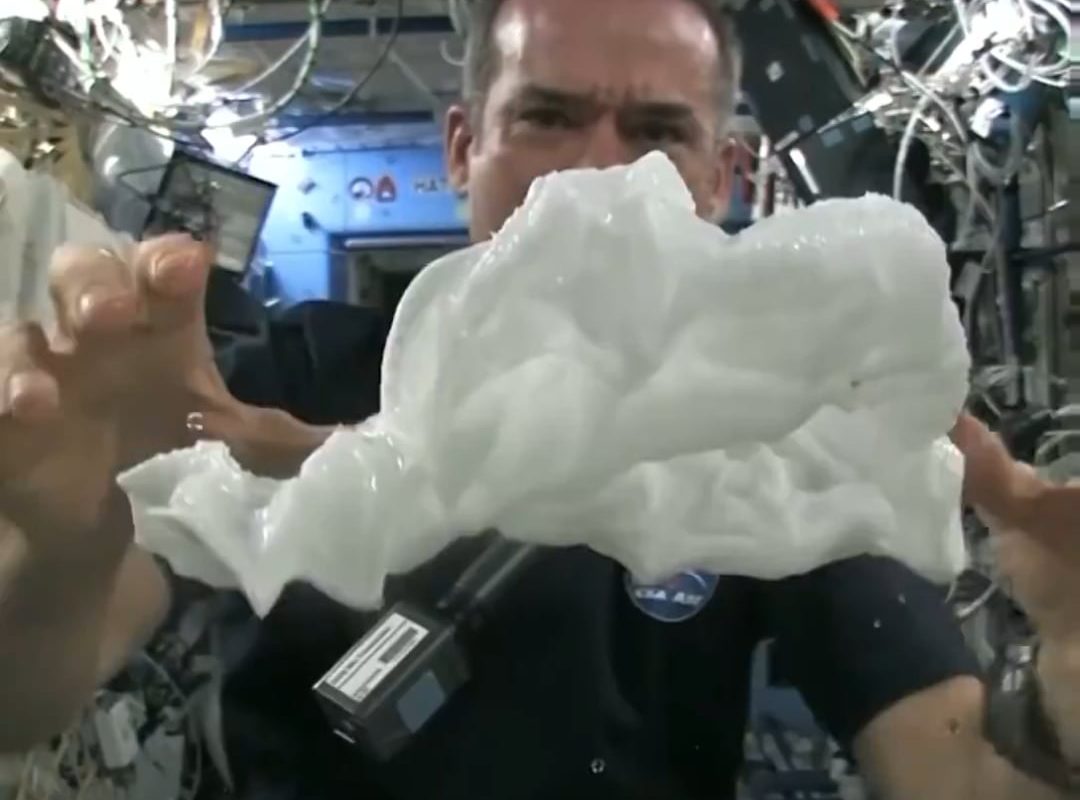
This is what happens when you squeeze out a wet towel in space.
Title: The Weird Physics Behind Wringing Out a Wet Towel in Space
Meta Description: What happens when you squeeze a water-soaked towel in microgravity? Discover the surreal science of surface tension, adhesion, and zero-gravity fluid dynamics in this cosmic experiment.
Introduction
Imagine floating aboard the International Space Station (ISS), holding a soaking-wet towel. You twist and squeeze it—the same way you would on Earth—but instead of water dripping to the ground, something bizarre unfolds. This quirky experiment, famously demonstrated by Canadian astronaut Chris Hadfield, reveals fundamental physics principles that work very differently in space. Here’s a breakdown of the science behind wringing out a wet towel in microgravity.
The Experiment in Microgravity
On Earth, squeezing a wet towel sends water cascading downward due to gravity. In space, however, the absence of gravity creates a jaw-dropping spectacle:
-
Water Forms a Sticky “Tube”:
Without gravity, water doesn’t fall. Instead, the moisture in the towel clumps into a cylindrical blob, held together by surface tension—the cohesive force between water molecules. The towel’s fibers trap the water temporarily, forming a shimmering, Jell-O-like tube around the fabric. -
The Water Clings Tightly:
As the astronaut wrings the towel, water doesn’t spray or splash. Instead, it clings to the towel and the astronaut’s glove due to adhesion (the attraction between water and solid surfaces). On the ISS, moisture behaves like gel, sticking to any surface it touches. -
A Dangerous Phenomenon?
Floating water droplets can threaten electronics or equipment, so astronauts must contain the liquid carefully. Hadfield used containers to capture the water for reuse—a reminder of space’s unforgiving environment.
Key Physics Principles at Play
This experiment highlights fascinating concepts:
-
Surface Tension Dominates:
On Earth, gravity overpowers surface tension (why raindrops fall). In microgravity, surface tension reigns supreme, allowing water to hold spherical shapes. -
Capillary Action in Zero-G:
Water spreads along surfaces via capillary forces, moving into absorbent materials without gravity’s pull. This is how astronauts drink coffee from sealed bags! -
Adhesion vs. Cohesion:
Adhesion (water sticking to solids) traps moisture on the towel, while cohesion (water sticking to itself) shapes it into orbs or tubes.
Why This Experiment Matters
Beyond the “cool factor,” studying fluids in space has real-world applications:
-
Designing Spacecraft Systems:
Understanding fluid dynamics helps engineers create safer water recycling, cooling, and fuel systems for long-term missions. -
Medical Technology Insights:
Surface tension principles are used in labs to develop drug delivery systems or miniature medical devices. -
Earth-Based Innovations:
Research on capillary flow in space has improved technologies like portable diagnostic tools for remote areas.
Watch It in Action
Want to see the magic for yourself? Astronaut Chris Hadfield performed this experiment live aboard the ISS in 2013. Watch the viral video here to witness how water cocoons his hands!
Conclusion
Wringing out a towel in space isn’t just an astronaut party trick—it’s a window into the invisible forces that govern our universe. On Earth, gravity hides the subtle power of surface tension and adhesion. But in space, these forces shine, reshaping how we understand everything from water to rocket fuel. The next time you squeeze out a sponge at home, remember: in the cosmos, water plays by a whole different set of rules.
Call-to-Action
Fascinated by space science? Follow NASA or the CSA for more mind-bending experiments conducted in microgravity!