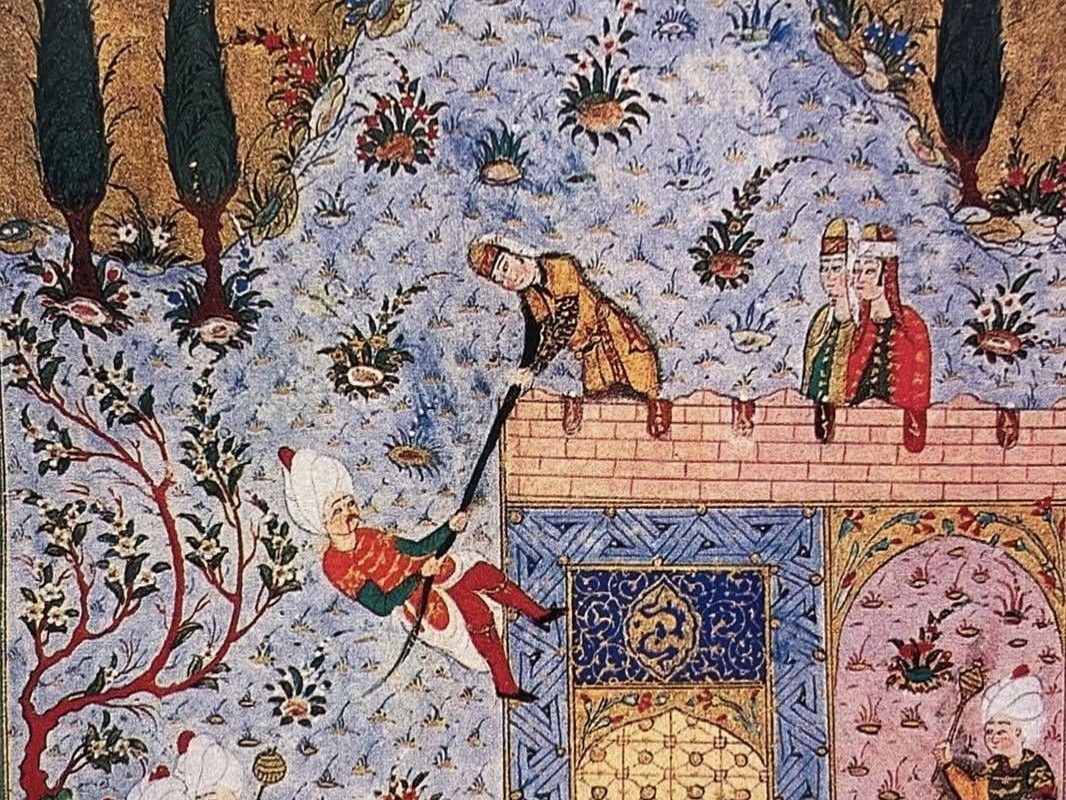
A depiction showing the conquest of the Roman castle of Aydos. According to the legends a Roman girl fell in love with the Turkmen commander Abdurrahman Gazi. She led down her hair, which Abdurrahman Bey used to climb over the walls, conquering the castle for the Ottomans.
Meta Title: The Legendary Conquest of Aydos Castle: A Love Story That Shaped Ottoman History
Meta Description: Discover the legendary tale of Abdurrahman Gazi and the Roman maiden whose love led to the Ottoman conquest of Aydos Castle—a pivotal moment in Anatolian history.
The Ottoman Conquest of Aydos Castle: Where Legend and History Intertwine
Nestled in the rugged hills of modern-day Istanbul, the ancient Aydos Castle stands as a silent witness to one of the most captivating stories in Ottoman history—a tale of love, betrayal, and conquest. According to legend, the capture of this Byzantine stronghold in 1328 wasn’t achieved through brute force alone but hinged on a romance between a Roman commander’s daughter and a Turkmen warrior: Abdurrahman Gazi, a devoted follower of Osman I, founder of the Ottoman Empire.
This story blends historical fact with folklore, symbolizing the Ottomans’ expanding influence in Anatolia and the emotional human drama often lost in grand narratives of war. Here’s how the legend unfolded—and why it still resonates today.
The Strategic Importance of Aydos Castle
By the early 14th century, Aydos Castle was a critical Byzantine fortification guarding the eastern approaches to Constantinople (modern Istanbul). Its strategic position made it a thorn in the side of the nascent Ottoman Beylik, which sought to consolidate power in Anatolia. Conquering Aydos meant securing control over trade routes and weakening Byzantine defenses—a prize worth any risk.
Osman I entrusted the campaign to his seasoned commander, Abdurrahman Gazi, celebrated for his bravery and tactical brilliance. Yet the castle’s towering walls and disciplined garrison made a direct assault near-impossible. For months, Abdurrahman’s forces laid siege, but the fortress held firm—until fate intervened in an unexpected way.
The Legend of the Roman Maiden and Abdurrahman Gazi
A Forbidden Love
Chronicles like the 15th-century Tevârîh-i Âl-i Osman (Ottoman Chronicles) recount that the castle’s Byzantine commander had a daughter, whose name varies in retellings (often called Holofira or simply “the Roman maiden”). From the ramparts, she watched Abdurrahman Gazi during the siege and became enamored with the Turkmen leader. Risking treason, she secretly sent him a message: she would betray the castle for love.
The Hair that Conquered a Fortress
Under cover of darkness, the young woman lowered her long, braided hair from the castle walls—a lifeline for Abdurrahman. Climbing silently, he breached the defenses, opened the gates, and allowed his warriors to storm the fortress. The surprised Byzantines were swiftly overcome, marking a decisive Ottoman victory.
In gratitude, Abdurrahman reportedly married the maiden, who converted to Islam. Some versions add tragic depth: she later died in battle defending her new homeland.
Fact vs. Folklore: Unraveling the Truth
Historical records confirm Abdurrahman Gazi did capture Aydos Castle around 1328, expanding Ottoman control toward the Bosphorus. However, the romantic subplot likely embellishes reality. Here’s what historians note:
- Symbolic Significance: The story mirrors classic tropes of “love overcoming boundaries,” echoing narratives like Rapunzel or the myth of Tarpeia in Roman lore. It highlights cultural exchange during the Ottoman expansion.
- Political Messaging: Ottoman chroniclers may have used the tale to legitimize their rule, framing conquest as destiny blessed by divine (or romantic) intervention.
- Abdurrahman Gazi’s Legacy: A real historical figure, Abdurrahman became a folk hero. His tomb in Sultanbeyli, Istanbul, remains a pilgrimage site.
Aydos Castle Today: A Living Legacy
The ruins of Aydos Castle still crown the hilltops of Sultanbeyli district, drawing history buffs and romantics alike. Visitors can:
- Explore the partially restored walls and towers.
- Enjoy panoramic views of Istanbul.
- Reflect on the legend at Abdurrahman Gazi’s tomb, nearby.
Local festivals and reenactments occasionally revive the tale, celebrating it as a symbol of Anatolia’s multicultural past.
Why This Story Matters
The conquest of Aydos Castle wasn’t just a military milestone—it represented the Ottomans’ rise as a regional power. The legend of Abdurrahman and the Roman maiden humanizes this shift, reminding us that history is shaped not just by battles but by personal choices, passions, and sacrifices.
Whether fully factual or not, the story endures as a testament to:
- Cross-Cultural Bonds: Love transcending enemy lines.
- Women’s Roles: The maiden’s agency in shaping history.
- Ottoman Mythology: How folklore fuels national identity.
Visiting Aydos Castle
📍 Location: Sultanbeyli, Istanbul, Turkey
🕒 Best Time to Visit: Spring or autumn for mild weather.
📸 Tip: Combine your trip with a visit to Abdurrahman Gazi’s tomb and the nearby Sancaktepe Historical Park.
Final Thoughts
The fall of Aydos Castle is more than a footnote in Ottoman history—it’s a legend where love and war collide, blurring the lines between fact and fable. As you walk its ancient stones, remember the Roman maiden who, according to lore, let down her hair and changed the course of Anatolia forever.
Keywords: Aydos Castle conquest, Abdurrahman Gazi legend, Byzantine-Ottoman wars, Ottoman love stories, historical castles of Istanbul, Anatolian folklore, Osman I conquests.