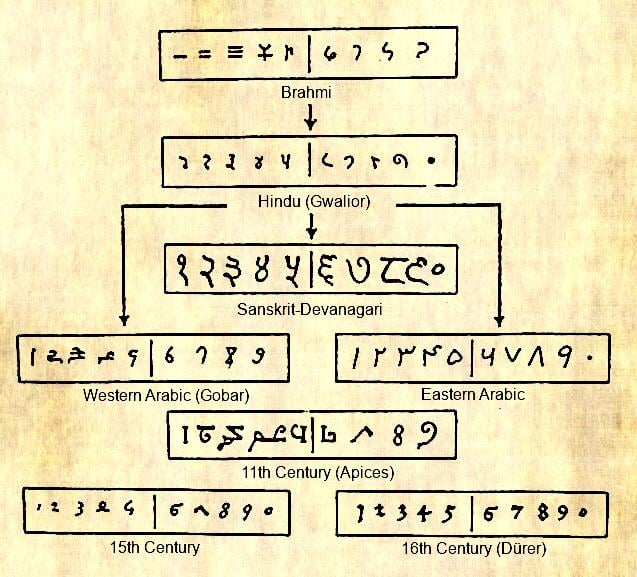
Evolution of Indian numerals into Arabic numerals and their adoption in the West
From India to the World: The Fascinating Evolution of Hindu-Arabic Numerals
For centuries, the numerals we use daily—0, 1, 2, 3, and so on—have been called “Arabic numerals.” But did you know their origins trace back to ancient India? This is the riveting story of how Indian numerals evolved into the Arabic numeral system, revolutionized mathematics, and forever changed the Western world.
The Birthplace: India’s Pioneering Numerical System
Long before the term “Arabic numerals” existed, ancient Indian mathematicians developed the foundation of our modern number system during the Gupta Empire (4th–6th centuries CE). Key innovations included:
- A Base-10 Decimal System: Using 10 symbols (1–9 and 0) to represent any number.
- Positional Notation: The value of a digit depends on its position (e.g., “3” in 30 vs. 300).
- The Concept of Zero: The numeral “0” (Sanskrit: śūnya, meaning “void”) was first recorded in the Bakhshali Manuscript (3rd–4th century CE).
These breakthroughs simplified calculations and enabled advanced astronomy, trade, and architecture.
The Arabic Transmission: Bridging East and West
By the 7th–8th centuries CE, India’s numeral system traveled westward through:
- Trade Routes: Merchants and scholars exchanged knowledge along the Silk Road and Indian Ocean networks.
- Islamic Scholarly Hubs: Centers like Baghdad’s House of Wisdom translated Indian texts into Arabic.
Key figures in this transformation included:
- Al-Khwarizmi (9th century): His book On the Calculation with Hindu Numerals popularized the system in the Arab world.
- Al-Kindi: Refined the numerals, adding features like decimal fractions.
The Arabs adapted the symbols into curved, cursive shapes (e.g., Indian “2” became → ➁ → 2), creating the foundation for modern Arabic numerals.
Adoption in Europe: The Battle Against Roman Numerals
Despite their efficiency, Hindu-Arabic numerals faced skepticism in medieval Europe, where Roman numerals (I, V, X) dominated. Their journey west included:
- Al-Andalus (Muslim Spain): European scholars encountered the numerals through texts like the Codex Vigilanus (976 CE).
- Fibonacci’s Liber Abaci (1202): Italian mathematician Leonardo Fibonacci championed the system in his book, demonstrating its superiority for commerce.
- Banking and Printing Presses: By the 15th century, merchants and printers adopted Arabic numerals for efficiency.
Resistance persisted: Critics called them “infidel numbers,” and France banned them in finance until the 18th century!
Why Hindu-Arabic Numerals Triumphed
The system’s global dominance stems from its unique advantages:
- Efficiency: Simplified arithmetic vs. cumbersome Roman numerals.
- Universality: Enabled scientific collaboration, from Newton’s calculus to modern computing.
- Scalability: Positional notation supports infinitely large/small numbers (e.g., 0.001 or 1 billion).
Legacy: The Universal Language of Numbers
Today, “Arabic numerals” are a misnomer—their DNA is undeniably Indian. This hybrid system shaped everything from Renaissance science to Silicon Valley’s binary code (0s and 1s).
Key Takeaways:
- Cultural Exchange: A testament to how ideas transcend borders.
- Zero’s Power: Without this Indian invention, modern technology wouldn’t exist.
- Global Standard: Used by 7.8 billion people and every digital device worldwide.
Final Thought
Next time you glance at a clock or check your phone, remember the millennia-old journey behind those digits—from the banks of the Ganges to Baghdad’s libraries and Fibonacci’s Italy. The story of Hindu-Arabic numerals isn’t just about math; it’s about humanity’s shared thirst for progress.
(Meta Keywords: Indian numerals, Arabic numerals, history of numbers, Fibonacci, decimal system, origin of zero, Hindu-Arabic numerals, Al-Khwarizmi, mathematical revolution)