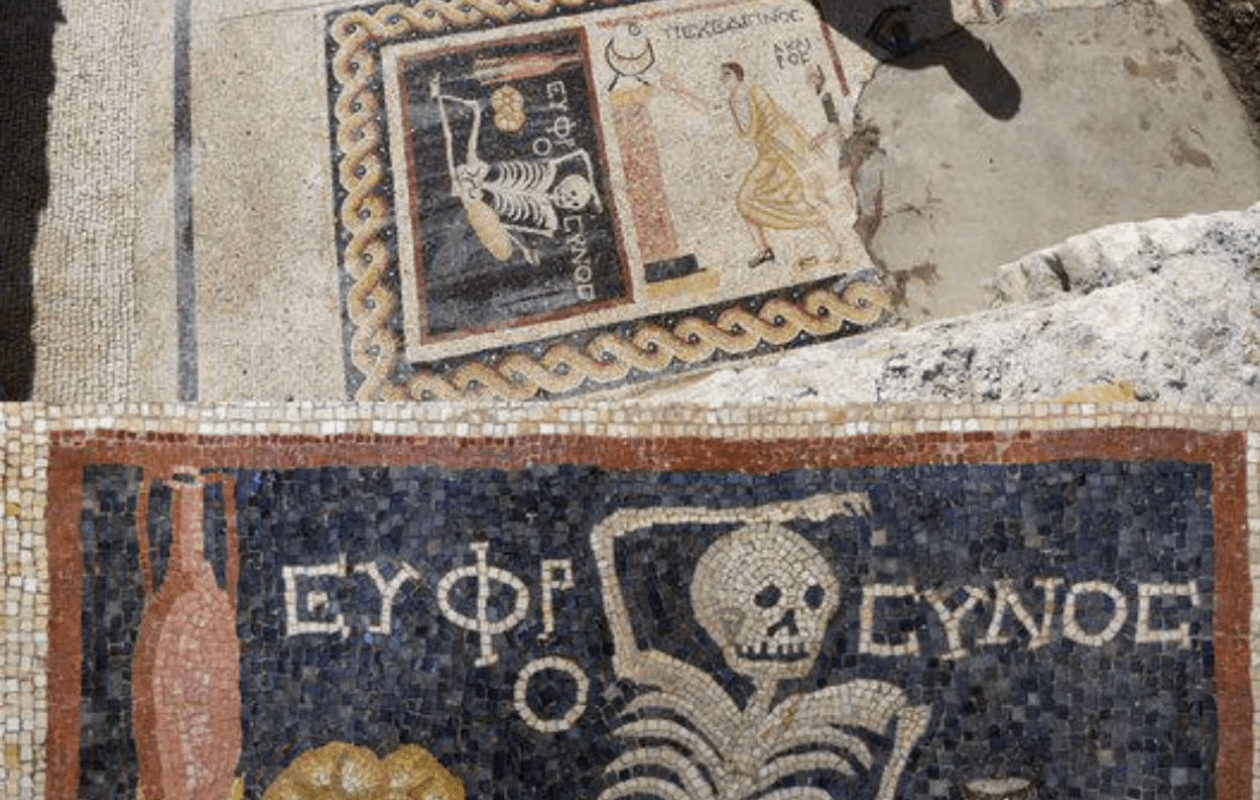
2,400 year-old mosaic featuring a reclining skeleton with a loaf of bread and a wine jug with the caption: “Be cheerful, enjoy your life” discovered in ancient city of Antioch (southern Turkey) -an ancient reminder of mortality & the importance of living life fully
Title: 2,400-Year-Old Mosaic in Antioch Urges Modern World: “Be Cheerful, Enjoy Your Life”
Meta Description: Discover the ancient Antioch mosaic featuring a reclining skeleton with bread and wine—a timeless message to embrace life. Explore its history, meaning, and why it resonates today.
Unearthing Wisdom: Antioch’s Ancient “Memento Mori” Mosaic
Archaeologists in southern Turkey have uncovered a stunning 2,400-year-old mosaic in the ancient city of Antioch (modern-day Antakya) that speaks directly to the human soul across millennia. The artwork, depicting a reclining skeleton beside a loaf of bread and a wine jug, bears an inscription in Greek: “Be cheerful, enjoy your life” (ἘσΊ χαῖρε καὶ εὐφραίνου). This striking discovery transforms a dining room floor into a philosophical manifesto, blending Hellenistic artistry with a profound meditation on mortality and joy.
The Discovery: A Feast for the Eyes—and the Mind
The mosaic was unearthed during excavations in Antioch, once a thriving hub of Greco-Roman culture and Syria’s capital under the Seleucid Empire. Dating to the 3rd century BCE, the artwork adorned a triclinium—a lavish dining area where elites gathered for symposia (drinking parties). Amid the vibrant tiles and geometric patterns, the macabre yet playful skeleton scene stands out:
- The Skeleton: Shown relaxed, arm raised as if mid-toast.
- The Symbols: A wine jug (oenochoe) and loaf of bread—staples of ancient feasting.
- The Message: An unambiguous call to celebrate life despite death’s inevitability.
For archaeologists, this mosaic is more than decoration—it’s a visual “memento mori” (“remember you must die”), designed to spark conversation about life’s fleeting nature.
Why Bread, Wine, and a Skeleton? Decoding the Symbolism
The mosaic’s imagery is steeped in ancient Mediterranean culture:
- Bread and Wine: Represent sustenance, community, and the ephemeral pleasure of feasting. In Hellenistic tradition, sharing food and drink was sacred—a ritual binding mortals to gods and each other.
- The Skeleton: Far from morbid, the figure embodies carpe diem (“seize the day”). By placing death at the table, Antioch’s artists reminded diners to savor every moment.
“This mosaic is a masterclass in ancient mindfulness,” says Dr. Leah Morgan, a classical archaeologist. “It merges vanitas symbolism with wit—death isn’t a threat here, but a playful guest urging us to live fully.”
Antioch: A City of Crossroads and Carpe Diem
Antioch thrived as a cosmopolitan melting pot where Greek, Roman, Persian, and Near Eastern cultures intersected—and its art reflected this philosophical diversity. The mosaic’s message echoes:
- Epicureanism: Embracing pleasure as life’s highest good (but not excess).
- Stoic Resilience: Accepting death’s inevitability to value the present.
Similar motifs appear in Pompeii’s “Carpe Diem” mosaics, but Antioch’s work predates them by centuries. “It’s one of the earliest known ‘memento vivere’ [remember to live] artworks,” notes historian Emre Öztürk, part of the Turkish excavation team.
Ancient Wisdom for Modern Times
Two millennia later, the mosaic’s plea—“Be cheerful, enjoy your life”—feels startlingly relevant. In an era of burnout and existential anxiety, its wisdom cuts through time:
- Mortality as Motivation: Acknowledging death doesn’t negate joy—it sharpens it.
- Community Over Chaos: The bread and wine symbolize shared humanity, urging us to prioritize connection.
“This isn’t just about indulgence,” explains philosopher Dr. Maria Papadopoulos. “It’s about balance—celebrating life’s small, sacred moments.”
Conclusion: A Toast to Legacy
The Antioch mosaic is more than an archaeological marvel; it’s a bridge between ancient souls and our modern search for meaning. As excavations continue in Turkey’s “City of Mosaics,” this 2,400-year-old skeleton—glass eternally raised—invites us to a timeless banquet. Its message endures: Life is fleeting. Feast wisely.
Keywords for SEO: Antioch mosaic, ancient memento mori, Hellenistic art Turkey, skeleton mosaic, enjoy life ancient, carpe diem archaeology, Antioch excavation, ancient philosophy, Roman mosaics, archaeology discovery 2023.