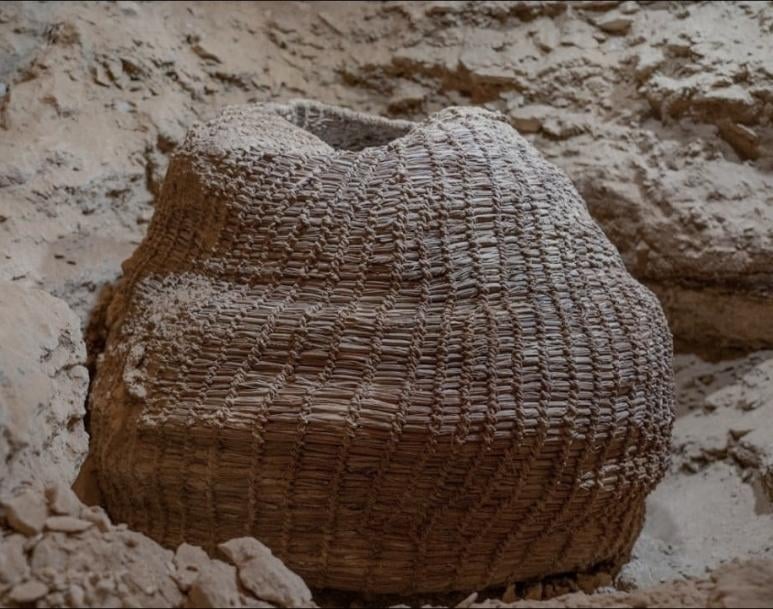
10,500 years old woven basket found in the Cave of Horrors, near the Dead Sea. It’s the oldest intact woven basket ever found in the world.
Unraveling Ancient Craftsmanship: 10,500-Year-Old Woven Basket Discovered in the Cave of Horrors
A Journey Back to the Dawn of Human Ingenuity
In a groundbreaking archaeological revelation, a perfectly preserved woven basket dating back 10,500 years has been unearthed in Israel’s Cave of Horrors, near the Dead Sea. This extraordinary artifact—now hailed as the oldest intact woven basket ever discovered worldwide—rewrites our understanding of Neolithic innovation and the sophistication of early human societies.
The Discovery: A Time Capsule from the Pre-Pottery Neolithic Era
Led by the Israel Antiquities Authority (IAA), archaeologists exploring the treacherous Judean Desert caves stumbled upon the basket in 2021 during Operation Scroll, a mission to safeguard ancient artifacts from looters. The basket survived millennia in the Cave of Horrors—a remote, cliffside cavern accessible only by rope—thanks to the region’s arid, low-humidity climate, which naturally mummified organic materials.
Key Features of the Ancient Basket
- Age: Radiocarbon dating places its creation between 10,500–10,300 BCE, predating pottery invention.
- Material: Woven from reeds or other hardy plant fibers in a complex helical pattern.
- Design: Oval-shaped, measuring ~90 cm in diameter and 35 cm deep, with a 30–40 liter capacity.
- Purpose: Likely used for grain or food storage—though no organic residue was found—or as a ritual offering.
Why the Cave of Horrors?
The cave’s ominous name derives from the 1950s discovery of 40 skeletons (likely refugees) from the Bar Kokhba Revolt (132–136 CE). However, its ultra-dry microclimate has preserved countless relics, including Dead Sea Scroll fragments, Roman sandals, and now this Neolithic basket.
A Window into Neolithic Life
This basket isn’t just an artifact—it’s a testament to human resilience and creativity. Crafted by early agricultural communities transitioning from hunter-gatherer lifestyles, it reveals:
- Advanced Weaving Technology: Mastery over intricate techniques requiring planning and skill.
- Community Collaboration: Basket-making likely involved collective labor and knowledge-sharing.
- Storage Solutions: Highlights the shift to surplus food production and settled societies.
As Dr. Haim Cohen, co-director of the excavation, notes:
“This basket holds a story of a population that knew how to preserve food for future generations despite environmental challenges.”
Breaking Records: Why This Find Matters
Prior to this discovery, the oldest-known intact baskets were Egyptian specimens aged ~7,000 years. The Cave of Horrors basket blows past that record by over 3 millennia, reshaping our timeline of early crafts.
FAQs: Unlocking Mysteries of the Oldest Basket
Q: How was the basket preserved so perfectly?
A: The Dead Sea’s hypersalinity and the cave’s 24% humidity created a “natural freezer,” halting decay.
Q: Who made it?
A: Pre-Pottery Neolithic B (PPNB) peoples—farmers and herders inhabiting the Levant.
Q: Where is the basket now?
A: It’s undergoing conservation at the IAA’s Climate-Controlled Lab before public display.
Q: Were other artifacts found nearby?
A: Yes! A 6,000-year-old mummified child and Dead Sea Scroll fragments were uncovered in the same cave system.
SEO Keywords for Further Exploration
- Oldest woven basket in the world
- Cave of Horrors discovery
- Neolithic artifacts Dead Sea
- Pre-Pottery Neolithic basket
- Ancient weaving technology
- Israel Antiquities Authority excavations
Conclusion: Rewriting Human History, One Fiber at a Time
The 10,500-year-old Cave of Horrors basket is more than a relic—it’s a bridge to our shared past. As researchers decode its secrets, we gain profound insights into how early humans harnessed nature’s resources to build thriving communities. For travelers and history buffs, the Judean Desert (a UNESCO-recognized heritage site) remains a frontier of discovery, where Earth’s driest corners guard humanity’s oldest stories.
Stay tuned as archaeology continues to unravel the mysteries woven into this ancient marvel.
Sources: Israel Antiquities Authority, Radiocarbon Journal, Proceedings of the National Academy of Sciences.
Image Credit: Israel Antiquities Authority (IAA).
Explore more archaeological wonders: Follow #DeadSeaDiscoveries and #NeolithicNews for updates!