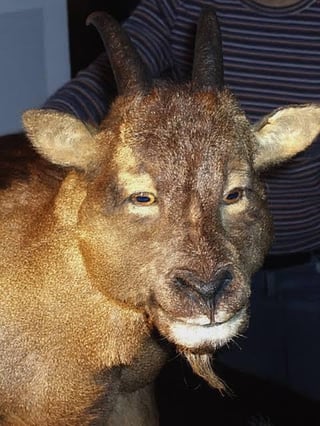
Myotragus balearicus is the only known goat to have evolved forward-facing eyes, making it one of the most unusual mammals ever shaped by island evolution
Unlocking the Island Secret: Myotragus Balearicus – The Goat That Evolved Like a Predator
Meta Description: Discover the bizarre tale of Myotragus balearicus, the extinct Balearic Islands goat that defied evolution with forward-facing eyes—a unique adaptation that rewrites the rules of island dwarfism.
Introduction: The Evolutionary Oddity of Myotragus Balearicus
When it comes to strange evolutionary twists, few creatures rival Myotragus balearicus, an extinct goat species that once roamed the rocky landscapes of Spain’s Balearic Islands. Nicknamed the “squirrel goat” for its peculiar traits, this Ice Age mammal holds a bizarre distinction: it was the only known goat to evolve forward-facing eyes, defying the norm for hoofed herbivores. This adaptation, typically seen in predators like cats or primates, is a dramatic example of how isolation reshapes species in extraordinary ways.
What Made Myotragus Balearicus So Unusual?
Myotragus balearicus lived on Mallorca and Menorca for over 5 million years before humans arrived around 3,000 BCE. While island evolution often leads to dwarfism (like Sicily’s miniature elephants), Myotragus took adaptation to another level with a suite of radical traits:
-
Forward-Facing Eyes:
Unlike modern goats, whose side-facing eyes provide wide peripheral vision to spot predators, Myotragus developed forward-facing, binocular vision. This predator-like adaptation suggests a dramatic shift in its ecological niche—possibly to judge distances accurately while climbing rocky terrain or targeting scarce vegetation. -
Slow Metabolism and Dwarfed Size:
Standing just 45–50 cm (18 inches) tall, Myotragus compensated for the islands’ limited resources with a slowed metabolism. Studies of its bones reveal growth patterns similar to reptiles, pausing development during lean periods—a trait unheard of in mammals. -
Reduced Brain and Senses:
In a classic “island effect,” the species downsized its brain by 50% compared to mainland goats, trading intelligence for energy efficiency. Its sense of smell also weakened, as predators were absent for millennia.
Why Did It Evolve Forward-Facing Eyes?
The answer lies in the unique pressures of island life. On the predator-free Balearics, Myotragus faced no threats, allowing it to abandon defenses like speed or vigilance. Instead, competition for scarce food likely drove its unusual anatomy:
- Precision Over Panorama: Forward eyes enabled depth perception for navigating cliffs and selectively browsing tough plants like boxwood.
- Energy Conservation: Reduced energy spent on brainpower and sensory processing allowed survival on low-nutrient diets.
This made Myotragus more squirrel than goat—agile, calculated, and hyper-specialized—but also vulnerable. When humans arrived, introducing predators and habitat disruption, the species swiftly vanished.
Island Evolution: Nature’s Extreme Laboratory
The saga of Myotragus highlights how isolation rewrites evolutionary rules:
- Resource Scarcity: Limited food and space favor smaller bodies and slower lifestyles.
- Predator Release: Without threats, defensive traits disappear, freeing energy for other adaptations.
- Niche Specialization: Species evolve to exploit narrow resources—like Myotragus’s cliff-scaling agility.
Similar cases include:
- Flores’ dwarf “hobbit” humans (Homo floresiensis)
- Madagascar’s elephant birds
- Sardinia’s Megaloceros deer
But Myotragus stands out for reimagining a herbivore’s anatomy in predator-like terms—a biological paradox.
Extinction: A Cautionary Tale of Fragility
Despite surviving climatic shifts for eons, Myotragus met its end around 1700 BCE when humans colonized the Balearics. Dogs, rats, and deforestation destabilized its ecosystem, proving that hyper-specialized island species rarely withstand sudden change. Today, its bones offer vital clues about evolution’s creativity—and fragility.
Key Takeaways: Why Myotragus Balearicus Still Matters
- Scientific Rarity: The only goat with forward-facing eyes—a unique window into island adaptation.
- Evolutionary Flexibility: Challenges assumptions about herbivore behavior and anatomy.
- Conservation Insight: Highlights the vulnerability of island endemics to human impact.
Conclusion: The Legacy of a Goat That Defied Expectations
Myotragus balearicus is more than a fossil curiosity—it’s a masterpiece of evolutionary reinvention. From forward-facing eyes to reptilian metabolism, this dwarf goat proves how isolation can mold life into surreal new forms. Yet its extinction also reminds us: extreme specialization is a survival gamble, one that rarely pays off in a changing world.
For paleontologists and nature lovers alike, the “squirrel goat” remains a symbol of evolution’s boundless creativity—and its risks.
Keywords: Myotragus balearicus, forward-facing eyes, island evolution, Balearic Islands, squirrel goat, dwarfism, predator-like herbivore, extinct goat species, binocular vision, hyper-specialization.
Rank Well Hint: Use images of Myotragus reconstructions and Balearic Island landscapes to boost engagement. Link to studies on PubMed or institutions like the Universitat de les Illes Balears for credibility.