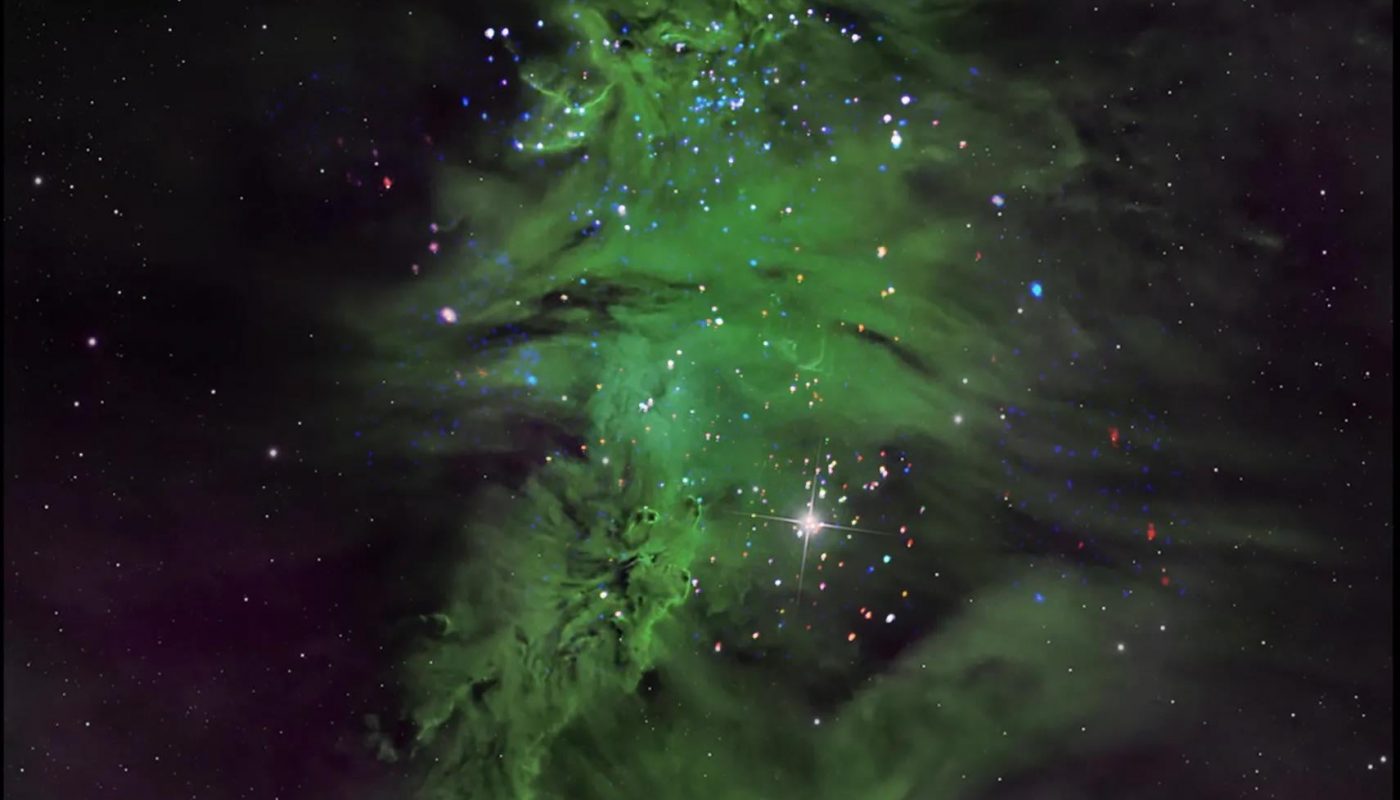
Located about 2,500 light-years from Earth, NGC 2264 is a cluster of young stars between one and five million years old. The stars appear as blue and white lights surrounded by swirls of gas—the “pine needles” of the tree—with green representing light in the visible spectrum. 🎄🎅
Title: NGC 2264: Exploring the Cosmic Christmas Tree Cluster
Meta Description: Discover NGC 2264, the “Christmas Tree Cluster” – a dazzling cluster of young stars nestled in a swirl of gas 2,500 light-years from Earth. Learn its secrets, appearance, and how to observe this celestial wonder!
🌌 NGC 2264: A Festive Stellar Spectacle
Located roughly 2,500 light-years from Earth in the constellation Monoceros (the Unicorn), NGC 2264 is a glittering cluster of young stars aged between one and five million years old. Often nicknamed the “Christmas Tree Cluster” for its festive resemblance to a cosmic evergreen, this stellar nursery combines hot blue-white stars with ethereal swirls of gas and dust that evoke the twinkling lights and needles of a holiday tree.
But the magic doesn’t stop there. When viewed in visible light, the green hues of the surrounding nebula – powered by ionized hydrogen and oxygen gas – act as the tree’s “pine needles,” completing this celestial holiday masterpiece 🎄.
🔭 Location & Discovery: The Science Behind the Sparkle
Discovered in the late 18th century by astronomer William Herschel, NGC 2264 is more than just a single cluster. It’s part of a sprawling star-forming region that includes:
- The Christmas Tree Cluster (the star group itself), whose young, massive stars shine with intense UV radiation.
- The Cone Nebula, a dense pillar of gas sculpted by stellar winds, acting as the “tree trunk.”
The entire structure spans over 30 light-years across, making it a laboratory for studying stellar birth.
🌟 Why Does NGC 2264 Look Like a Christmas Tree?
The cluster’s festive nickname comes from its structure when imaged with specialized filters:
- Blue & White Stars: Hot, young stars (O- and B-type) dominate the cluster, emitting brilliant blue-white light akin to twinkling holiday bulbs.
- Pine Needle Nebulas: Swirling reddish-pink gas (emission from hydrogen) and green-tinted dust (oxygen emission in visible light) create the “branches.”
- A Tilted Shape: Telescopic views reveal the cluster’s stars arranged in an inverted V-shape, resembling a decorated evergreen.
For an extra touch of drama, infrared and X-ray telescopes (like Chandra) reveal hidden protostars and jets within the gas clouds—proof that this nursery is still active!
🌠 Scientific Significance: The Youthful Energy of NGC 2264
This cluster is a treasure trove for astronomers studying star formation. Key features include:
- Protostars: Embedded within the nebula, these infant stars are still growing by accreting gas.
- Stellar Feedback: The cluster’s massive stars blast intense radiation and winds, shaping the nebula and triggering new star birth—or halting it.
- Magnetic Fields: Filaments of dust trace magnetic forces guiding the collapse of gas into stars.
The stars here are cosmic toddlers compared to our Sun (4.6 billion years old), offering insights into how solar systems like ours begin.
👀 How to Observe the Christmas Tree Cluster
While NGC 2264 isn’t visible to the naked eye, amateur astronomers can spot it with modest equipment:
- Best Time to View: Winter months (December–March) in the Northern Hemisphere.
- Equipment Needed: A small telescope (4-inch aperture or larger) or binoculars under dark skies.
- Look For: The cluster lies near Procyon (in Canis Minor) and Betelgeuse (in Orion). Use a star-hopping app like Stellarium to navigate.
Pro tip: Use an H-alpha filter to enhance the red gas clouds or a broadband filter to isolate the green oxygen emission. Astrophotographers can capture the “tree” in all its glory through long exposures!
🎅 Fun Facts: Cosmic Holiday Magic
- The “tree” is upside down in telescopic views! Its brightest star, S Monocerotis, sits at the base (the tree topper, ironically).
- The green in images isn’t just artistic license—it represents actual visible-light wavelengths from ionized gas.
- Light from NGC 2264 began its journey toward Earth around 500 BCE, meaning we see it as it looked during the rise of ancient Greek civilization.
✨ Conclusion: A Stellar Gift for Skywatchers
NGC 2264, the Christmas Tree Cluster, is more than a seasonal wonder—it’s a dynamic region where stars are born, gas dances in kaleidoscopic hues, and science blends seamlessly with beauty. Whether you’re an astronomer hunting for stellar nurseries or simply want to enjoy a cosmic holiday display, this 2,500-light-year-old marvel delivers awe at every wavelength.
So this winter, grab a telescope, look toward Monoceros, and celebrate the universe’s version of holiday cheer! 🚀🔭
SEO Keywords: NGC 2264, Christmas Tree Cluster, Cone Nebula, star cluster, nebula photography, young stars, Monoceros constellation, astrophotography targets, stellar formation emission nebula.
Image Suggestion: Pair this article with Hubble or Chandra X-ray Observatory images of NGC 2264 to showcase its colorful structure.
(Share this cosmic holiday card with stargazers! 🌟)