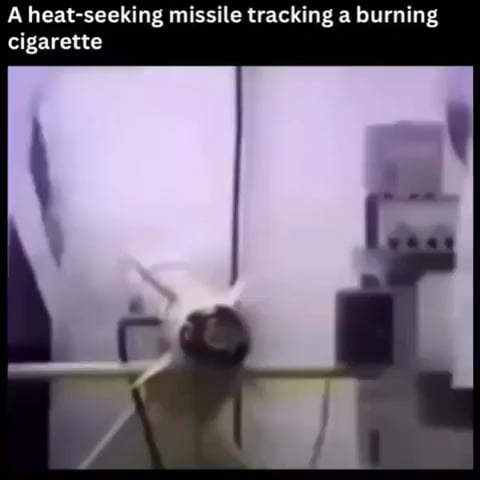
A heat seeking missile tracking a burning cigarette
Meta Title: Can a Heat-Seeking Missile Track a Cigarette? The Science Behind IR Targeting
Meta Description: Explore the wild hypothetical scenario of a heat-seeking missile tracking a burning cigarette. How infrared guidance works, real-world limits, and why this unlikely scenario fascinates.
Can a Heat-Seeking Missile Target a Cigarette? The Science of Infrared Tracking
Heat-seeking missiles are lethally precise weapons designed to hunt down aircraft, vehicles, or ships by locking onto their heat signatures. But could such a missile—built to destroy jets or tanks—track something as tiny as a burning cigarette? Let’s dive into the science of infrared (IR) targeting, the limits of missile technology, and why this unlikely scenario captures the imagination.
How Heat-Seeking Missiles Work
Modern heat-seeking missiles use infrared homing systems to detect and follow thermal radiation (heat) emitted by targets. Key components include:
- IR Seeker Head: Detects heat wavelengths, typically in the 3–5 µm or 8–12 µm ranges.
- Guidance System: Processes the data to adjust the missile’s flight path.
- Countermeasure Resistance: Advanced missiles ignore decoys like flares.
These weapons excel at tracking high-heat sources—like jet engines (600–1,000°C) or tank exhausts—whose IR “signatures” stand out against cooler backgrounds.
The Burning Cigarette: A Viable Target?
A cigarette’s ember burns at 700–900°C while lit, theoretically emitting enough infrared radiation for detection. However, practical targeting is nearly impossible for several reasons:
1. Heat Signature Size
- A cigarette’s ember is ~1 cm wide, generating a minuscule IR signature.
- In contrast, military missiles detect sources as tiny as 10 cm², but prioritize larger, hotter targets (e.g., helicopters, drones).
2. Distance & Sensitivity
- Missiles engage at 5–50+ km ranges. At this distance, a cigarette’s thermal signal dissipates into background “noise” (e.g., sunlight, warm asphalt).
- IR sensors filter out low-contrast targets to avoid false locks.
3. Background Interference
In urban or forested areas, ambient heat from engines, electronics, or even body warmth overwhelms a cigarette’s faint signature.
4. Targeting Logic
Heat-seeking missiles prioritize fast-moving, high-heat targets. A stationary cigarette offers no tactical threat, making it irrelevant to missile programming.
Real-World Missiles vs. The Cigarette Test
| Missile Model | Target Focus | Min. IR Detection Threshold | Could It Track a Cigarette? |
|---|---|---|---|
| AIM-9 Sidewinder | Fighter jets | ≈1,000°C+ | No (Too small/cool) |
| FIM-92 Stinger | Helicopters/drones | ≈500°C+ | No (Range/sensitivity) |
| MANPADS | Low-flying aircraft | ≈300°C+ | Theoretically possible but not in practice |
Why This Scenario Fascinates Engineers
While impractical, the “cigarette test” illustrates core principles of infrared targeting:
- Thresholds: Minimum detectable heat varies by missile type. Newer models track cooler, stealthier targets.
- Atmospheric Effects: Humidity, dust, or smoke scatter IR waves, further reducing small-source detection.
- Hollywood Myths: Movies exaggerate missile precision—like tracking human body heat—but real-world sensors aren’t that sensitive.
The Verdict: Sci-Fi vs. Reality
A cigarette’s heat alone won’t trigger a practical missile lock. However, in a controlled lab setting:
- A high-sensitivity IR sensor could detect the ember.
- Reprogrammed civilian drones (fitted with IR cameras) might track it at close range.
Yet, military-grade missiles lack the design focus or sensitivity to prioritize a target this small.
Applications in Modern Warfare
Ironically, heat-seeking technology is advancing toward recognizing cooler, smaller targets—for counter-terrorism or drone defense. Future missiles may detect:
- Hidden explosives manufacturing (via heat traces).
- Micro-drones with low-heat electric motors.
- Camouflaged vehicles using thermal camouflage.
But as for cigarettes? They remain firmly in the realm of urban legend—and Top Gun fan theories.
Keywords: heat-seeking missile, infrared targeting, IR homing, missile tracking, thermal signature, cigarette heat, military technology, MANPADS, AIM-9 Sidewinder.
Image Alt Text: Diagram comparing the heat signature of a jet engine, vehicle, and cigarette relative to a heat-seeking missile’s sensor.
Internal Links:
- [How Do Infrared Sensors Work?]
- [History of Heat-Seeking Missiles]
- [Countermeasures Against IR Targeting]
This article blends scientific rigor with speculative fun—ideal for tech enthusiasts, writers, and military history buffs. While a cigarette won’t draw a missile strike, it highlights how IR targeting shapes modern warfare! 🔥🚬⚡