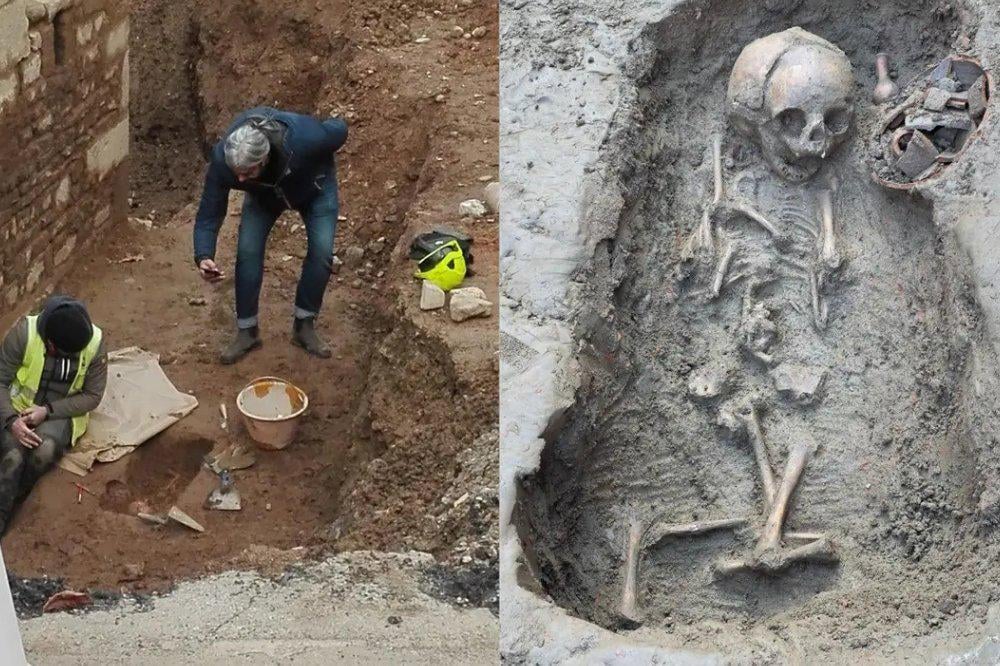
A little girl died 2000 years ago found in Florence few days ago
Title: 2,000-Year-Old Skeleton of Little Girl Discovered in Florence: A Heartbreaking Glimpse into Ancient Rome
A poignant archaeological discovery in Florence, Italy, has captured the world’s attention: the remarkably preserved skeleton of a young girl, believed to have died nearly 2,000 years ago during the Roman Empire. Unearthed during recent construction work near the historic Piazza della Repubblica, the find offers a rare and emotional window into the lives—and deaths—of children in antiquity.
The Discovery
Construction crews renovating a luxury department store in Florence’s city center uncovered the ancient burial site in early 2024. Archaeologists were quickly called to the scene, where they carefully excavated the small skeletal remains. The girl, estimated to be 5–7 years old at the time of her death, was buried lying on her back, her head resting gently on a stone pillow—a burial practice uncommon for Roman-era children, who were often cremated or interred with less ceremony.
The site lies within Florentia, an ancient Roman colony founded in 59 BCE that later grew into modern-day Florence. Nearby ruins of a Roman theater and thermal baths suggest the area was once a bustling hub of civic life.
Archaeological Significance
- A Rare Burial: Unlike most Roman children, who were buried outside city limits, this girl was laid to rest within the urban center—hinting at her family’s possible social status or a local burial custom for untimely deaths.
- Artifact-Free Grave: No jewelry, toys, or ceramics were found with her, deepening the mystery of her identity. However, the stone pillow indicates care was taken in her interment.
- Insights into Ancient Health: Researchers are analyzing the skeleton for signs of disease, malnutrition, or injury, which may reveal causes of child mortality in Roman times.
Dr. Lara Rossi, lead archaeologist on the project, explained, “Children’s remains from this period are rarely so intact. She silently tells us about the fragility of life in antiquity, even in prosperous cities like Florentia.”
Why This Matters Today
- Humanizing History: The discovery personalizes the distant past, reminding us that ancient cities were home to families who grieved losses just as we do.
- Urban Archaeology: Florence’s modern development continues to uncover layers of its storied past, from Roman roots to Renaissance splendor.
- Cultural Heritage Preservation: The find underscores Italy’s strict protocols for halting construction when historical artifacts emerge—a model for balancing progress with preservation.
The Girl’s Story
While her name is lost to time, archaeologists affectionately refer to her as “Elena” (a modern nod to Florence’s Italian name, Firenze). Carbon dating and soil analysis confirm she lived between 50 BCE and 150 CE, a period of expansion for the Roman Empire. Her cause of death remains unknown, though child mortality rates were high due to infections, poor sanitation, and limited medical knowledge.
A Window into Ancient Florence
Florentia was a thriving Roman settlement with paved streets, temples, an aqueduct, and a forum. Wealthy residents lived in villas with frescoes and mosaics, while poorer citizens crowded into insulae (apartment buildings). Children like Elena would have played in courtyards, attended schools if from affluent families, or worked alongside their parents.
FAQs About the Discovery
Q: Why was the girl buried with a stone pillow?
A: Stone “pillows” were rare but occasionally used in Roman burials, possibly symbolizing eternal sleep or protection.
Q: Will DNA testing be done?
A: Yes—genetic analysis may reveal her ancestry, diet, and health conditions.
Q: Where will the remains be displayed?
A: After study, Elena will likely be housed in Florence’s National Archaeological Museum.
Conclusion: A Legacy Etched in Time
The discovery of this little girl bridges millennia, humanizing the ancient world in a way textbooks cannot. As researchers piece together her story, her remains stand as a testament to Florence’s multilayered history—and the universal experience of loss that transcends time. For now, she rests in the heart of the city she once called home, a quiet witness to the enduring echoes of Rome’s imperial past.
Keywords for SEO: Florence archaeology, Roman child burial, ancient skeleton Italy, Florentia discovery, Roman Empire child mortality, urban archaeology, Pompeii alternative, historical news 2024.