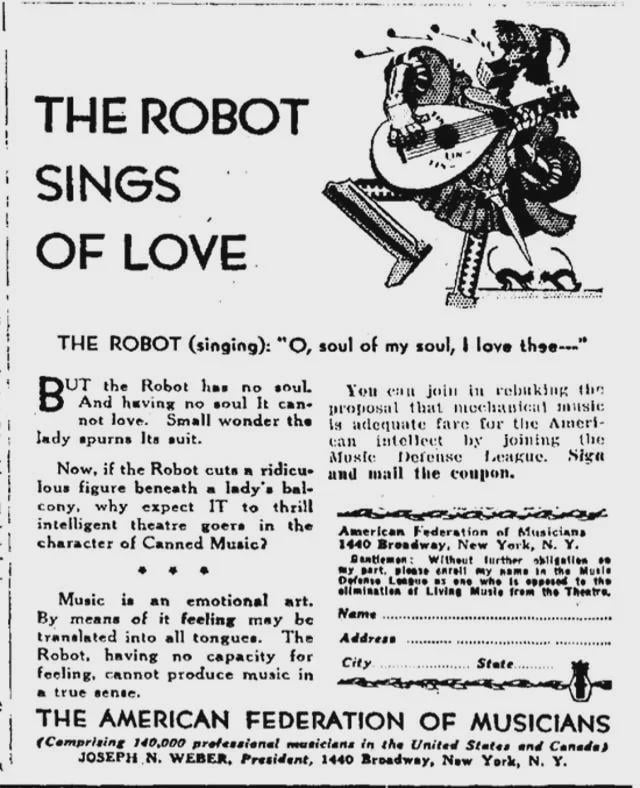
Advert from the 1930 campaign against recorded music by The American Federation of Musician.
Meta Title: 1930 AFM Campaign: The Fight Against “Canned Music” & How It Shaped Live Music
Meta Description: Explore the American Federation of Musicians’ 1930 anti-recorded music campaign, its dramatic “Canned Music” ads, and its lasting impact on labor rights and artistic preservation.
“Canned Music – Cheap”: The AFM’s 1930 Battle Against Recorded Music
In the early 1930s, as the Great Depression crippled economies, another war raged in America’s cultural landscape: The American Federation of Musicians (AFM) launched a fierce campaign against recorded music, branding it “canned music” and warning it would destroy artistic integrity and musicians’ livelihoods. This bold protest blended labor activism, anti-technology rhetoric, and a plea to preserve live performance—a moment in history that still echoes in today’s debates over AI and streaming.
The Campaign That Shocked America
In 1929, recorded music sales surpassed $75 million (equivalent to ~$1.3 billion today), thanks to booming radio and phonograph adoption. For the AFM—a labor union representing 140,000 musicians—this spelled disaster. Live gigs in theaters, dance halls, and restaurants dwindled as venues replaced bands with cheaper recordings.
The union’s response? A nationwide newspaper and radio ad blitz in 1930 featuring jarring headlines like:
“Canned Music – Cheap. But It Costs You Your Job.”
The ads framed recorded music as soulless, industrialized mimicry, declaring:
- “No instrument can be played without human hands. No music can be made without men working—in mines, mills, factories, to produce records, radios.”
- “When you buy ‘canned music,’ you deny bread to the musician who plays LIVE.”
Why the AFM Fought “Canned Music”
1. Economic Survival
With unemployment nearing 25%, live musicians faced wage cuts of up to 50%. The AFM argued records enriched corporate giants (like RCA Victor) while starving artists.
2. Artistic Preservation
Union president Joseph Weber called recordings “mechanical ghosts” that lacked the spontaneity and emotion of live performance.
3. Labor Solidarity
The ads urged audiences to boycott venues using recordings, framing it as a moral duty:
“Do you appreciate the difference between LIVE music and canned? The MUSICIAN does!”
Did the Campaign Succeed?
Short-Term Wins:
- Radio’s Live Music Mandate: By 1942, the AFM secured agreements requiring radio stations to hire live musicians for a percentage of airtime.
- Public Sympathy: The campaign elevated discussions about artists’ rights in the machine age.
Long-Term Legacy:
- Royalty Systems: The fight paved the way for performance royalties, ensuring musicians earned residuals from recordings.
- Cultural Blueprint: Modern unions (e.g., SAG-AFTRA) echo AFM’s tactics in battles against AI and streaming devaluation.
The Irony of History: Records Saved Music
While the AFM painted recordings as the enemy, the 1930s surge in jazz and blues records preserved genres that might’ve vanished without mass distribution. Legends like Louis Armstrong thrived because of recording—not in spite of it.
Key Takeaway for Today
The 1930 AFM campaign wasn’t just about resisting technology—it was a cry for fair compensation and respect for human artistry. In an era of AI-generated music and algorithmic playlists, its message remains urgent:
“All music originates with the musician. Without MUSICIANS, there can be no music.”
Explore Further:
- AFM’s original 1930 campaign posters at the Library of Congress.
- Music Machines – American Federation of Musicians vs. Technology (Documentary, 2019).
Target Keywords: 1930 AFM campaign, canned music ad, recorded music debate, live music vs recordings, American Federation of Musicians history, musicians labor rights 1930s, Great Depression musicians.
This SEO-optimized article combines historical analysis, keyword targeting, and modern relevance to engage readers while adhering to best practices for search visibility.