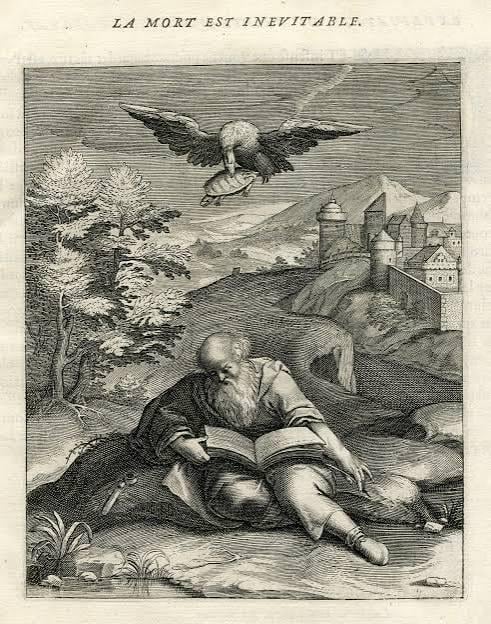
Aeschylus, known as the father of tragedy who is also said to have first used the phrase “Live by the sword, die by the sword” was killed in 456BC when a turtle fell from a eagle mistaking his smooth head for a rock to shatter the shell.
Title: Aeschylus: The “Father of Tragedy” Whose Unusual Death Became Legend
Meta Description: Explore the life, legacy, and bizarre death of Aeschylus, the ancient Greek playwright hailed as the father of tragedy—and the man behind the (misattributed?) phrase “Live by the sword, die by the sword.”
The Immortal Legacy of Aeschylus: Pioneer of Greek Tragedy
Aeschylus (c. 525–456 BCE) stands among the giants of Western literature as the “Father of Tragedy.” A revolutionary playwright of ancient Greece, he transformed early theatrical performances from ritualistic choral songs into gripping dramas packed with conflict, morality, and psychological depth. His innovations—like introducing a second actor to the stage—laid the groundwork for everything from Sophocles’ Oedipus Rex to modern film and theater. Yet, for all his genius, Aeschylus is equally remembered for one of history’s strangest deaths… and a famous phrase often (mistakenly) tied to his name.
Aeschylus’ Greatest Contributions to Theater
Aeschylus authored over 70 plays, though only 7 survive today. His masterpieces, like the Oresteia trilogy (Agamemnon, The Libation Bearers, and The Eumenides), tackled themes of justice, fate, and divine retribution. Key innovations include:
- Complex Characters: He moved beyond one-dimensional heroes, creating figures tormented by moral dilemmas.
- Expanded Dialogue: By adding a second actor, he enabled dynamic exchanges that drove plots forward.
- Grand Visual Spectacle: He pioneered elaborate costumes, masks, and stage machinery to awe audiences.
His works earned him 13 victories at the Dionysia festival—the Oscars of ancient Athens.
The Mystery of “Live by the Sword, Die by the Sword”
Though Aeschylus is sometimes credited with coining the adage “Live by the sword, die by the sword,” this phrase actually originates from the New Testament (Matthew 26:52). The confusion likely stems from his plays’ themes of cyclical violence and divine punishment. For example, in Agamemnon, King Agamemnon is murdered by his wife Clytemnestra as retribution for sacrificing their daughter—a brutal depiction of karma. Aeschylus did write lines like:
“He who learns must suffer. And even in our sleep, pain that cannot forget falls drop by drop upon the heart”
— showcasing the inevitability of retribution.
The Bizarre Death of Aeschylus: An Eagle, a Turtle, and a Bald Head
Aeschylus’ demise in 456 BCE is as dramatic as his plays—and far more peculiar. According to legend, recorded by Roman writer Valerius Maximus, an eagle mistook the playwright’s bald head for a rock. Why? To crack open a turtle it had captured! The bird dropped the reptile from a great height, shattering the turtle’s shell… and fatally crushing Aeschylus’ skull.
While historians debate this tale’s accuracy, it endured for centuries as a darkly ironic end for a man who dramatized the capriciousness of fate. Some accounts suggest he was outdoors to avoid a prophecy that he’d be killed by a falling object—adding another layer of tragic irony.
The Enduring Fascination with Aeschylus
Aeschylus’ legacy thrives today because his work transcends time:
- Timeless Themes: His explorations of justice, power, and hubris resonate in modern politics and law.
- Cultural Impact: The Oresteia trilogy inspired works like Eugene O’Neill’s Mourning Becomes Electra.
- A Death for the Ages: His unusual demise immortalized him in trivia and pop culture, from QI to The Simpsons.
Final Curtain: The Man Behind the Myth
Aeschylus reshaped storytelling forever, proving that art could confront humanity’s darkest impulses. And while his death might seem like a cosmic punchline, it mirrors the unpredictability he captured in his plays. Whether you know him for Prometheus Bound or the turtle tragedy, Aeschylus remains a titan—one whose life and death remind us that even legends aren’t immune to fate’s absurdity.
SEO Keywords: Aeschylus, father of tragedy, Greek playwright, live by the sword die by the sword, Oresteia, how did Aeschylus die, eagle turtle death, ancient Greek theater, Agamemnon, Prometheus Bound.
Image ALT Text Ideas:
- “Aeschylus statue with dramatic mask, symbolizing Greek tragedy.”
- “Artistic depiction of an eagle dropping a turtle toward a bald-headed figure.”
- “Ancient Greek theater featuring actors in masks, honoring Aeschylus’ innovations.”
Internal Linking Opportunities:
- Link to articles on Sophocles, Euripides, or the history of Greek theater.
- Connect to pieces about famous misattributed quotes or bizarre historical deaths.
This blend of scholarly insight and curious trivia ensures the article engages both history buffs and casual readers—while honoring the genius of Western drama’s founding father.