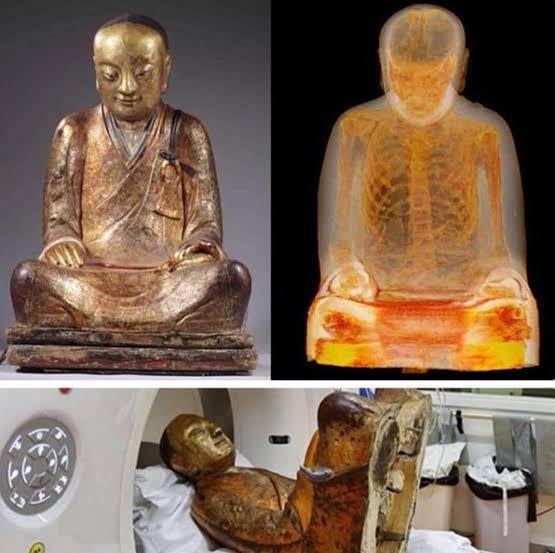
After a CT scan on this 1000 year old Buddha statue, scientists found the remains of a mummified monk inside
Unveiling Ancient Secrets: 1,000-Year-Old Buddha Statue Reveals Mummified Monk Inside
In an astonishing discovery blending spirituality, archaeology, and cutting-edge technology, scientists have uncovered the remains of a mummified monk concealed within a 1,000-year-old Buddha statue. This revelation, made possible by advanced CT scanning, has captivated historians and Buddhists alike, shedding light on ancient rituals and the enigmatic practice of self-mummification.
The Discovery: A CT Scan Unveils the Unthinkable
The remarkable story began when a Chinese Buddha statue, dated to the 11th or 12th century, underwent a routine medical examination—but not for health reasons. Researchers at the Drents Museum in the Netherlands, where the statue was temporarily displayed, decided to subject it to a CT scan to uncover its internal structure. What they found was nothing short of extraordinary: the tightly packed remains of a monk, sitting in the lotus position, hidden for centuries inside the statue’s lacquered and gilded exterior.
Further analysis revealed that the monk’s organs had been removed and replaced with ancient scriptures and material resembling rotted paper. The startling find was later confirmed to be an example of sokushinbutsu—a rare Buddhist practice of self-mummification practiced in Japan, China, and Tibet.
The Science Behind the Revelation
The CT scan, combined with endoscopic sampling, allowed scientists to peer into the statue without damaging its delicate structure. Here’s what they uncovered:
- The Monk’s Identity: Inscription analysis suggests the monk was likely Liuquan, a master of the Chinese Meditation School who died around 1100 AD.
- Preservation Process: The body showed signs of meticulous preservation: the organs were removed to slow decomposition, and the remains were positioned in deep meditation.
- Cultural Clues: The statue itself, crafted from papier-mâché over wood and bronze, was designed as a reliquary to honor the monk’s enlightenment.
What Is Sokushinbutsu? The Path to Self-Mummification
The discovery has reignited interest in sokushinbutsu, an extreme ascetic practice where monks undergo years of ritual preparation to mummify themselves alive. The process involved:
- Dietary Restrictions: Monks would switch to a diet of nuts, seeds, and toxic tree sap (urushi) to purge the body of bacteria and fat.
- Self-Entombment: After years of preparation, monks entered a sealed stone chamber, where they meditated until death. The chamber’s dry, low-oxygen environment encouraged natural mummification.
- Veneration: If the body was preserved, it was viewed as a sign of enlightenment and enshrined as a “living Buddha.”
Only a few dozen sokushinbutsu have ever been confirmed—making this Buddha statue’s hidden occupant a rare and haunting relic.
Why This Discovery Matters
- Cultural Insight: The finding opens a window into medieval Buddhist beliefs, where physical endurance and transcendence of the body were seen as paths to spiritual purity.
- Medical Marvel: The monk’s preserved state, combined with the statue’s craftsmanship, highlights advanced understanding of anatomy and preservation techniques in ancient East Asia.
- Ethical Questions: The statue-turned-reliquary raises debates about repatriation and the ethics of displaying human remains in museums.
Where Is the Buddha Statue Now?
After touring European museums, the statue was returned to China and has become a subject of ongoing research. Scholars continue to study its materials, inscriptions, and the monk’s DNA to unravel more secrets about life—and death—in ancient Buddhist communities.
Conclusion: Bridging the Past and Present
The discovery of a mummified monk inside a 1,000-year-old Buddha statue is a poignant reminder of humanity’s enduring quest for meaning. It blurs the line between art and relic, science and spirituality, inviting us to reflect on ancient traditions that still resonate today. As technology like CT scanning allows us to explore history without destruction, who knows what other secrets lie hidden within the artifacts of the past?
Meta Description: Scientists discovered a mummified monk inside a 1,000-year-old Buddha statue using CT scans. Explore the ancient practice of sokushinbutsu, the monk’s identity, and the cultural impact of this eerie archaeological revelation.
Keywords: mummified monk in Buddha statue, sokushinbutsu, ancient Buddha statue CT scan, Liuquan monk discovery, Buddhist self-mummification, 1,000-year-old Buddha statue, Drents Museum mummy, archaeology finds, Buddhist relics, preserved monk remains.
Internal Links:
- [The Science of Mummification: How Ancient Cultures Preserved the Dead]
- [10 Most Puzzling Archaeological Discoveries of the Decade]
- [Buddhist Relics: Artifacts of Enlightenment and Devotion]
External Sources:
- National Geographic: The Mummy Inside the Buddha
- Drents Museum Research Paper on the Buddha Statue
- Tibetan Buddhist Archives on Sokushinbutsu
By weaving science, history, and spirituality, this discovery continues to inspire awe—proving that even after a millennium, the past still has secrets to share.