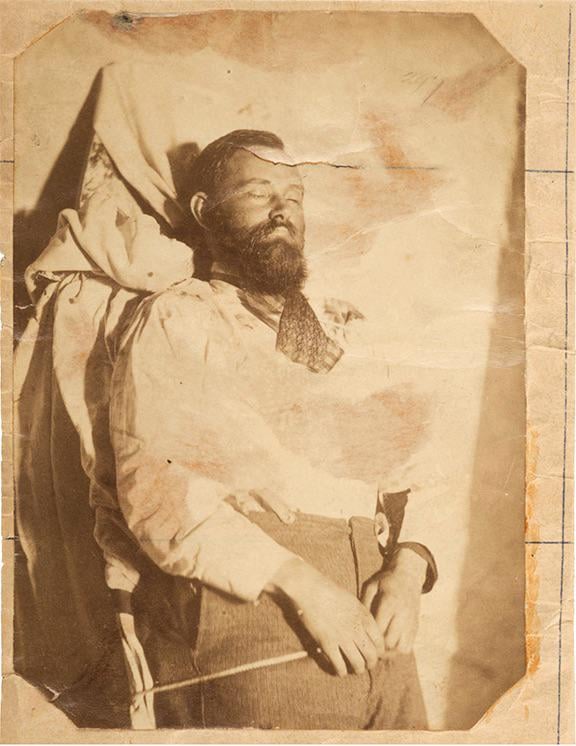
After outlaw Jesse James was killed in 1882, photographs of his corpse were sold to the public for 50¢. This is one of them.
Title: The Grim Souvenir: The Story Behind the Infamous Jesse James Death Photo
In the dusty annals of American outlaw lore, few figures loom larger than Jesse James—the charismatic Civil War guerrilla turned notorious bank robber. His death in 1882 marked the violent end of a rebellious era, but it birthed a morbid chapter in American pop culture: the commodification of his corpse. For just 50 cents, the public could own a haunting photograph of James’ lifeless body—a macabre keepsake that blurred the lines between news, exploitation, and mythology.
The Assassination of an Outlaw Legend
On April 3, 1882, Jesse James was shot in the back of the head by Robert Ford, a member of his own gang lured by Missouri Governor Thomas Crittenden’s $10,000 reward for James’ capture—dead or alive. Ford’s betrayal was calculated: James had removed his pistols moments earlier, sensing no threat from his trusted associate. The murder cemented Ford’s infamy as “the dirty little coward who shot Mr. Howard” (James’ alias at the time) in folk ballads, but it also sparked an unlikely frenzy.
The Birth of “Death Photography” as Mass Media
In an era before television or social media, photographs of celebrities (or criminals) were rare treasures. James’ corpse became an immediate spectacle. Within hours, his body was displayed in St. Joseph, Missouri, where curious crowds lined up to view it. Entrepreneurial photographers capitalized on the morbid curiosity, snapping images of the slain outlaw laid out in a coffin, a bullet wound visible above his brow.
These images were hastily printed as cartes-de-visite (small portrait cards) or tintypes, priced at 50 cents—equivalent to roughly $15 today. For context, this was affordable enough for working-class Americans to own a piece of the sensational story. Newspapers fueled demand, framing James as a tragic antihero whose violent end warranted commemoration.
Why Did People Buy These Photos?
The psychology behind the sales reveals a cultural obsession:
- Morbid Curiosity: Death was no stranger in the 19th century, but public figures like James invited fascination.
- Myth-Making: James was already a folk hero to some Southern sympathizers, and the photo served as a martyr-like relic.
- Sensationalism: Media hype turned crime into entertainment—a precursor to today’s true-crime podcasts.
The Photo’s Legacy: Authenticity and Controversy
Today, surviving copies of the death photo are auctioned for thousands of dollars, but historians debate their authenticity. Multiple photographers claimed to have taken “the” definitive image, leading to variations in staging (e.g., open vs. closed coffins). Forensic analysis confirms James’ distinctive features—his furrowed brow, square jaw, and the fatal wound—but reproductions and fakes abound.
Key details in the photograph:
- Jesse’s pose, arranged to appear peaceful despite his violent end.
- His clothing, notably a fine suit, hinting at his Robin Hood-esque reputation.
- The coffin’s modest woodwork, contrasting with his legendary status.
A Dark Prelude to Modern True Crime
The commercialization of Jesse James’ corpse foreshadowed today’s commodification of tragedy. From Bonnie and Clyde’s death photos to viral school shooting manifestos, society grapples with the ethics of consuming violent imagery. In 1882, though, there were no such debates—only demand.
Where to See the Photo Today
Original prints reside in institutions like the Library of Congress, the National Archives, and private collections. Digital archives (e.g., Missouri Digital Heritage) offer accessible copies, but viewing them requires confronting the uncomfortable allure of violence as spectacle.
Conclusion: Death as a Commodity in the Wild West
The 50-cent Jesse James death photo wasn’t just a morbid souvenir—it was a cultural artifact of a nation wrestling with fame, infamy, and the ethics of memory. As true crime continues to fascinate modern audiences, James’ photograph reminds us that the line between memorializing history and exploiting tragedy has always been faint.
SEO Keywords: Jesse James death photo, Jesse James corpse, 1882 assassination, Robert Ford, outlaw memorabilia, American West history, true crime artifacts, Jesse James assassination photo, death photography 1800s.
Did this article unearth a piece of history you’d never heard of? Share it to spark a conversation about the ethics of tragedy in media—then and now.