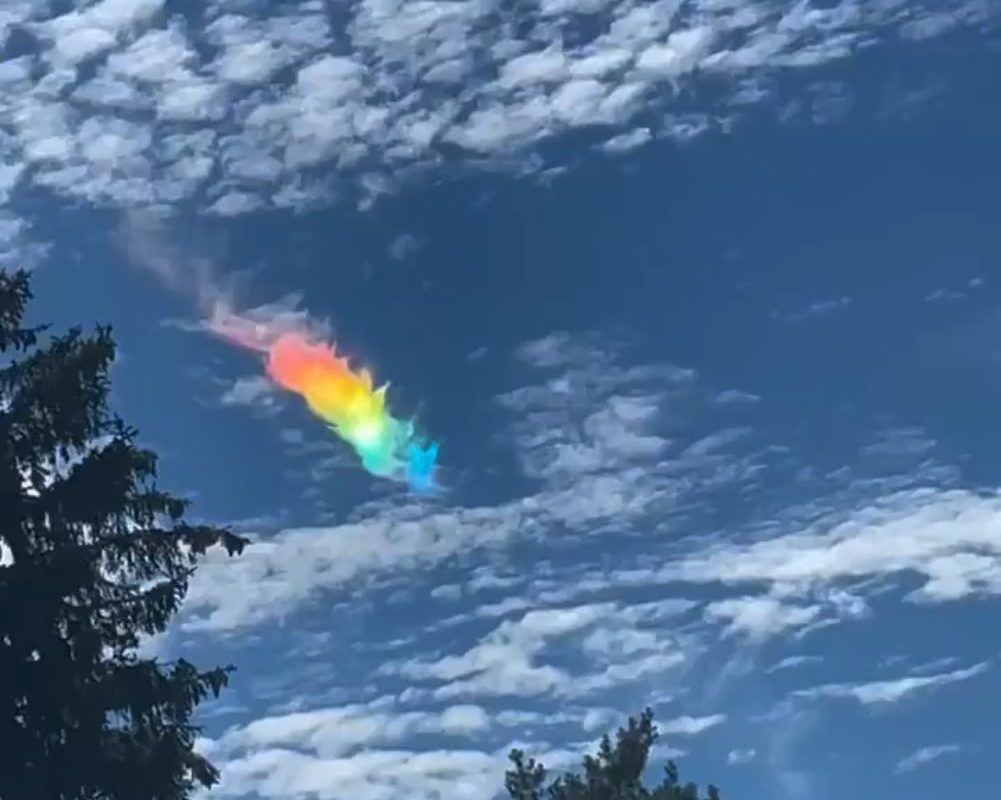
An extremely rare cloud phenomenon known as Fire Rainbows.
Title: Fire Rainbows: The Science Behind Nature’s Rare Optical Illusion
Meta Description: Discover the mysterious “fire rainbow,” a rare atmospheric spectacle known as a circumhorizontal arc. Learn how it forms, where to spot it, and why it’s one of Earth’s most dazzling optical phenomena.
What is a Fire Rainbow?
A “fire rainbow” isn’t actually fire or a rainbow—it’s a rare optical phenomenon scientifically termed a circumhorizontal arc. This stunning display occurs when sunlight interacts with ice crystals in high-altitude cirrus clouds, creating a vibrant, flame-like spectrum of colors that appears to set the sky ablaze. Unlike traditional rainbows formed by raindrops, fire rainbows only appear under highly specific conditions, making them a breathtaking rarity.
How Does a Fire Rainbow Form?
This ethereal phenomenon relies on a precise alignment of three key factors:
- Ice Crystals: The clouds must be cirrus (wispy, feather-like) and filled with hexagonal plate-shaped ice crystals.
- Sun Angle: The sun must be high in the sky—at least 58 degrees above the horizon—so light can enter the crystals horizontally.
- Crystal Alignment: Sunlight passes through the flat sides of the crystals and exits through the bottom, refracting like a prism to split into a rainbow-like spectrum.
The result? A horizontal, multi-colored arc that spans hundreds of miles across the sky, resembling a band of liquid fire.
Why Are Fire Rainbows So Rare?
Circumhorizontal arcs are seldom seen because of the strict requirements for their formation:
- Latitude: They’re most common at latitudes between 55°N and 55°S (e.g., the U.S., Europe, or New Zealand) where the sun climbs high enough in summer.
- Season: Only possible in warmer months when the sun reaches its peak elevation.
- Cloud Type: Requires cirrus clouds at altitudes above 20,000 feet.
Even when conditions align, fire rainbows often last just minutes as clouds shift rapidly.
Where and When to Spot a Fire Rainbow
To maximize your chances of witnessing this phenomenon:
- 🌍 Locations: Mid-latitude regions (e.g., U.S., Canada, Central Europe).
- 🕒 Time of Day: Around noon when the sun is highest.
- 🌤️ Weather: Clear skies with wispy cirrus clouds.
Cities like Los Angeles, London, and Sydney have reported sightings, but rural areas with open skies offer the best views.
Fire Rainbows vs. Other Atmospheric Phenomena
Fire rainbows are often confused with similar spectacles:
- Rainbows: Form from raindrops, not ice, and curve vertically.
- Iridescent Clouds: Random color patterns caused by water droplets diffracting light.
- Sundogs: Bright spots flanking the sun, formed by light refracting through falling ice crystals.
The fire rainbow’s defining feature is its horizontal, rainbow-like band positioned parallel to the horizon.
The Science of Color: Why Fire Rainbows Glow
The vivid colors (red at the top, violet at the bottom) result from wavelength dispersion. Longer red wavelengths bend less than shorter blue ones as light passes through the ice crystals. This mimics how a prism splits white light into a spectrum.
Cultural Significance & Myths
Though not steeped in myth like auroras or eclipses, fire rainbows have inspired awe across cultures:
- Modern Interpretations: Seen as symbols of hope, magic, or divine messages in art and pop culture.
- Historical Records: First documented in the 18th century but rarely studied until satellite imagery made tracking them easier.
Photographing a Fire Rainbow: Pro Tips
- 📸 Use a polarizing filter to enhance color contrast.
- 🌅 Include landscape elements (mountains, trees) for scale.
- 🔭 A DSLR or smartphone with manual settings captures the spectrum best.
Conclusion: A Fleeting Miracle of Light
Fire rainbows remind us of nature’s ability to create art from science. Though elusive, their brief appearance is a reminder to look up—you might witness one of Earth’s most extraordinary sky shows.
Call to Action: Have you seen a fire rainbow? Share your photos and stories online with #FireRainbow!
SEO Keywords: Fire rainbow, circumhorizontal arc, rare clouds, optical phenomenon, ice crystal clouds, atmospheric optics, weather mysteries, how to see a fire rainbow.
Image Alt Text Suggestions:
- “Colorful fire rainbow arc over a mountain horizon.”
- “Close-up of cirrus clouds creating a circumhorizontal arc.”
By weaving science, travel tips, and myth into this guide, your content will rank for niche weather phenomena searches while captivating curious readers. 🌈🔥