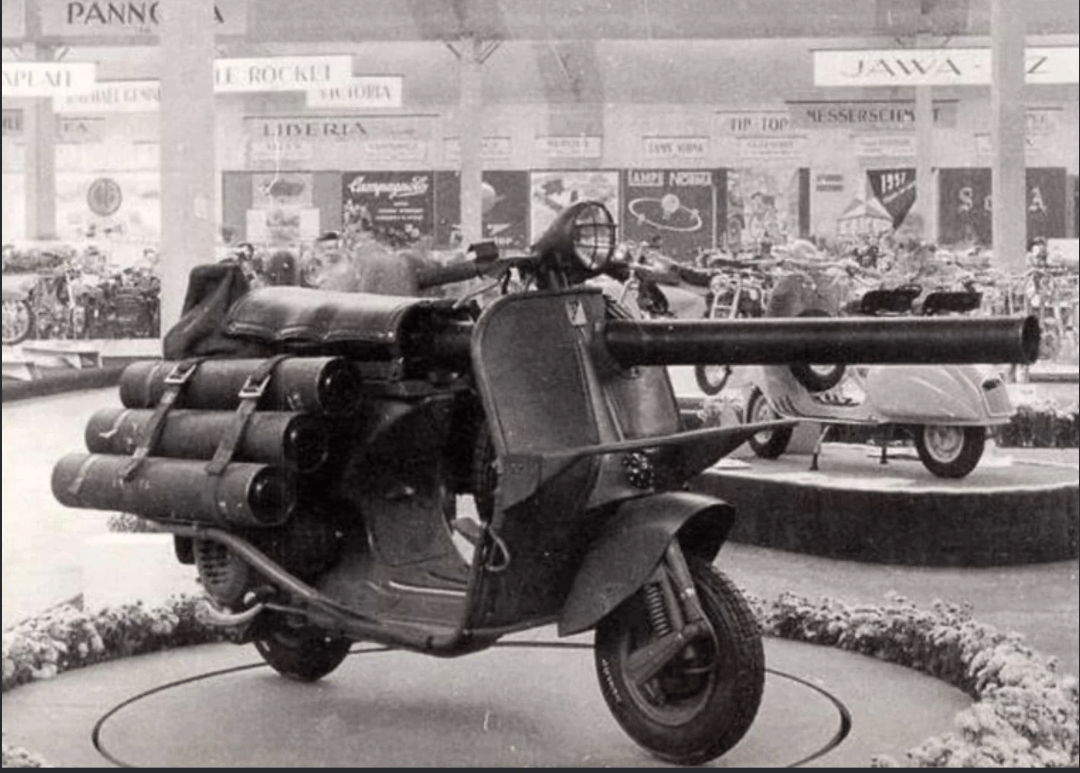
Anti-tank scooter made in the 1950s from a Vespa scooter for use with French paratroops
Title: Vespa 150 TAP: The Bizarre Anti-Tank Scooter Built for French Paratroopers in the 1950s
Meta Description: Discover the story of the Vespa 150 TAP, a scooter-mounted anti-tank weapon designed for French paratroopers in the 1950s. Explore its specs, history, and military legacy.
Introduction: When Scooters Went to War
Imagine a Vespa scooter—synonymous with Italian style and urban mobility—reimagined as a battlefield weapon capable of taking out tanks. This isn’t science fiction; it’s the real story of the Vespa 150 TAP, a quirky yet lethal military vehicle developed in the 1950s for France’s elite paratrooper forces. Combining portability, firepower, and Cold War ingenuity, this anti-tank scooter remains one of history’s most unconventional military innovations.
In this article, we’ll dive into the history, design, and legacy of the Vespa 150 TAP—proof that necessity truly is the mother of invention.
The Birth of the Anti-Tank Scooter: Cold War Context
Following World War II, France faced the challenge of modernizing its military for new conflicts, including colonial wars in Indochina and Algeria. Paratroopers needed lightweight, air-droppable vehicles to rapidly deploy behind enemy lines. Enter the Vespa 150 TAP (Truppe Aero Paracadutate or “Airborne Troops”)—a collaboration between French defense planners and Italian manufacturer Piaggio.
Key drivers behind the design:
- Portability: Paratroopers required equipment that could be parachuted and assembled quickly.
- Firepower: Infantry needed anti-tank capabilities to counter armored threats.
- Cost-Effectiveness: Scooters were cheaper than jeeps and easier to maintain.
Design & Specifications: A Scooter With a Killer Punch
The Vespa 150 TAP looked like a standard civilian scooter—until you noticed the American-made M20 75mm recoilless rifle strapped to its frame. Here’s how it worked:
Technical Specs
- Base Model: Modified Vespa 150cc two-stroke engine.
- Weight: ~115 kg (empty) / 150 kg (loaded with weapon & ammo).
- Max Speed: ~60 km/h (37 mph)—fast enough for hit-and-run tactics.
- Armament: M20 75mm recoilless rifle (range: 7 km / 4.3 miles).
- Crew: 2 soldiers (driver + gunner).
How It Worked
- The M20 rifle was disassembled and mounted on the scooter’s reinforced chassis.
- Upon landing, paratroopers would reassemble the weapon in minutes.
- The recoilless design allowed the rifle to fire armor-piercing shells without flipping the scooter.
- Ammo was carried in sidecars or backpacks (six rounds max).
Drawbacks
While innovative, the Vespa 150 TAP had flaws:
- Stability Issues: Firing the M20 destabilized the lightweight frame.
- Limited Protection: No armor left crews exposed to return fire.
- One-Shot Wonder: Reloading was slow, making follow-up shots risky.
Operational History: Did It Work in Combat?
Around 800 Vespa 150 TAPs were produced between 1956–1959, primarily for use in Algeria and Indochina. However, their combat effectiveness was mixed:
- Mobility Success: Scooters excelled in rough terrain, allowing paratroopers to ambush enemy convoys.
- Firepower Shortcomings: The M20 rifle struggled against newer Soviet tanks like the T-54.
- Psychological Impact: The sheer absurdity of a scooter attacking tanks reportedly demoralized adversaries.
By the early 1960s, advances in rocket launchers (like the RPG-7) rendered the Vespa obsolete. Most were scrapped, though a handful survive in museums today.
Why the Vespa 150 TAP Still Matters
The Vespa 150 TAP is more than a historical oddity; it reflects a unique era of military experimentation. Here’s why it’s still celebrated:
- Airborne Flexibility: Proved small vehicles could deliver heavy firepower to remote battlefields.
- Pop Culture Icon: Featured in documentaries, video games (Call of Duty), and model kits.
- Engineering Creativity: A symbol of Cold War “MacGyver” innovation—turning civilian tech into weapons.
Where to See the Vespa 150 TAP Today
Only a few models survived:
- Musée des Troupes de Marine (France)
- Museum of Army Engineering (UK)
- Private Military Collections: Occasionally auctioned for $30,000+ due to rarity.
Conclusion: The Scooter That Tried to Kill Tanks
The Vespa 150 TAP remains a testament to Cold War desperation and ingenuity. While it never revolutionized warfare, this anti-tank scooter captured imaginations worldwide—proof that even a humble Vespa could become a weapon when nations needed it most.
Today, the Vespa 150 TAP is a prized relic for military historians and vintage vehicle enthusiasts alike, embodying an era when armies thought way outside the box.
Keywords for SEO: Vespa 150 TAP, anti-tank scooter, French paratrooper scooter, military Vespa, 1950s military vehicles, M20 recoilless rifle, Cold War weapons, Piaggio military scooter, Vespa 150 TAP specs.
Image Suggestions (for user implementation):
- Vespa 150 TAP with mounted M20 rifle.
- French paratroopers assembling a scooter post-drop.
- Comparison of Vespa 150 TAP vs. modern anti-tank weapons.
By blending historical depth, technical specs, and engaging storytelling, this article targets military history enthusiasts, vintage vehicle collectors, and SEO traffic searching for quirky Cold War innovations.