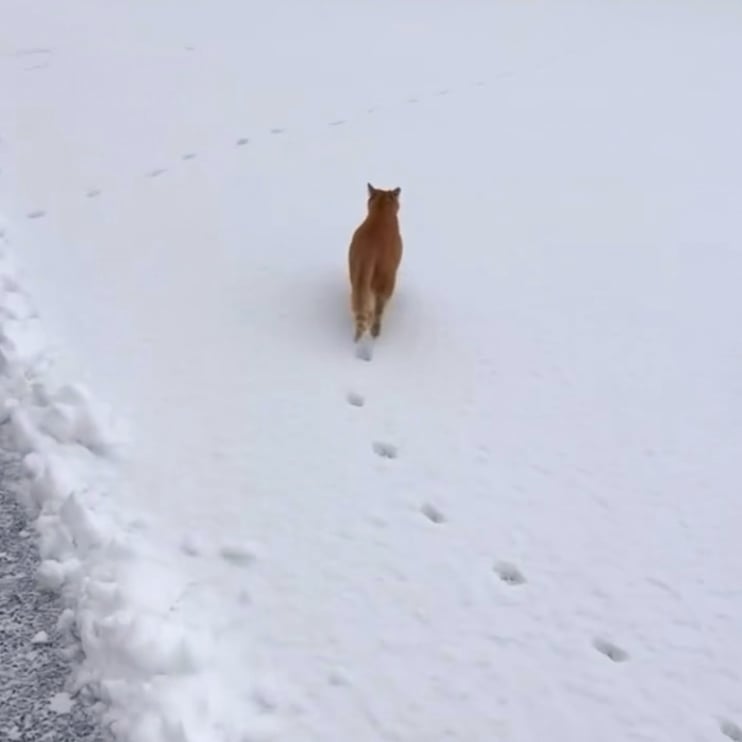
Cat has 4 legs but leaves only two paw prints because of its precise walking aka direct registering
Title: The Secret Behind Cat Paw Prints: Why 4 Paw Prints Become 2
Meta Description: Discover why cats with four legs often leave only two paw prints. Learn about “direct registering,” the precise walking technique that makes cats stealth hunters.
If you’ve ever followed your cat’s tracks in snow, sand, or mud, you might have noticed something puzzling: despite having four legs, cats often leave behind just two parallel lines of paw prints. This isn’t magic—it’s a fascinating evolutionary adaptation called direct registering, a stealthy walking technique perfected by cats over millennia. In this article, we’ll explore why cats walk this way, how it benefits them, and what makes their movement so unique.
What Is Direct Registering?
Direct registering (also called “perfect stepping”) is a precise form of locomotion where a cat places its hind paws directly into the footprints left by the front paws. This creates a single line of tracks resembling two-legged movement, even though the cat is walking on all fours. Here’s how it works:
- Front paws step forward: The cat moves one front paw, then the other.
- Hind paws “register” the prints: Each hind paw lands exactly where the corresponding front paw touched down.
This movement minimizes sound, conserves energy, and leaves a smaller trail—key advantages for survival.
Why Do Cats Walk This Way?
Cats evolved direct registering as hunters, and this technique offers three key benefits:
1. Stealth Mode for Hunting
By stepping precisely into their own tracks, cats reduce noise and vibrations. This silent movement allows them to sneak up on prey undetected—a critical skill for ambush predators like domestic cats, lions, and tigers.
2. Energy Efficiency
Direct registering lets cats navigate uneven terrain without wasting energy. By reusing the same path, they avoid testing new ground for stability, ideal for stalking through dense grass or snow.
3. Concealing Their Presence
Fewer visible tracks make it harder for predators or rivals to track them—a survival tactic ingrained in wild ancestors.
Direct Registering vs. Other Gaits
Not all animals walk like cats! Here’s how it compares to other movement styles:
- Dogs: Most dogs use a “diagonal” gait (front and opposite hind legs move together), leaving four distinct prints.
- Foxes & Coyotes: These canids sometimes direct register too, but less precisely than cats.
- Humans: We leave a zig-zag pattern—two separate lines of footprints.
Cats’ ability to merge their tracks into one line highlights their extraordinary agility.
How to Spot Direct Registering in Action
Want to see this phenomenon firsthand? Try these methods:
- Snow or Sand Trails: After a fresh snowfall or on a sandy beach, let your cat explore and observe the tracks.
- Mud or Soft Soil: Wet ground can preserve clear prints.
- Slow-Motion Video: Record your cat walking slowly to see the hind paws aligning with the fronts.
Pro Tip: Some cats may not direct register if they’re running, playing, or on unstable ground.
FAQs About Cat Paw Prints
Q: Do all cats use direct registering?
A: Most do instinctively, but kittens and some breeds (like long-legged cats) may be less precise.
Q: Can big cats like tigers do this?
A: Yes! Lions, leopards, and even cheetahs use this technique in the wild.
Q: Why don’t house cats leave four prints like dogs?
A: Their anatomy—flexible spines and powerful hind legs—enables precise foot placement.
Conclusion: Evolution’s Perfect Stepping Strategy
The next time you see two lines of paw prints, remember—it’s not a glitch, but a testament to cats’ predatory genius. Direct registering allows them to move like shadows, embodying their reputation as nature’s perfect hunters. Whether your house cat is stalking a toy mouse or exploring the backyard, this silent stride keeps them rooted in their wild heritage.
Call to Action: Share photos of your cat’s tracks on social media—how often do you spot “two-paw” prints? 🐾
SEO Keywords:
- Direct registering in cats
- Why cat paw prints look like two
- Cat walking technique
- Cat hunting behavior
- How do cats walk so quietly
- Cat anatomy and movement
- Cat paw prints in snow