Cymatics ( the study on visible sound waves)
Meta Title: Cymatics: Seeing Sound Waves in Action – The Science of Visible Vibrations
Meta Description: Explore the fascinating world of cymatics, the study of visible sound waves. Discover how vibrations create mesmerizing patterns and their applications in art, science, and healing.
Cymatics: The Mesmerizing Science of Visible Sound Waves
Have you ever imagined seeing sound? Thanks to cymatics—the study of visible sound and vibration—we can visualize the hidden geometric patterns created by sound waves. This intersection of science, art, and mysticism reveals how frequencies shape matter, offering insights into everything from music therapy to universal geometry.
What Is Cymatics?
Cymatics (from the Greek kyma, meaning “wave”) is the science of making sound waves visible. By transmitting sound frequencies through mediums like water, sand, or powders, researchers observe intricate patterns that form in response to vibrations. These visible sound waves unveil the organizing power of resonance, demonstrating how energy influences physical form.
A Brief History: From Chladni to Modern Research
The Chladni Patterns (18th Century)
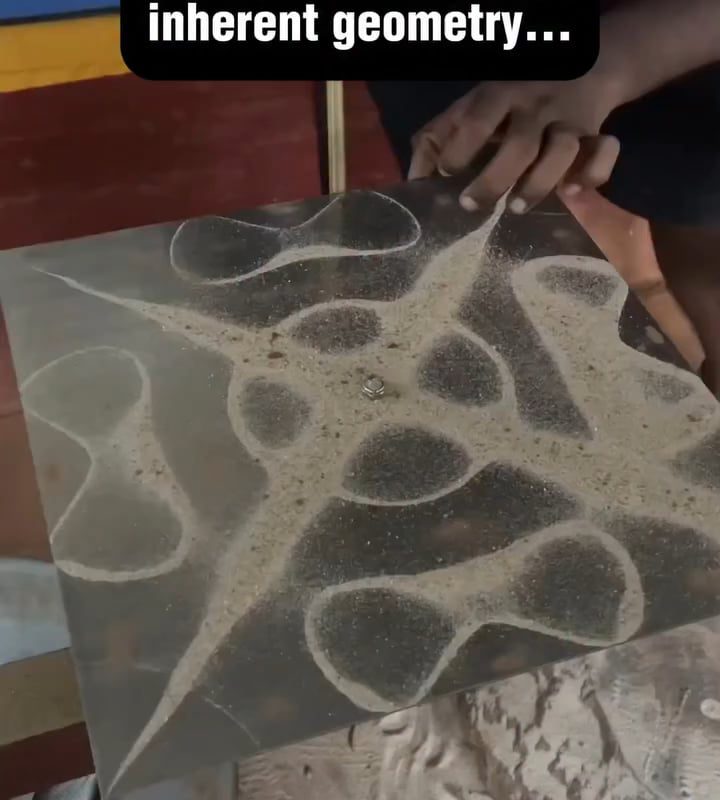
German physicist Ernst Chladni pioneered cymatics in 1787 by sprinkling sand onto metal plates and vibrating them with a violin bow. High-frequency sounds caused the sand to shift into symmetrical patterns, now called Chladni figures. These findings proved that sound directly shapes matter—a revelation that bridged acoustics and visual art.
Hans Jenny’s Contributions (20th Century)
In the 1960s, Swiss doctor Hans Jenny coined the term “cymatics” and expanded Chladni’s work. Using specialized machines, he filmed how liquids, pastes, and powders formed dynamic shapes—like mandalas, spirals, and fractals—at specific frequencies. His book Cymatics: A Study of Wave Phenomena remains a cornerstone of the field.
Modern Explorations
Today, tools like tonoscopes (frequency generators) and high-speed cameras let scientists and artists dive deeper. Researchers such as John Stuart Reid use cymatics to study coral communication, while musicians like Nigel Stanford create viral “sound visualizations” in music videos.
How Cymatics Works: The Physics of Sound Made Visible
Sound waves travel as vibrations, creating areas of high pressure (peaks) and low pressure (troughs). When these waves interact with a physical medium:
- Frequency: Determines the pattern’s complexity (e.g., low frequencies create simple circles; high frequencies form intricate geometries).
- Amplitude: Affects the pattern’s size and intensity.
- Medium: Water highlights fluid dynamics, while granular materials like salt reveal rigid, fractal-like structures.
Famous Cymatic Patterns:
- Flower of Life: Sacred geometry emerges at 111 Hz.
- Hexagons: Common in nature (e.g., honeycombs), appearing at mid-range frequencies.
- Chaotic Motion: Low frequencies often create disordered patterns before order emerges.
Applications of Cymatics: Beyond the Lab
1. Music & Arts
Musicians and visual artists use cymatics to blend sound with striking visuals. From album covers to live performances, pattern-based art inspired by frequencies captivates audiences.
2. Medical & Therapeutic Uses
Sound healers leverage frequencies (e.g., 432 Hz or 528 Hz) believed to promote relaxation. Although debated, studies explore cymatics’ potential in directing sound waves for targeted tissue therapy.
3. Scientific Research
- Molecular Biology: Studying how vibrations influence cell formation.
- Archaeology: Testing whether ancient monuments like Stonehenge were designed using acoustic resonance.
4. Education
Cymatics makes physics tangible for students, illustrating abstract concepts like frequency, resonance, and wave interference.
Try It Yourself: DIY Cymatics Experiment
You don’t need a lab to explore cymatics!
Materials:
- A metal plate or speaker
- Sand, salt, or water
- A tone generator app (or singing bowl)
Steps:
- Place the plate on a speaker or hold it firmly.
- Sprinkle sand or pour a thin layer of water.
- Play tones (e.g., 100 Hz, 500 Hz) and watch patterns form!
Need inspiration? Search “cymatics DIY” on YouTube for mesmerizing examples.
The Future of Cymatics: Bridging Science and Spirituality
Cymatics sits at a crossroads of hard science and metaphysical curiosity. While skeptics demand empirical proof, enthusiasts see it as evidence of a “vibrational universe”—where everything from atoms to galaxies resonates with hidden harmonies. Upcoming research areas include:
- Acoustic Levitation: Using sound waves to manipulate objects.
- Architectural Acoustics: Designing spaces with resonance-based shapes.
Conclusion: Sound as a Universal Architect
Cymatics reveals the unseen beauty of sound, transforming noise into breathtaking art and offering clues about nature’s deepest designs. Whether you’re a scientist, artist, or curious explorer, this field invites you to see the music of the universe.
Further Reading:
- Cymatics: A Study of Wave Phenomena by Hans Jenny
- The Cymascope (cymatics imaging tool): Cymascope.com
Keywords: Cymatics, visible sound waves, Chladni patterns, sound visualization, frequency patterns, Hans Jenny, sound healing, resonance experiments, vibrational science.
Optimize your website with this guide to captivate audiences searching for “what is cymatics,” “sound wave patterns,” or “how to see sound.” 📡🎨🔊