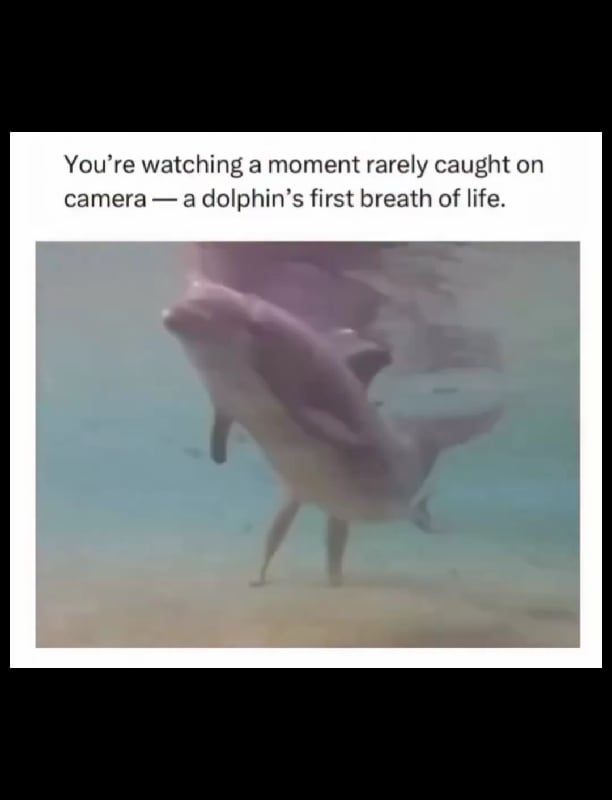
Dolphin’s first breath of life.
Title: Dolphin’s First Breath of Life: A Survival Miracle Unfolds
Meta Description: Discover how newborn dolphins take their first breath in a thrilling race against time. Explore the science, instincts, and marvels of this aquatic adaptation.
Introduction: A Dangerous Transition
Dolphins, beloved for their intelligence and playful nature, are born into a world where life begins with a perilous gamble: the first breath. Unlike human babies, who breathe automatically upon birth, dolphin calves must consciously reach the ocean’s surface to gulp air—or face drowning. This dramatic moment blends instinct, biology, and maternal care into a survival spectacle. In this article, we dive into the science behind a dolphin’s first breath and how it defines their aquatic existence.
The Birthing Process: A Race to the Surface
Dolphin births happen quickly, often in under two hours. The calf emerges tail-first to prevent suffocation, guided by the mother’s powerful contractions. Once free, the newborn faces its first critical task:
- Immediate Ascent: Within 10–30 seconds, the calf swims (or is nudged) to the surface.
- First Breath: Using its blowhole—a specialized nostril atop its head—the calf exhales seawater and inhales oxygen-rich air.
- Rapid Adaptation: Neonatal dolphins instinctively know to open their blowholes, a feat made possible by muscle memory encoded through evolution.
This process repeats every 3–5 minutes for newborns, compared to adult dolphins’ 10–15 minute intervals.
Why Breathing Isn’t Automatic for Dolphins
As marine mammals, dolphins breathe voluntarily, unlike humans or terrestrial animals. Their brains actively control each breath, meaning even newborns must “decide” to surface. Factors enabling this include:
Neonatal Swimming Reflex
A calf can swim from birth, aided by buoyancy from its blubber-rich body and instinctive paddling motions.
Maternal Support
The mother (and sometimes “auntie” dolphins in the pod) pushes the calf upward, teaches it to locate the surface, and protects it from predators.
Blowhole Mechanics
Newborns develop strong blowhole musculature in the womb, allowing them to seal it underwater and open it upon surfacing.
The Risks & Evolutionary Triumphs
Nearly 20% of dolphin calves do not survive infancy, often due to complications during or immediately after birth. Challenges include:
- Stillbirths from umbilical cord entanglements.
- Predator threats like sharks during vulnerable early moments.
- Human impacts, such as pollution or boat strikes.
Yet, evolution has equipped dolphins with remarkable adaptations:
- Echolocation: Mothers use clicks and whistles to guide calves.
- Fat-rich milk: High-calorie nourishment fuels rapid growth and strength.
- Pod protection: Social structures shield newborns during their critical first weeks.
The Science of “Live Birth” in Water
Dolphins are placental mammals, meaning they share key birthing traits with humans but face unique hurdles:
- No Gills: Unlike fish, dolphins lack gills and rely solely on lungs.
- Diving Reflex: Calves suppress breathing underwater—a trait that optimizes oxygen use.
- Thermal Shock: Warm-bodied newborns adjust to cooler ocean temperatures rapidly.
Conservation & Human Impact
Understanding a dolphin’s first breath highlights their fragility. Threats like ocean plastics, noise pollution, and habitat loss disrupt birthing cycles and maternal bonds. Conservation efforts—such as marine protected areas and responsible wildlife tourism—can safeguard these critical moments.
Conclusion: A Breath That Echoes Through Life
A dolphin’s first breath is more than a biological milestone—it’s a testament to nature’s ingenuity. From voluntary breathing to pod solidarity, this process ensures the survival of one of the ocean’s most charismatic species. By protecting marine ecosystems, we give future dolphin calves the chance to surface, breathe, and thrive.
Keywords for SEO: dolphin first breath, dolphin birth process, how do dolphins breathe, newborn dolphin survival, marine mammal adaptations, dolphin blowhole function, dolphin conservation.
Engage with marine conservation initiatives to protect dolphins worldwide. Share this article to spread awareness!
![A city with the stars as their only light [Credit:Thierry Cohen]](https://www.smartplusmedia.com/wp-content/uploads/2026/02/A-city-with-the-stars-as-their-only-light-CreditThierry-445x265.png)