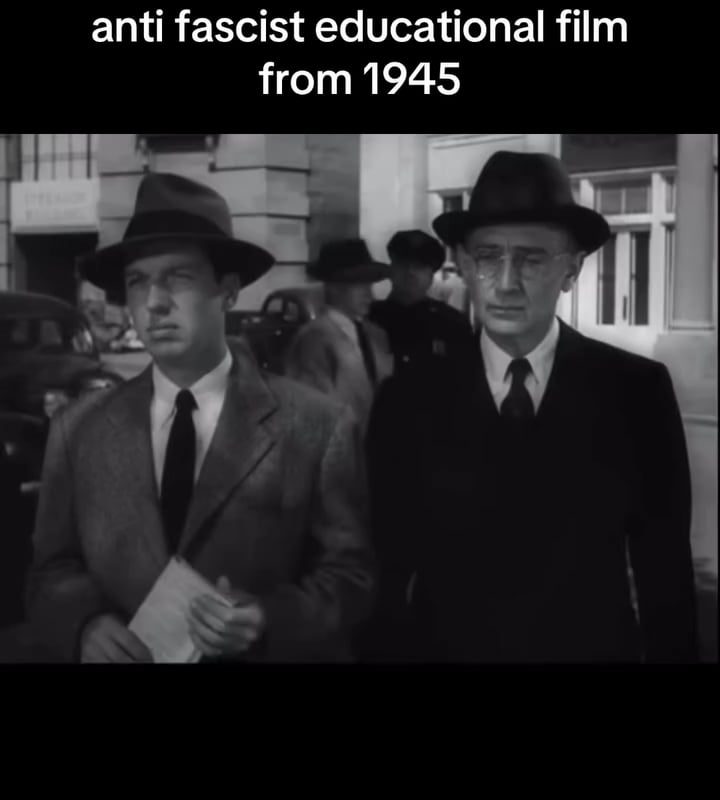
“Don’t be a sucker”, a film made in 1943 by the US Department of War, showing how fascists weaponize prejudice to divide and take over nations.
Title: “Don’t Be a Sucker” (1943): The US War Department’s Timeless Warning Against Fascism & Propaganda
Meta Description: Discover the 1943 U.S. War Department film “Don’t Be a Sucker” – a chilling guide to how fascists exploit prejudice to divide nations. Learn why it’s more relevant today than ever.
Introduction: A Film Ahead of Its Time
In 1943, amid the chaos of World War II, the U.S. Department of War (now the Department of Defense) released a short film titled “Don’t Be a Sucker” to educate Americans about the dangers of fascist rhetoric and propaganda. Decades later, this 17-minute masterpiece remains a jaw-droppingly relevant dissection of how authoritarian leaders weaponize prejudice, fear, and division to seize power.
As extremism and polarization surge globally, “Don’t Be a Sucker” serves as both a history lesson and a survival guide for democracies. This article breaks down the film’s message, its historical context, and its urgent warning for modern society.
The Plot: How Fascism Preys on the Divided
The film opens with an American man (an everyman figure) listening to a street speaker ranting against minority groups—including immigrants, Freemasons, and Black Americans. Seduced by the speaker’s blame-shifting narrative, the man nods along until a Hungarian refugee intervenes.
The refugee, who survived Nazi violence in Europe, delivers the film’s core message: “I have seen this happen in Germany… First, they came for the socialists, then the Jews, then the unions. I was too quiet, so now I have no one left.” He explains how dictators rise by targeting marginalized groups, framing them as threats to “real citizens,” and convincing ordinary people to turn against each other.
Key takeaways from the plot:
- The “Divide and Conquer” Playbook: Fascists inflame existing prejudices to fracture solidarity.
- The Sucker’s Trap: Those who blindly follow hateful rhetoric become tools in their own oppression.
- Unity as Resistance: Protecting civil rights for all groups safeguards democracy itself.
Historical Context: America’s Preemptive Strike Against Fascist Ideology
Made two years after Pearl Harbor, “Don’t Be a Sucker” reflected the U.S. government’s fear that fascist tactics could infiltrate American society despite their fight against it overseas. The film was part of a broader campaign to counter:
- Racial Tensions: Segregation and antisemitism still plagued the U.S. in the 1940s.
- Far-Right Movements: Groups like the German-American Bund had openly supported Hitler.
- Wartime Paranoia: Japanese-American internment camps demonstrated how fear erodes rights.
Ironically, after WWII ended, the film was recut during the Cold War to frame communism (instead of fascism) as the new threat—proving its messaging could adapt to any ideology exploiting division.
The 7 Tactics of Fascism Exposed in the Film
“Don’t Be a Sucker” spotlights strategies still used by authoritarian movements today:
- Fearmongering Against “Others”: Vilifying minorities as enemies of the nation.
- Scapegoating: Blaming complex problems on vulnerable groups (e.g., immigrants, activists).
- Propaganda Over Truth: Using emotional lies to override facts.
- Suppressing Opposition: Silencing dissent by labeling critics as “unpatriotic.”
- Promoting “Us vs. Them”: Defining citizenship through exclusion (religion, race, or ideology).
- Appeals to Nostalgia: Promising a return to a mythical “glorious past.”
- Exploiting Economic Anxiety: Redirecting anger toward marginalized communities.
The film’s Hungarian character warns: “When they take away your neighbor’s rights, yours will be next.”
Why “Don’t Be a Sucker” Is Shockingly Relevant Today
From rising white nationalism to conspiracy theories on social media, the film’s lessons resonate powerfully in 2024:
- Echoes in Modern Politics: Populist leaders worldwide use identical tactics—scapegoating minorities, attacking the press, and undermining democratic norms.
- Social Media as the New Street Corner: Online algorithms amplify divisive content, mirroring the film’s manipulative orators.
- A Civic Toolkit: The film teaches viewers to recognize propaganda and refuse complicity.
Organizations like the Anti-Defamation League (ADL) and Southern Poverty Law Center (SPLC) have screened “Don’t Be a Sucker” in recent years as a primer on resisting extremism.
Where to Watch the Film Today
As a U.S. government production, “Don’t Be a Sucker” is in the public domain. You can view it for free on:
- YouTube (uploaded by official archives, including the U.S. National Archives)
- Internet Archive (archive.org)
- Educational platforms like Teaching Tolerance or Kanopy
Conclusion: Don’t Be a Sucker—A Call to Vigilance
Eighty years after its release, “Don’t Be a Sucker” remains a masterclass in recognizing and resisting authoritarianism. Its warning is clear: democracies fall when people trade solidarity for scapegoats.
In an era of misinformation and fractured trust, the film challenges us to ask:
- Who benefits when we turn against each other?
- Are we falling for the same tricks that doomed nations in the past?
Watch the film. Share it. Discuss it. As the refugee implores: “It’s not too late—unless you let them fool you.”
Keywords for SEO:
Don’t Be a Sucker film, 1943 anti-fascist movie, US War Department propaganda, how fascists use prejudice, fascist propaganda tactics, lessons from Don’t Be a Sucker, resisting authoritarianism, divide and conquer strategies.
Internal Linking Opportunities:
- Articles on WWII propaganda
- Guide to spotting authoritarian tactics
- Historic speeches on unity (e.g., MLK, Roosevelt)
By revisiting this forgotten gem, we arm ourselves against the oldest trick in the dictator’s handbook: making suckers of us all.