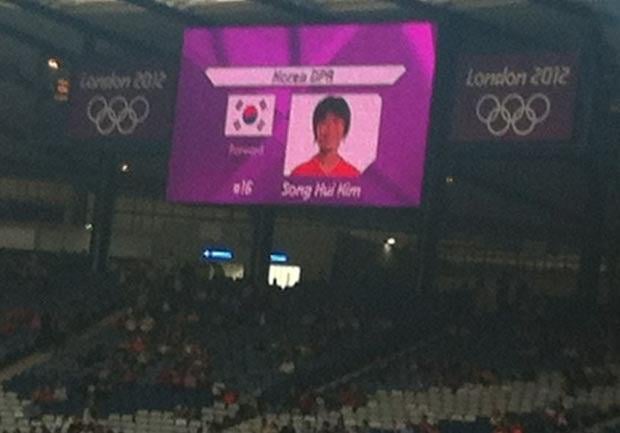
During the 2012 Olympics, the North Korean women’s football team walked off the pitch in protest before a match, after the players noticed that their faces were being pictured alongside the South Korean flag
Title: The 2012 Olympic Flag Fiasco: When North Korea’s Football Team Walked Off Over a South Korean Flag
Meta Description: Uncover the dramatic moment North Korea’s women’s football team protested at the 2012 Olympics after a flag mix-up, exposing deep-rooted political tensions.
Introduction: A Match Delayed by Diplomacy
The 2012 London Olympics were meant to celebrate global unity through sport. Yet, for one brief, chaotic moment, the women’s football tournament became a flashpoint for decades-old geopolitical friction. On July 25, 2012, the North Korean women’s football team stormed off the pitch ahead of their group-stage match against Colombia—not due to foul play or poor conditions, but because a glaring error on the stadium screen had paired their players’ faces with the South Korean flag.
This incident, which delayed the game by over an hour, highlights how even small symbolic oversights can ignite powerful reactions in the volatile context of inter-Korean relations.
The Incident: A Flag Error Sparks Fury
Minutes before kickoff at Glasgow’s Hampden Park, the North Korean team noticed a grave error on the stadium’s large screens. While introducing their starting lineup, the graphics displayed each player’s photo alongside the flag of South Korea—the blue-and-red Taegeukgi, not North Korea’s red-starred Ramhongsaek Konghwagukgi.
For North Korea, a country fiercely protective of its sovereignty and locked in a bitter rivalry with the South since the 1950–53 Korean War, this was unacceptable. Players immediately refused to take the field, forcing organizers into crisis mode.
The Fallout
- The match was delayed by 68 minutes as officials scrambled to apologize and correct the flag.
- North Korea’s coach, Sin Ui-Gun, declared the error “unforgivable,” stating it disrespected their national identity.
- The match proceeded only after assurances that the correct flag would be displayed. North Korea went on to win 2–0.
Behind the Symbolism: Why the Flag Mix-Up Mattered
To outsiders, the two Koreas’ flags might seem similar, but their distinctions carry immense weight. North Korea’s flag features a red star (symbolizing communism) and blue stripes (sovereignty and peace), while South Korea’s centers a taegeuk (yin-yang) and four trigrams (cosmic principles).
A History of Sensitivity
- National Identity: For North Korea, the flag is a sacred emblem of its Juche ideology and resistance to external pressure.
- Ongoing Tension: The two Koreas remain technically at war, with no peace treaty signed after the Korean War. Sports events often become political battlegrounds.
- Past Precedents: In 2010, North Korea’s men’s team walked out of a World Cup qualifier in Seoul when South Korean fans waved unification flags.
The London Olympics incident mirrored these sensitivities. Even innocuous mistakes can resurface deep-seated grievances between the two nations.
The Organizers’ Response and Lessons Learned
London 2012 organizers swiftly apologized, attributing the error to human oversight by a graphics operator. A spokesperson stressed:
“We sincerely apologize for the error. Correct national flags are of paramount importance.”
Broader Implications for International Sports
- Protocol Precision: The incident underscored the need for rigorous checks on national symbols at global events.
- Politics vs. Sport: Despite the Olympic Charter’s call for neutrality, politics often intrude—especially in Korea’s case.
- Détente Efforts: In rare moments, sports have bridged divides (e.g., the unified Korean teams at the 2018 Winter Olympics), but mistrust persists.
Aftermath: North Korea’s Performance and Legacy
After the flag was corrected, the North Korean team defeated Colombia and advanced to the quarterfinals, where they lost to France. While the protest dominated headlines, their campaign demonstrated resilience—both on and off the pitch.
Key Takeaways
- Symbols Matter: National flags represent identity, history, and pride—especially for nations in conflict.
- Sport as a Political Stage: The Olympics often amplify geopolitical struggles, even inadvertently.
- Zero Room for Error: Organizers must ensure cultural and political accuracy to avoid protests or boycotts.
Conclusion: When a Flag Became a Flashpoint
The 2012 Olympics flag controversy was more than a technical glitch—it exposed the raw nerves of inter-Korean relations. While the North Korean team’s walkout delayed a match, it also highlighted how sports can unintentionally magnify the world’s most intractable divides. A lesson in symbolism, sensitivity, and the power of protocol, the incident remains a cautionary tale for future global events.
Keywords for SEO:
North Korea 2012 Olympics protest, South Korean flag mix-up, North Korean women’s football team, inter-Korean tensions, London 2012 controversies, geopolitical sports incidents, Olympic flag errors.
By blending historical context with real-time drama, this article explores how a single misstep in 2012 laid bare the enduring rift between two nations—on and off the football field.