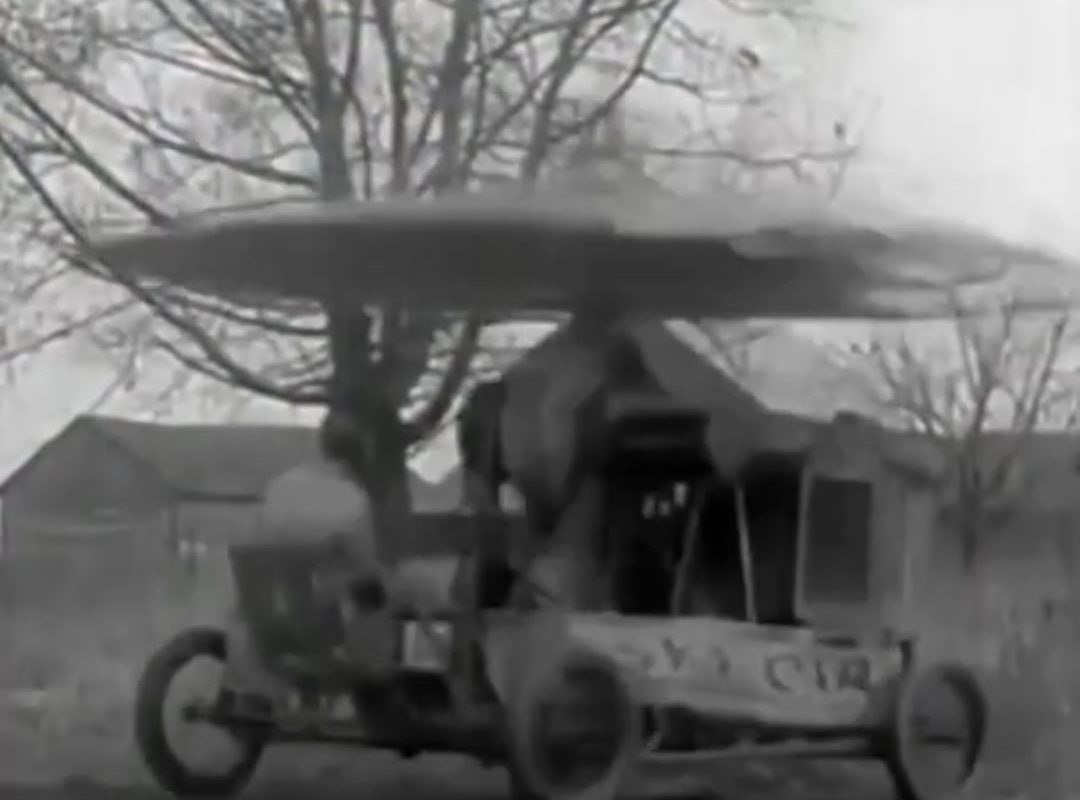
Early attempts at creating a helicopter. The Pitts Sky Car Back in the 1920s, John W. Pitts had a wild dream of vertical flight. The famous Pitts Sky Car. The Design: It featured a massive circular rotor with sixty hinged blades
Title: The Pitts Sky Car: John W. Pitts’ Wild 1920s Helicopter Dream
Introduction
In the 1920s, aviation pioneers were racing to conquer the skies, not just with airplanes but with revolutionary vertical-flight machines. Among these visionaries was John W. Pitts, whose Pitts Sky Car stands as one of history’s most ambitious—and unconventional—early attempts at building a functional helicopter. Though it never took flight, this experimental aircraft embodied the daring spirit of innovation that defined the era. Discover how the Sky Car’s bizarre design, featuring a gargantuan rotor with sixty hinged blades, pushed the boundaries of aeronautics.
John W. Pitts and the Dream of Vertical Flight
John W. Pitts was an engineer driven by a radical idea: a personal aircraft that could lift off vertically, hover, and land anywhere—decades before the helicopter became a reality. Inspired by inventors like Leonardo da Vinci and Igor Sikorsky, Pitts envisioned the Sky Car as a “flying automobile” for the masses. In an era dominated by biplanes, his concept was equal parts revolutionary and audacious.
The Pitts Sky Car: A Design Unlike Any Other
The Sky Car’s most striking feature was its massive circular rotor system, which spanned over 15 feet in diameter. Unlike modern helicopters with 2-6 rigid blades, Pitts’ design incorporated sixty hinged blades made of lightweight wood and fabric. The blades were arranged in concentric rings, theoretically allowing for greater lift and stability through complex aerodynamics.
Key design elements included:
- Radial Engine Integration: A centrally mounted engine powered the rotor via a series of gears and driveshafts.
- Simplified Control System: Pilots would steer using levers and pedals linked to the rotor’s pitch mechanism.
- Open Cockpit: The pilot sat exposed beneath the rotor, a design choice that prioritized weight reduction over safety.
Pitts believed the multiple blades would distribute lift evenly, eliminating the need for a tail rotor. However, this complexity also made the Sky Car mechanically fragile and prone to imbalance.
Why the Sky Car Never Flew
Despite Pitts’ relentless experimentation, the Sky Car faced insurmountable challenges:
- Material Limitations: 1920s engineering lacked lightweight, durable alloys needed to handle the rotor’s stress.
- Control Chaos: Sixty hinged blades created unpredictable turbulence, making stable hover impossible.
- Power Deficit: Early engines couldn’t generate sufficient torque to lift the aircraft vertically.
- Safety Risks: The open rotor design endangered pilots, earning it the nickname “the flying Cuisinart.”
By the late 1920s, Pitts abandoned the project. The sole prototype, now lost to history, likely never left the ground.
Legacy: The Sky Car’s Impact on Aviation
Though a failure, the Pitts Sky Car contributed to helicopter evolution:
- Blade Innovation: Its hinged-blade concept influenced later designs like the autogyro.
- VTOL Vision: Pitts’ dream of vertical takeoff/landing (VTOL) foreshadowed modern drones and air taxis.
- Inspiration: Engineers learned from its flaws, paving the way for Sikorsky’s successful VS-300 in 1939.
As Igor Sikorsky himself noted: “True innovation often begins as a failure—and ends as a foundation.”
More Early Helicopter Prototypes to Explore
- de la Cierva Autogiro (1923): Used unpowered rotors for lift, inspiring later gyrocopters.
- Cornu Helicopter (1907): The first manned rotary-wing aircraft (but only hovered briefly).
- Focke-Wulf Fw 61 (1936): The first fully controllable helicopter.
Conclusion: The Beauty of “What If?”
The Pitts Sky Car remains a testament to humanity’s obsession with flight. While it never soared, its bold design reminds us that progress is built on daring—and sometimes disastrous—experiments. Today, as eVTOLs (electric vertical takeoff vehicles) fill headlines, John W. Pitts’ 1920s dream feels closer than ever to reality.
For more on aviation history’s forgotten pioneers, subscribe to our newsletter or explore our archives!
SEO Keywords: Pitts Sky Car, John W. Pitts, early helicopter prototypes, 1920s aviation, VTOL history, vertical flight experiments, hinged rotor blades, lost inventions.