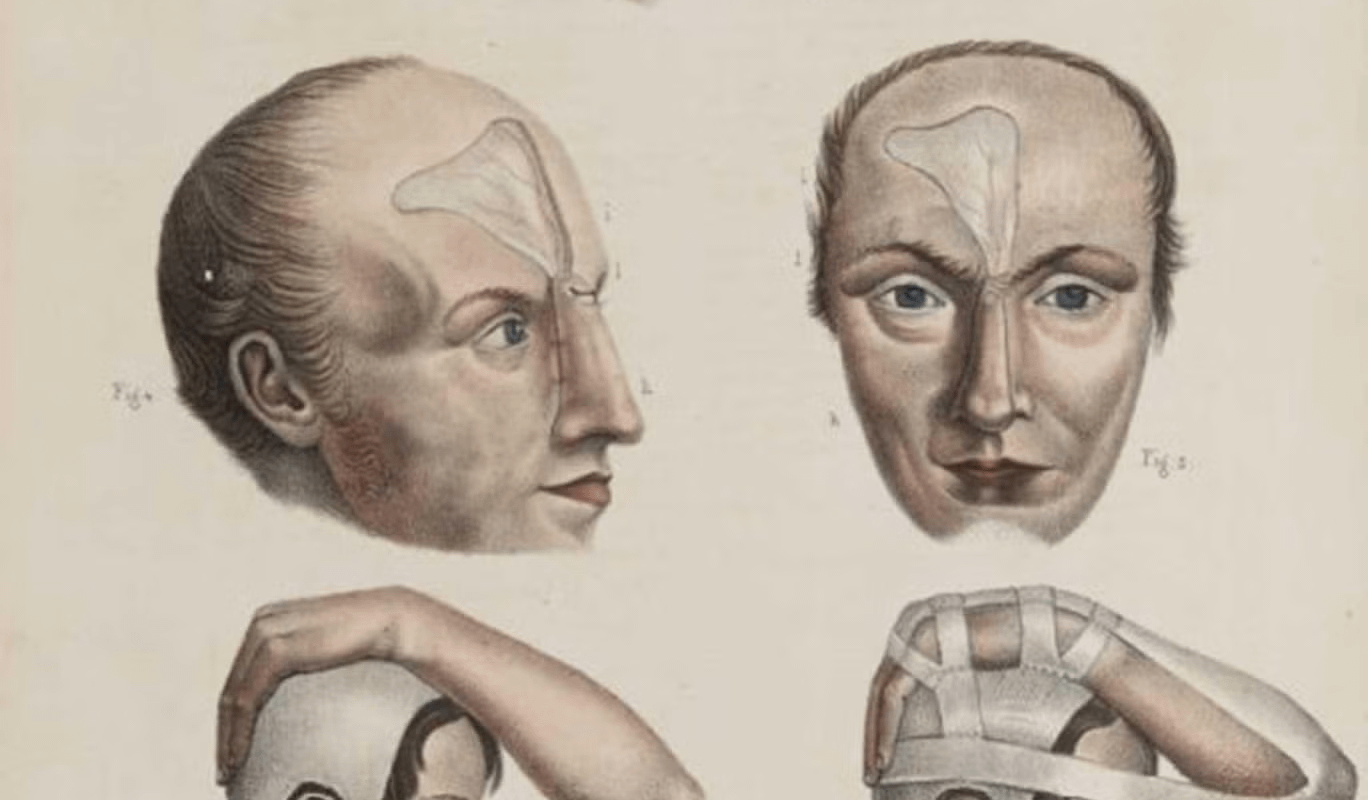
Early surgery methods to reconstruct a nose, From the book “Iconografia d’anatomia”, 1841
Title: Early Nose Reconstruction Methods: 19th-Century Surgical Artistry from “Iconographia Anatomica” (1841)
Meta Description: Explore groundbreaking early nose reconstruction techniques illustrated in Antonio Sangiovanni’s 1841 book “Iconographia Anatomica.” Discover pre-modern surgical ingenuity for rhinoplasty.
The Dawn of Reconstructive Surgery: Restoring the Nose in the 19th Century
Long before the advent of anesthesia, antibiotics, or microsurgery, early surgeons devised remarkable methods to reconstruct facial features—particularly the nose. Among the most valuable historical records documenting these techniques is Antonio Sangiovanni’s Iconographia Anatomica, published in 1841. This seminal work not only detailed human anatomy but also captured groundbreaking surgical procedures of the era, including early rhinoplasty (nose reconstruction) methods.
Here, we journey back to the mid-19th century to examine the painstaking—and often painful—art of nose restoration as illustrated in Sangiovanni’s atlas.
Why Nose Reconstruction? The Historical Context
In the 1800s, nasal injuries were tragically common. Causes included:
- Disease: Syphilis and leprosy caused tissue decay.
- Trauma: Duels, warfare, and occupational accidents.
- Punishment: Amputation of the nose as a judicial or cultural penalty.
The absence of a nose carried profound social stigma, driving demand for restorative techniques. Surgeons turned to autografts (using the patient’s own tissue), as synthetic materials and anesthesia were not yet available.
Two Pioneering Methods Illustrated in Iconographia Anatomica
Sangiovanni’s masterwork featured detailed lithographs and descriptions of two predominant nose reconstruction techniques of the time:
1. The Italian Method (Tagliacozzi Technique)
Named after Gaspare Tagliacozzi (1546–1599), this method was refined over centuries. It involved harvesting skin from the patient’s upper arm:
- Step 1: A rectangular flap of skin (with underlying tissue) was partially cut from the inner arm, leaving it attached as a “pedicle” to maintain blood flow.
- Step 2: The flap was twisted and sewn onto the nasal stump, with the arm immobilized against the head for weeks.
- Step 3: Once new blood vessels formed, the pedicle was severed, and the flap was shaped into a nose.
Challenges: Patients endured weeks of immobility, high infection risk, and scarring. Sangiovanni’s engravings vividly depicted the multi-stage process.
2. The Indian Method (Forehead Flap Rhinoplasty)
This ancient technique, revived in Europe in the 19th century, borrowed from Indian surgical traditions described in the Sushruta Samhita (600 BCE). It used forehead skin:
- Step 1: A flap of skin from the forehead was partially detached, rotated downward, and attached to the nasal remnants.
- Step 2: After healing, the flap’s base was severed from the forehead, and sculpted into nostrils and a bridge.
Advantages: The forehead’s vascularity improved survival rates compared to arm flaps. However, it left a visible scar above the eyebrows.
Limitations and Innovations of 19th-Century Rhinoplasty
Sangiovanni’s Iconographia emphasized anatomical precision but could not overcome era-specific hurdles:
- No Anesthesia: Surgeries were excruciating. Ether wasn’t widely used until the 1840s.
- Infection Risk: Sterilization (via Lister’s antiseptics) emerged decades later.
- Primitive Tools: Surgeons used knives, saws, and needles without magnification.
Despite these challenges, the techniques highlighted in Sangiovanni’s work demonstrated extraordinary anatomical ingenuity, laying groundwork for modern plastic surgery.
Legacy of Iconographia Anatomica in Medical History
Sangiovanni, an Italian anatomist, created his atlas to educate surgeons through visual precision. His depictions of rhinoplasty weren’t just technical guides—they were testaments to resilience in pre-modern medicine. Today, these methods seem crude but reveal the birth of principles still used in reconstructive surgery:
- Pedicle flaps remain essential in microsurgery.
- Autografts (self-donated tissue) are preferred for biocompatibility.
Conclusion: A Foundation for Modern Plastic Surgery
The nose reconstruction methods in Iconographia Anatomica (1841) are more than historical curiosities—they represent humanity’s relentless pursuit of healing against daunting odds. Antonio Sangiovanni’s illustrations immortalize the skill and daring of early surgeons who turned disfigurement into dignity, one painstaking suture at a time.
For medical historians, these procedures underscore how far reconstructive surgery has come, while celebrating the timeless ingenuity encoded in its origins.
Keywords: Rhinoplasty history, 19th-century surgery, Iconographia Anatomica, Antonio Sangiovanni, Tagliacozzi technique, Indian forehead flap, early plastic surgery, nose reconstruction methods.
Internal Linking Suggestions:
- [The Evolution of Plastic Surgery: From Ancient India to Modern Times]
- [Gaspare Tagliacozzi: The Renaissance Father of Reconstructive Surgery]
- [Victorian-Era Medical Instruments and Their Uses]