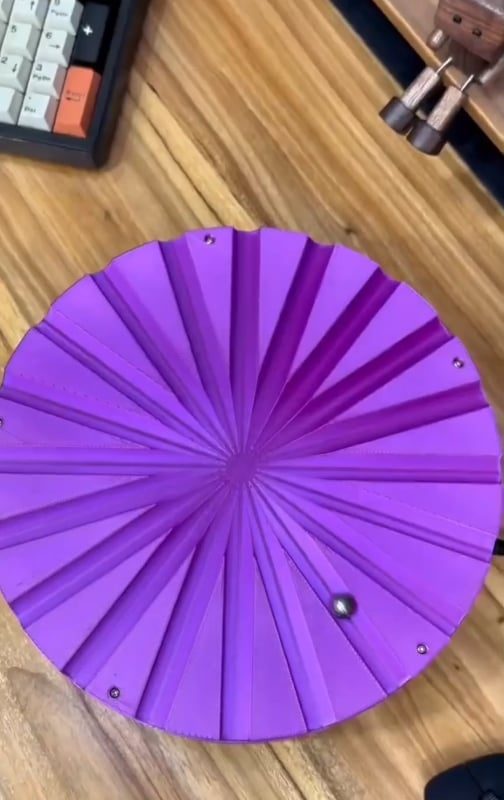
Every Sphere moves in a straight line making a perfect circle
Title: The Paradox of Motion: How Every Sphere Moves in a Straight Line Yet Creates a Perfect Circle
Meta Description: Discover the fascinating physics behind why a sphere moving in a straight line can form a perfect circle. Learn about centripetal force, tangential velocity, and real-world examples.
Introduction: A Curious Cosmic Dance
At first glance, the idea that “every sphere moves in a straight line while making a perfect circle” sounds contradictory. How can an object travel straight yet trace a circular path? This paradox lies at the heart of classical mechanics and reveals profound insights into forces, motion, and geometry. In this article, we’ll unravel how spheres—from planets to playground marbles—achieve this cosmic balancing act and why it’s essential to understanding everything from orbits to everyday physics.
The Science Behind Straight-Line Motion in Circular Paths
To resolve the paradox, we turn to Newton’s first law of motion: an object moves in a straight line unless a force acts upon it. So how does a sphere trace a circle? The answer is centripetal force, an invisible “center-seeking” force that constantly bends the sphere’s straight-line motion into a curve.
-
Tangential Velocity: The Illusion of Straight Motion
- At any instant, a sphere in circular motion moves in a straight line tangent to its circular path. This instantaneous direction is called tangential velocity.
- Imagine whirling a ball tied to a string: if the string snaps, the ball flies off in a straight line (its tangential path).
-
Centripetal Force: The Curve-Maker
- Without centripetal force (e.g., gravity for planets, tension in a string), the sphere would move linearly.
- This force continuously redirects the sphere inward, creating a perfectly circular trajectory.
Mathematics of the Motion
The interplay between straight-line tendencies and circular paths is elegantly captured by physics equations:
-
Centripetal Force Formula:
[
F_c = frac{m cdot v^2}{r}
]
(Where (F_c) = centripetal force, (m) = mass, (v) = tangential velocity, (r) = circle’s radius) -
Tangential Velocity:
[
v = frac{2pi r}{T}
]
(Where (T) = time for one full rotation)
These formulas show how velocity and force dictate the circle’s size and consistency.
Real-World Examples
- Planetary Orbits
- Earth’s straight-line motion through space is bent into a near-perfect circle by the sun’s gravity (centripetal force).
- Sports and Games
- A basketball spinning on a fingertip balances gravity and spin to stabilize its circular path.
- Amusement Park Physics
- Roller coasters loop-the-loop using centripetal force to keep riders safely in their seats.
Debunking Common Misconceptions
-
Myth: “Circular motion requires circular force.”
Truth: The force acts perpendicular to motion, redirecting—not driving—the object. -
Myth: “Spirals or ellipses disprove this.”
Truth: Non-circular paths arise when forces are unbalanced (e.g., cometary orbits under weak gravity).
Conclusion: The Harmony of Straight Lines and Perfect Circles
The sphere’s circular path is a dance between two universal truths: its innate tendency to move straight and the forces that sculpt its journey into curves. Understanding this principle unlocks deeper insights into astrophysics, engineering, and even art—where the beauty of circles begins with the simplicity of straight lines.
Next time you watch a basketball arc or gaze at the moon, remember: even the most perfect circle is born from a straight line’s ambition, masterfully guided by unseen forces.
SEO Keywords: sphere moves straight line perfect circle, centripetal force, tangential velocity, uniform circular motion, circular path physics, Newton’s laws of motion, planetary orbits, centripetal force examples, physics of circular motion.
Optimize your physics knowledge—share this article with fellow science enthusiasts!