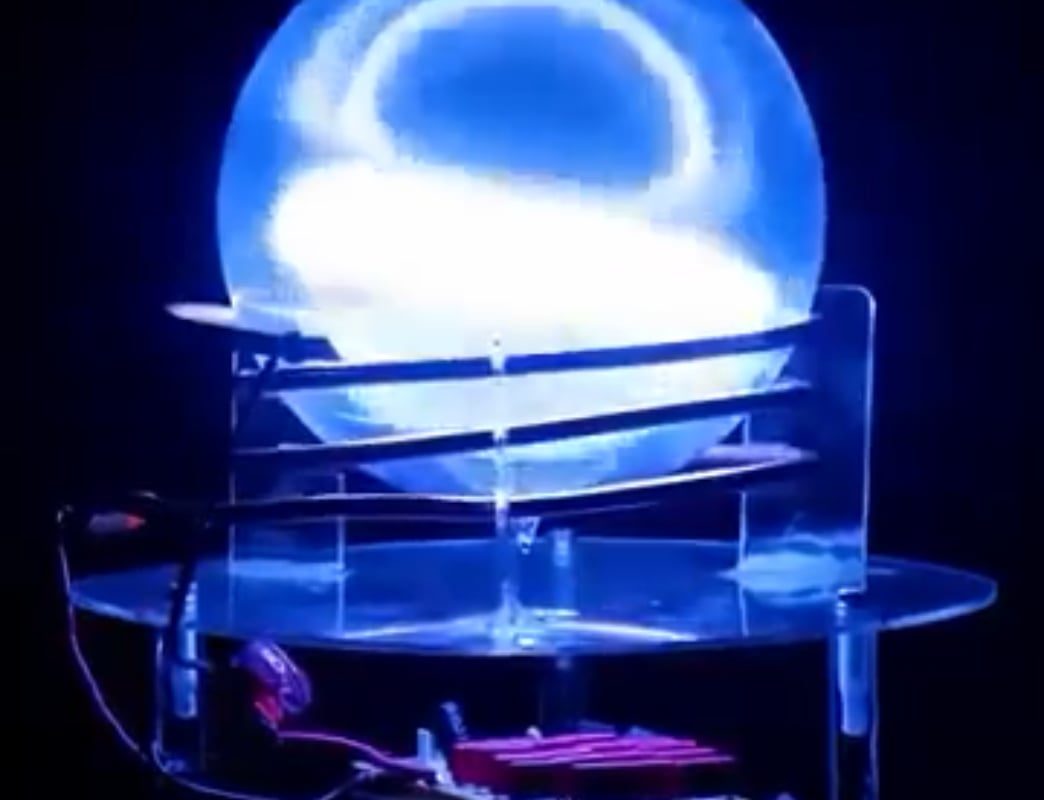
Floating plasma toroid
Floating Plasma Toroid: The Cutting-Edge Science of Ring-Shaped Fire
Imagine a glowing, doughnut-shaped orb of pure energy floating effortlessly in mid-air—a mesmerizing blend of science and spectacle. This is a floating plasma toroid, one of the most enigmatic and promising phenomena in modern physics. Often compared to sci-fi “energy shields” or miniature stars, these self-contained plasma rings could revolutionize fields from clean energy to propulsion systems. In this article, we explore what floating plasma toroids are, how they work, their potential applications, and why they captivate scientists worldwide.
What is a Floating Plasma Toroid?
A plasma toroid is a ring-shaped structure composed of plasma—the fourth state of matter, consisting of ionized gas particles. Unlike solids, liquids, or gases, plasma is electrically conductive and responds strongly to magnetic fields. A floating plasma toroid is levitated without physical contact, often using magnetic fields or acoustic waves to counteract gravity.
Key Characteristics:
- Shape: Stable toroidal (doughnut-like) geometry, maintained by magnetic self-confinement.
- Composition: Superheated ionized gas (plasma) at temperatures exceeding 10,000°C.
- Levitation: Suspended via electromagnetic fields or ultrasonic waves to avoid contact with containers, which would cool and disrupt the plasma.
How Are Floating Plasma Toroids Created?
Creating and sustaining a floating plasma toroid requires precision engineering and advanced physics. Here’s how scientists achieve this feat:
1. Magnetic Confinement
Most toroids are formed using pulsed magnetic fields. A sudden burst of electrical current induces a magnetic “pinch,” compressing plasma into a stable ring. Researchers at institutions like Caltech have done this using specialized electrodes to generate transient toroidal shapes.
2. Acoustic Levitation
In rare cases, ultrasonic standing waves can levitate small plasma rings, though this method is less common due to instability challenges.
3. Lasers or Microwave Pulses
High-energy lasers or microwaves can ionize gas into plasma and shape it into toroidal forms, often in vacuum chambers.
The Stability Challenge
Plasma toroids naturally want to expand or dissipate. To counter this, scientists use:
- Self-Organizing Magnetic Fields: The plasma’s own currents generate stabilizing magnetic fields.
- Rapid Rotation: Spinning the toroid centrifugally counteracts disruption.
Potential Applications: From Fusion Energy to Aerospace
While still experimental, floating plasma toroids hold transformative potential across industries:
🔥 1. Nuclear Fusion Research
Tokamaks (donut-shaped fusion reactors) already use toroidal plasmas. Floating toroids could simplify designs by eliminating physical containment walls, reducing energy loss and material damage.
🚀 2. Advanced Propulsion Systems
NASA and private aerospace firms study plasma toroids for space propulsion. A contained “plasma bubble” could shield spacecraft from radiation or enable novel thrust mechanisms.
🔋 3. Energy Storage
Theoretical models suggest stabilized plasma rings could store vast amounts of energy magnetically, akin to superconducting loops but at higher densities.
⚡ 4. Industrial & Medical Uses
- Waste Processing: Toroids could incinerate hazardous materials with ultra-high temperatures.
- Precision Surgery: Focused plasma rings might remove tumors with minimal tissue damage.
🌌 5. Fundamental Physics Research
Floating toroids offer a unique lab for studying astrophysical phenomena like solar flares or accretion disks around black holes.
Challenges & Current Research Frontiers
Despite their promise, floating plasma toroids face hurdles:
- Containment Time: Most lab-generated toroids last milliseconds. Extending longevity is critical.
- Energy Efficiency: Input power often exceeds the toroid’s energy output.
- Scalability: Scaling lab-sized toroids to industrial applications remains untested.
Leading Research Initiatives:
- Princeton Plasma Physics Lab (PPPL): Exploring magnetic confinement optimizations.
- Quaise Energy: Investigating hybrid laser-magnetic toroidal systems for deep geothermal drilling.
- TAE Technologies: Using plasma rings in their linear fusion reactors.
Conclusion: A Glimpse Into a Plasma-Powered Future
Floating plasma toroids represent a thrilling convergence of physics, engineering, and imagination. As research advances, these ethereal rings of fire could unlock breakthroughs in clean energy, space exploration, and beyond. Though challenges remain, their very existence proves that the boundaries of science are continually expanding—one glowing toroid at a time.
The future isn’t just bright; it’s plasma-hot.
Keywords for SEO: floating plasma toroid, plasma ring technology, toroidal plasma applications, nuclear fusion research, magnetic confinement, plasma energy storage, space propulsion, Caltech plasma experiment, future of clean energy, self-sustaining plasma.