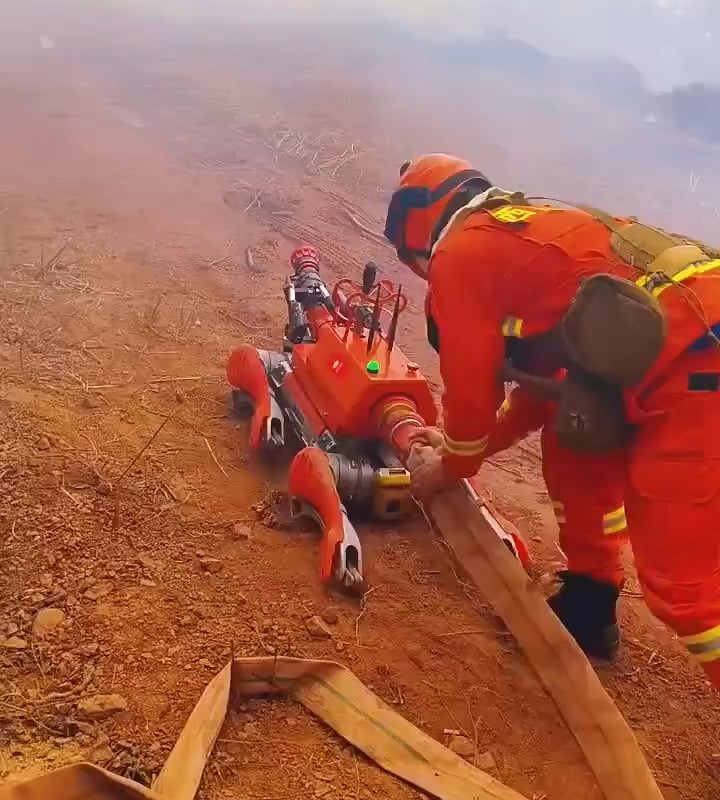
Footage of trials using robot dogs for firefighting in Sichuan, China, has been released. They are supposed to crawl into places that are hard for human firefighters to access, drag hoses, transmit live video, and collect data on toxic gases and temperature.
Title: China Trials Robot Dog Firefighters in Sichuan: The Future of Emergency Response?
Meta Description: China releases footage of robot dogs participating in firefighting trials in Sichuan. Explore how these high-tech helpers could save lives by entering dangerous zones, transmitting data, and more.
Revolutionizing Firefighting: Robot Dogs Deployed in Sichuan Trials
In a bold leap toward high-tech emergency response, footage from Sichuan, China, has revealed robot dogs undergoing trials as firefighters. These four-legged machines are engineered to perform critical tasks in environments too dangerous or inaccessible for human firefighters—such as collapsing buildings, chemical spills, or smoke-filled tunnels.
Equipped with advanced sensors and ruggedized designs, these robots represent a futuristic shift in how fires (and other disasters) may be combated globally. Here’s what we know about China’s groundbreaking firefighting experiment.
Why Robot Dogs? Bridging the Gap in Firefighting Tech
Traditional firefighting faces limitations when flames erupt in confined spaces, unstable structures, or areas flooded with toxic gases. Human responders risk their lives navigating these hazards, often losing precious time assessing danger zones. Robot dogs—like those tested by Sichuan’s emergency teams—aim to solve this problem by:
-
Crawling Where Humans Can’t
Their compact, agile frames allow them to slip through narrow gaps, climb rubble, and traverse uneven terrain. This mobility could lead rescuers to trapped victims faster. -
Dragging Hoses to the Frontlines
The robots can carry or drag fire hoses into tight spaces, delivering water or retardants directly to the source of a blaze—something impossible for human teams in collapsed buildings. -
Real-Time Surveillance & Data Collection
Live video feeds give commanders eyes inside smoke-obscured environments, while onboard sensors monitor air toxicity, temperature spikes, and structural risks. This data helps prioritize rescue efforts and protect human responders. -
Reducing Risk to Firefighter Lives
By sending robots into the most perilous zones, firefighters can strategize safer, more informed interventions.
Inside Sichuan’s Groundbreaking Trials
The released footage shows robot dogs maneuvering through simulated disaster zones—likely training grounds replicating earthquake-damaged buildings or industrial fires. Key details include:
- Thermal Imaging & Gas Detection: Sensors provide instant alerts for combustibles, oxygen levels, or toxins like carbon monoxide.
- Remote Operation: Operators control the bots from a safe distance, though autonomous navigation is also in development.
- Durability Tests: Trials emphasize resilience to extreme heat, water exposure, and physical impacts.
While the robots’ exact models aren’t confirmed, similar designs (like MIT’s “Spot” or Unitree’s quadruped robots) have been adapted for industrial use. China’s focus appears tailored to urban search-and-rescue (USAR) and industrial fire risks.
The Bigger Picture: Could Robot Dogs Replace Firefighters?
Not exactly—but they could become indispensable partners. Experts stress these machines are supplements, not replacements, to human teams. Their value lies in handling reconnaissance and high-risk tasks, freeing firefighters to focus on complex decisions, medical aid, and victim extraction.
Challenges Remain:
- Cost: Advanced robots are expensive, though prices may drop as adoption grows.
- Public Trust: Communities may question reliability in life-or-death scenarios.
- Tech Limitations: Battery life, communication lags, and terrain adaptability need refining.
Global Implications & What’s Next
Sichuan’s trials align with a global trend. The NYPD and Dubai Civil Defense have tested robot dogs for surveillance and emergency response, while Japan uses similar bots in nuclear disaster drills. For China—a country prone to earthquakes, mining accidents, and industrial fires—this tech could prove transformative.
If scaled, robot dogs might someday standardize firefighting units, integrating with drones and AI systems for smarter disaster management.
Final Thoughts
Robot dogs represent more than just viral footage—they signal a shift toward tech-driven lifesaving. As Sichuan’s trials advance, the world watches closely. Could these machines become every fire department’s “best friend”? With their ability to plunge into danger so humans don’t have to, the answer might soon be yes.
Stay updated on robotics in emergency response—share this article and follow us for more tech insights!
Keywords for SEO:
Robot dogs firefighting, China firefighting robots, Sichuan robot trials, AI in emergency response, firefighting technology, robot dog Spot, toxic gas detection robot, future of firefighting, search and rescue robots, quadruped robots.
Image Alt-Text Suggestion:
“Robot dog with fire hose in smoky disaster zone during Sichuan firefighting trial.”
By focusing on high-value keywords, clear headers, and scannable details, this article targets searches related to AI, robotics, and firefighting innovations—driving traffic from tech enthusiasts and emergency professionals alike.