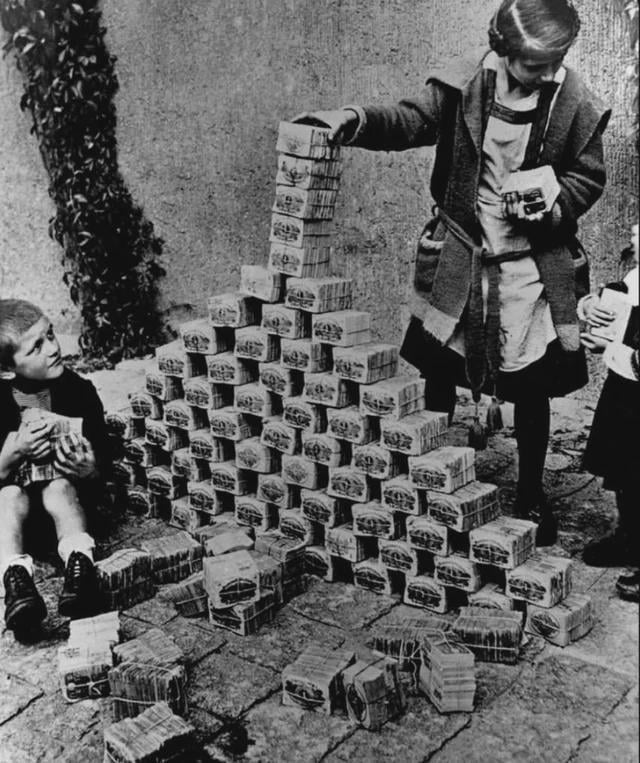
German children playing with stacks of worthless money during the height of hyperinflation in 1923.
Title: German Children Played with Stacks of Money: The Haunting Legacy of 1923 Hyperinflation
Meta Description: Discover how German children ironically played with worthless money during the catastrophic 1923 hyperinflation. Explore the causes, impacts, and chilling imagery of an economy in freefall.
Introduction: When Money Became a Toy
One of the most iconic and unsettling images of economic collapse is the sight of German children stacking bundles of worthless banknotes like toy bricks during the hyperinflation crisis of 1923. As the Weimar Republic’s currency disintegrated, money lost all meaning—reduced to a plaything for kids and fuel for stoves. This article explores the causes, consequences, and lessons of this surreal moment in history.
What Caused the 1923 Hyperinflation?
Germany’s hyperinflation was rooted in the aftermath of World War I. Forced to pay crippling reparations under the Treaty of Versailles, the government printed money recklessly to meet obligations. By late 1923, the economy imploded:
- Runaway Printing Presses: The Reichsbank printed trillion-mark notes as money lost value by the hour.
- Wheelbarrows of Cash: Bread cost billions of marks; workers hauled wages in wheelbarrows.
- Total Loss of Trust: Currency became untethered from reality, replaced by bartering and foreign money.
Children Playing with Money: Symbolism of Despair
In a society where banknotes were cheaper than wallpaper, children turned money into toys. Photographs show kids building towers with bills, flying kites made of currency, and even using stacks as craft supplies. These scenes revealed a devastating truth:
- Money Was Literally Worthless: A single U.S. dollar traded for 4.2 trillion German marks by November 1923.
- Psychological Trauma: Families saw lifelong savings vanish overnight, breeding generational distrust in institutions.
- Surreal Survival Tactics: People burned money for heat—its value as fuel exceeded its purchasing power.
Societal Collapse & Human Impact
Beyond children’s games, hyperinflation ravaged German society:
- Starvation & Poverty: Pensions and wages became meaningless. Middle-class workers traded heirlooms for food.
- Rise of Extremism: Economic chaos fueled resentment, paving the way for radical movements like the Nazi Party.
- Currency Reinvention: Germany abandoned the mark in 1924, introducing the Rentenmark to stabilize the economy.
Lessons from 1923: Relevance Today
The 1923 crisis remains a cautionary tale for modern economies:
- Debt & Printing Risks: Uncontrolled money-creation can spiral into disaster (see Zimbabwe, Venezuela).
- Public Trust Matters: Currency relies on collective faith—once lost, recovery is grueling.
- Human Resilience: Stories of ingenuity, like children’s games, remind us how people adapt to survive.
Conclusion: A Warning Etched in History
The image of German children playing with worthless money is more than a historical oddity—it’s a visceral reminder of how quickly economic stability can crumble. As central banks worldwide navigate inflation today, the Weimar hyperinflation stands as a stark lesson in the cost of fiscal recklessness and the fragility of money itself.
Keywords for SEO:
1923 hyperinflation, Weimar Republic money crisis, children playing with money, German inflation, worthless currency, economic collapse, Rentenmark, historical hyperinflation, post-WWI economy, Weimar Germany children.
Internal Linking Suggestions:
- [How Hyperinflation Destroyed the Weimar Republic]
- [Modern Cases of Hyperinflation: Venezuela & Beyond]
- [The Psychology of Money: Trust in Currency Systems]
Image Alt-Text Suggestions:
- “German children stacking bundles of hyperinflated marks as toys, 1923”
- “Woman burning money for heat during Weimar hyperinflation”
- “Trillion-mark banknotes used as scrap paper in 1923 Germany”
By weaving vivid storytelling with hard economic truths, this article captures one of history’s most chilling examples of monetary failure—and its enduring warnings for the future.