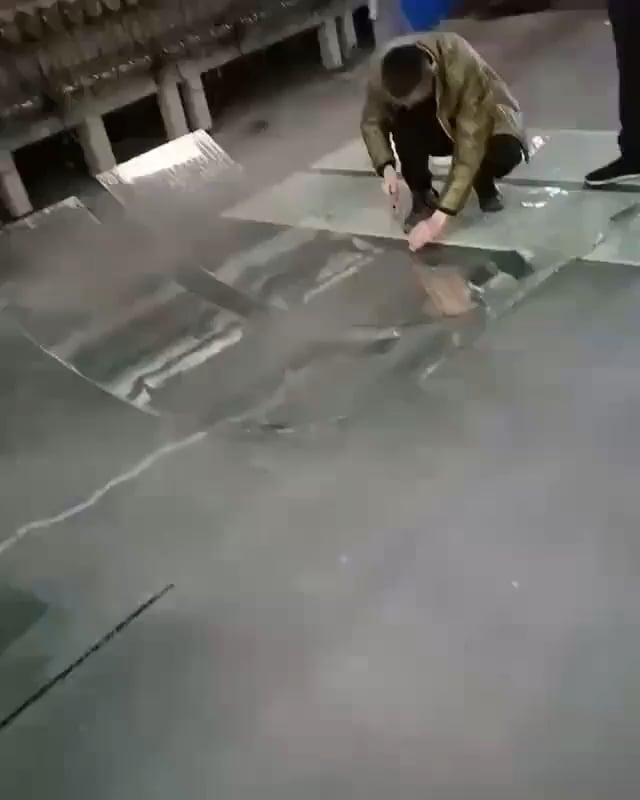
Glass Flattening Operation
The Ultimate Guide to Glass Flattening Operations: Precision, Processes, and Applications
Introduction
In high-precision industries—from semiconductor manufacturing to aerospace optics—ultra-flat glass is critical. Glass flattening is a specialized process that transforms traditional glass substrates into flawlessly flat surfaces with micron-level accuracy. This article explores what glass flattening entails, its methods, applications, and why it’s indispensable for advanced technologies.
What is Glass Flattening?
Glass flattening (or glass planarization) is a post-production process that eliminates surface irregularities, warping, or curvature in glass substrates. Traditional manufacturing methods, such as float glass production, leave slight imperfections that can disrupt optical, electronic, or mechanical performance. Glass flattening corrects these flaws to meet stringent tolerances required for specialized applications.
Key Methods of Glass Flattening
Different techniques achieve flatness based on the glass type, thickness, and end-use:
1. Thermal Flattening (Annealing)
- Process: Glass sheets are heated near their softening point (600–900°C) and slowly cooled under controlled conditions to relieve internal stresses.
- Applications: Ideal for display glass (LCD/OLED), architectural panels, and optical components.
- Precision: Achieves tolerances of ±5–20 microns/meter.
2. Mechanical Lapping & Polishing
- Process:
- Lapping: An abrasive slurry grinds the surface against a flat plate (e.g., cast iron or ceramic).
- Polishing: Fine abrasives (cerium oxide) or diamond pads refine the surface to optical-grade smoothness.
- Applications: Optics, photomasks, and laser components.
- Precision: Surfaces flat to λ/10 (≈63 nm) or better for high-end optics.
3. Chemical Flattening (Etching)
- Process: Acid-based solutions (e.g., HF) uniformly etch the glass surface to remove microscopic peaks.
- Applications: Thin-film coatings, MEMS devices, and sensors.
4. Computer-Controlled (CNC) Flattening
- Process: CNC machines use diamond-tipped tools or ion beams to selectively remove material.
- Precision: Sub-micron accuracy (±0.1 µm).
Why Ultra-Flat Glass Matters: Applications
Flattened glass is essential in industries where minor distortions cause catastrophic errors:
-
Optics & Photonics:
- Laser lenses, mirrors, and prisms require λ/20 flatness to prevent beam distortion.
- Telescope mirrors and lithography equipment depend on nanometer-scale uniformity.
-
Semiconductors:
- Photolithography masks must be flawless to accurately transfer nano-circuitry onto silicon wafers.
-
Displays & Touchscreens:
- OLED/LCD panels demand flat glass to prevent uneven backlighting or touch sensor malfunctions.
-
Aerospace & Defense:
- Guidance systems, cockpit displays, and satellite optics rely on distortion-free substrates.
-
Medical Devices:
- Endoscope lenses and imaging sensors need ultra-flat surfaces for clear diagnostics.
Benefits of Professional Glass Flattening
- Enhanced Optical Clarity: Eliminates light scattering for superior imaging.
- Improved Adhesion: Ultra-smooth surfaces enable better thin-film coating bonds.
- Dimensional Stability: Reduces thermal expansion or stress-induced warping.
- Extended Lifespan: Minimizes micro-cracks and stress points.
Quality Control in Glass Flattening
Flattening is monitored using:
- Interferometers: Measure flatness via light wave interference patterns (e.g., Fizeau interferometer).
- Profilometers: Scan surfaces to detect deviations at nanometer scales.
- ISO 10110: Optical component standards define acceptable flatness tolerances.
Challenges & Considerations
- Material Limitations: Thin or fragile glass risks breakage during thermal/mechanical processing.
- Cost: High-precision flattening adds expense but is non-negotiable for critical components.
- Environmental Controls: Temperature, humidity, and vibration must be strictly managed.
Future Trends
- Automation: AI-driven CNC systems optimize material removal for faster, more consistent results.
- Hybrid Processes: Combining chemical etching with ion beam polishing for atomic-level flatness.
- Eco-Friendly Methods: Recycling abrasives and reducing HF usage in chemical treatments.
FAQs
Q: How flat is “ultra-flat” glass?
A: Tolerances range from <1 micron/meter (engineering-grade) to <0.1 microns (semiconductor-grade).
Q: Can tempered glass be flattened?
A: No—tempering creates internal stresses; flattening must occur pre-tempering.
Q: What’s the difference between lapping and polishing?
A: Lapping removes material to achieve flatness; polishing refines the surface for smoothness.
Conclusion
Glass flattening operations bridge the gap between mass-produced glass and precision-engineered substrates. As industries push the boundaries of miniaturization and accuracy, demand for ultra-flat glass will only grow. Partnering with an expert manufacturer ensures compliance with exacting standards, enabling breakthroughs in technology.
Rank well by targeting keywords: “glass flattening process,” “ultra-flat glass manufacturing,” “precision glass planarization,” “optical glass flattening,” “glass lapping and polishing.”