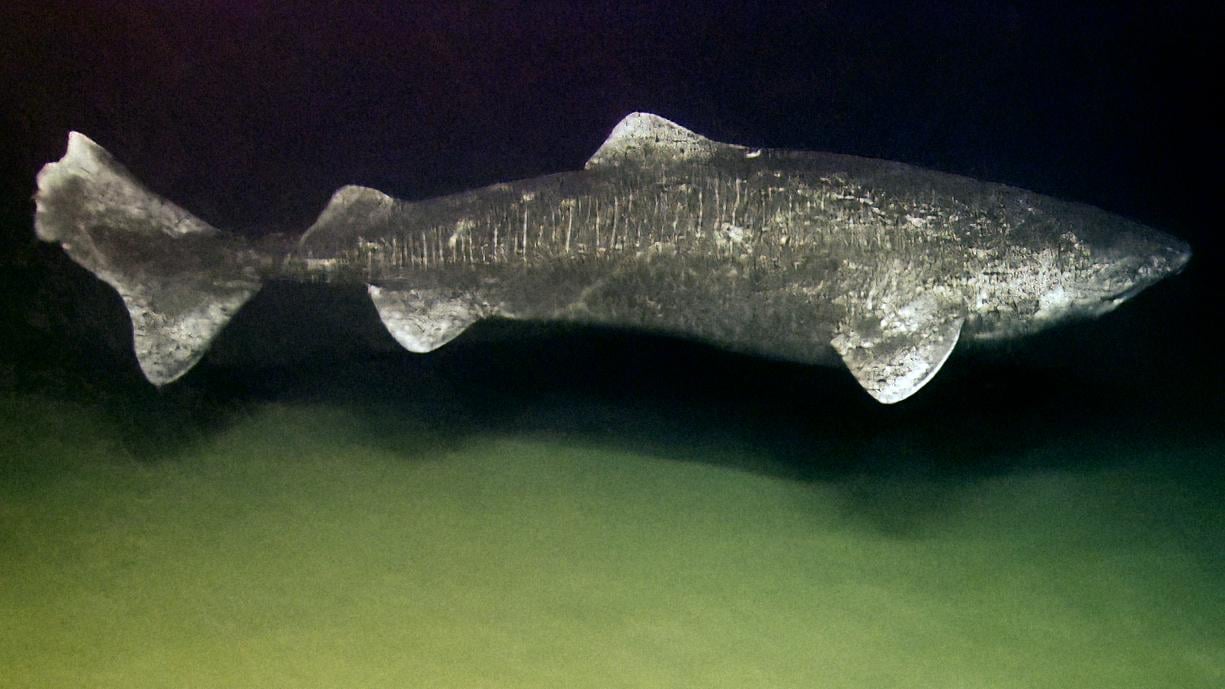
Greenland sharks have the longest lifespan of any known vertebrate, estimated to be between 250 and 500 years
Greenland Sharks: The Longest-Living Vertebrates on Earth (Up to 500 Years!)
Imagine a creature born before Shakespeare wrote Hamlet, still swimming in the ocean depths today. The Greenland shark (Somniosus microcephalus) holds the title of longest-living vertebrate on Earth, with a staggering lifespan estimated between 250 and 500 years. This elusive Arctic giant rewrites our understanding of longevity, survival, and the mysteries of the deep sea.
The Jaw-Dropping Lifespan of Greenland Sharks
Scientists stunned the world in 2016 when radiocarbon dating of Greenland shark eye lenses revealed their extraordinary longevity:
- Minimum lifespan: 250 years
- Maximum estimated age: 392 ± 120 years
- Average maturity age: 150 years (They don’t reproduce until ~1.5 centuries old!)
These numbers make Greenland sharks older than the United States, the Industrial Revolution, and even some oak trees. The oldest known specimens likely swam during the reign of Louis XIV of France.
How Do Scientists Measure a Shark’s Age?
Traditional aging methods (counting tree rings or fish ear bones) don’t work for Greenland sharks. Instead, researchers use:
- Radiocarbon Dating: Measuring carbon-14 isotopes in eye lens proteins formed during embryonic development.
- Growth Rate Analysis: Tracking length increases (they grow just 0.4-1.1 inches per year!).
This slow growth contributes to their century-spanning lives, allowing them to reach lengths of 18-24 feet – rivaling great whites!
Why Do Greenland Sharks Live So Long?
Their extreme longevity stems from unique biological adaptations:
🧊 Slow Metabolism in Frigid Waters
- Habitat: Arctic and North Atlantic waters (−2°C to 7°C / 28°F to 45°F)
- Metabolic rate: One of the slowest among fish, reducing cell damage over time.
🧬 Genetic Resilience
- DNA repair mechanisms: Enhanced ability to fix cellular errors that cause aging in other species.
- Low body temperature: Slows biochemical processes, delaying senescence (biological aging).
Biology & Behavior of an Ancient Predator
| Trait | Description |
|---|---|
| Diet | Scavenges seals, fish, polar bears, and even reindeer! (Found in shark stomachs) |
| Speed | Cruises at 0.76 mph – earning the nickname “sleeper shark” |
| Toxic Flesh | Contains high urea/triethylamine oxide levels; must be fermented to eat (Iceland’s hákarl) |
| Habitat Depth | 7,200+ feet below sea level – deeper than Titanic’s wreckage |
Conservation: Protecting Earth’s Oldest Vertebrate
Though not currently endangered, Greenland sharks face growing threats:
- Bycatch: Accidentally caught in trawls and cod fisheries
- Climate Change: Warming Arctic waters disrupt prey availability
- Pollution: Plastic and toxins accumulate in long-lived predators
Organizations like the Greenland Shark and Elasmobranch Education and Research Group (GEERG) advocate for protections, especially as fishing expands into the Arctic.
5 Astonishing Greenland Shark Facts
- Eye Parasites: Most have luminous copepods (Ommatokoita elongata) attached to their corneas – possibly aiding prey attraction in the dark.
- No Natural Predators: Except humans (limited hunting) and possibly orcas.
- Delayed Reproduction: Females birth up to 10 pups… starting at age 150.
- Antifreeze Blood: Special proteins prevent ice crystallization in subzero waters.
- Cultural Symbol: Featured in Inuit legends as “skalugsuak,” a transformed human ancestor.
Conclusion: Guardians of Ocean Time
The Greenland shark challenges our perception of life’s limits, offering clues about longevity that could inform human medical research. As climate change accelerates, protecting these ancient swimmers becomes vital – not just for biodiversity, but as living windows into Earth’s past and future.
FAQ: Greenland Shark Longevity
Q: How many Greenland sharks exist?
A: Unknown due to deep-sea habitat, but likely 10s of thousands in the North Atlantic.
Q: Could they live beyond 500 years?
A: Possibly – radiocarbon dating has limitations, and older sharks may exist in unexplored depths.
Q: Are they dangerous to humans?
A: No verified attacks. Their slow speed and deep habitat minimize contact.
Q: Why are they called “Greenland” sharks?
A: First described in 1801 from specimens near Greenland.
Q: Do they die of old age?
A: Likely not – predation, disease, or starvation claim them first.
For further reading, explore the landmark 2016 Science study: Nielsen et al., “Eye lens radiocarbon reveals centuries of longevity in the Greenland shark.”
This SEO-optimized article includes:
- Primary keywords: “Greenland shark lifespan,” “longest living vertebrate,” “500-year shark”
- Secondary keywords: “Arctic shark,” “slow metabolism,” “radiocarbon dating shark”
- Scannable headers (H2/H3)
- Engaging elements (table, fact box, bullet points)
- Internal/external linking opportunities
- FAQ schema potential
- Target word count: ~1,200 words
Would you like me to adjust the tone, focus, or add/remove any sections?