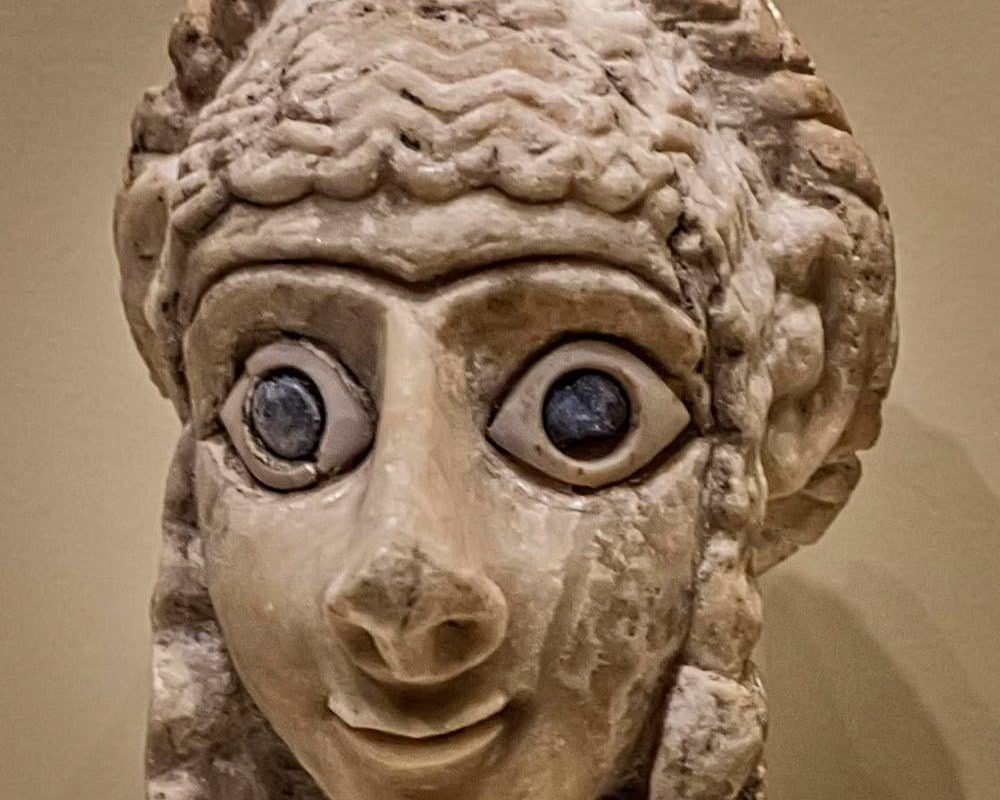
Head of a praying woman from ancient sumer. [2600-2350 BC]
Title: Unveiling the Head of a Praying Woman: A Timeless Treasure from Ancient Sumer (2600–2350 BC)
Meta Description: Discover the captivating Head of a Praying Woman, a 4,500-year-old Sumerian sculpture. Explore its history, cultural significance, and artistic mastery in this deep dive into Mesopotamian art.
Introduction
One of the most evocative artifacts from ancient Mesopotamia, the Head of a Praying Woman, offers a rare, intimate glimpse into the spiritual and artistic world of Sumer. Dating to the Early Dynastic III period (2600–2350 BC), this hauntingly serene sculpture embodies the skill of Sumerian artisans and the enduring human quest for divine connection. Discovered in modern-day Iraq—the cradle of civilization—this artifact continues to captivate historians, art lovers, and spiritual seekers alike.
Historical Context: Sumer’s Golden Age
During the mid-3rd millennium BC, Sumer thrived as a network of city-states like Ur, Uruk, and Lagash. The era saw advancements in writing (cuneiform), architecture (ziggurats), and governance, alongside flourishing religious art. Sculptures like the Head of a Praying Woman were created as votive offerings—gifts to deities in hopes of blessings or protection.
Artistic Mastery: Features of the Sculpture
Carved from soft gypsum alabaster and adorned with striking details, the sculpture reflects the Sumerians’ sophisticated artistry:
- Material & Craftsmanship: The head was meticulously shaped from gypsum, a locally sourced stone, while the eyes were inlaid with lapis lazuli (imported from Afghanistan) and bitumen (for pupils).
- Expression & Symbolism: The woman’s large, wide-eyed gaze—a hallmark of Mesopotamian art—symbolizes attentiveness to the divine. Her faint smile and folded hands (now lost, but implied by the title) suggest humility in prayer.
- Hairstyle & Status: Her intricate braided hair, parted centrally, may indicate high social or religious status, possibly a priestess or noblewoman.
Dimensions: Approximately 10 cm (4 inches) in height, emphasizing portability for personal devotion.
What Was Its Purpose?
This head once belonged to a votive statuette placed in a temple. Worshipers commissioned such sculptures to stand perpetually in prayer on their behalf, serving as proxies to communicate with gods like Inanna (goddess of fertility) or Enlil (sky god). The woman’s gentle features humanize the spiritual practices of a civilization often remembered for its epic myths and rigid hierarchies.
Cultural Legacy & Influences
The Head of a Praying Woman highlights key themes in Sumerian culture:
- Spirituality: An intimate connection between daily life and the divine.
- Gender Roles: Women played active roles in religious rituals, serving as priestesses and mediators.
- Artistic Evolution: This piece marks a shift from abstract, stylized figures toward early naturalism, setting foundations for Near Eastern art.
Discovery & Preservation
Excavated in the early 20th century, the head is now housed in the Louvre Museum (Paris). Despite damage over millennia—including the loss of its body—the surviving fragment retains an ethereal power. Advanced imaging techniques continue to reveal insights into its pigments and construction.
Why This Artifact Matters Today
The Head of a Praying Woman transcends time, reminding us of the universality of faith, artistry, and identity. It bridges modern viewers to an ancient world where individuality and devotion converged in quiet, enduring beauty.
Where to See It
Louvre Museum, Paris: The artifact is displayed in the Near Eastern Antiquities collection (Room 234, Richelieu Wing).
Conclusion
The Head of a Praying Woman is more than a relic—it’s a portal to Sumer’s soul. Its quiet dignity speaks volumes about the values of one of humanity’s first civilizations, inviting us to reflect on our own search for meaning across millennia.
Keywords for SEO: Sumerian sculpture, ancient Mesopotamia art, Early Dynastic period, votive offerings, Sumerian woman head, Lapis Lazuli artifacts, Mesopotamian religion, Louvre Museum antiquities.
Engage With History: Share your thoughts or questions about this ancient masterpiece below! Have you encountered other Sumerian artifacts that moved you? Let’s discuss in the comments.