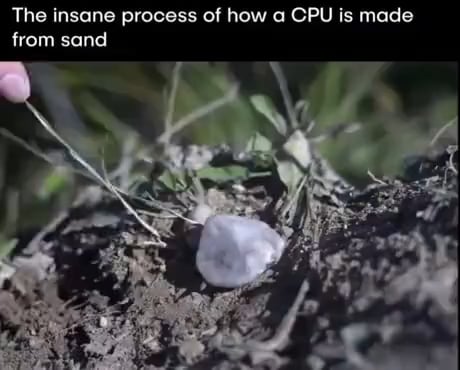
I think it’s wild that we went from stone age living to creating stuff like this out of sand
Title: From Flint to Chips: Humanity’s Mind-Blowing Tech Evolution Using Sand
Introduction
Imagine a caveman crafting a rudimentary stone axe, then fast-forward 12,000 years to engineers shaping silicon wafers from beach sand to power supercomputers. It’s almost unbelievable. Our journey from Stone Age survival to the digital revolution is a testament to human ingenuity—and it all hinges on humble SAND, the unsung hero of civilization’s greatest leaps.
1. Stone Age Foundations: When Rocks Were Cutting-Edge Tech
Long before microprocessors, our ancestors relied on flint, obsidian, and quartz—rocks painstakingly shaped into blades and tools. These innovations laid the groundwork for survival, agriculture, and early trade routes. Yet, these materials were limited by their physical rigidity. The real revolution began when humanity unlocked a hidden potential beneath their feet: sand.
Why sand matters:
- Composition: Rich in silicon dioxide (SiO₂), the second-most abundant mineral on Earth.
- Versatility: When transformed, it becomes glass, concrete, and eventually—silicon, the backbone of modern electronics.
2. The Alchemy of Sand: From Glass to Silicon Valley
The Ancient Breakthrough: Glassmaking
Around 3500 BCE, Mesopotamians discovered that superheated sand could become glass—sparking innovations in architecture (stained glass), science (microscopes), and culture (art). Yet, this was just the start.
The Silicon Revolution
Fast-forward to the 20th century: Scientists realized that purified silicon—derived from sand—could conduct electricity under specific conditions. This sparked the semiconductor era.
Key milestones:
- 1947: The first transistor, built with germanium (later replaced by silicon).
- 1971: Intel’s 4004 microprocessor, powered by silicon chips, revolutionized computing.
3. How Sand Becomes a Smartphone: The Tiny Marvels Inside Tech
Today, 99% of microchips use silicon. But how does grainy sand turn into a computer chip?
- Purification: Sand is melted into molten silica, then refined into 99.9999% pure silicon ingots.
- Wafer Slicing: Ingots are cut into thin wafers, polished to atomic smoothness.
- Circuit Etching: Nanoscale transistors are printed via photolithography—akin to “drawing” circuits with light.
Mind-blowing stats:
- A single grain of sand holds billions of transistors in modern chips.
- The iPhone’s A15 chip contains 15 billion transistors—a density Stone Age humans couldn’t fathom.
4. Beyond Chips: Sand’s Role in Building the Modern World
Silicon isn’t just for tech. Sand shapes our physical and digital infrastructure:
- Concrete: 50 billion tons of sand are used yearly for construction.
- Fiber Optics: Glass cables (from sand) transmit data at light speed.
- Solar Panels: Silicon photovoltaic cells harness sunlight for clean energy.
5. What’s Next? Quantum Computing and Humanity’s Future
We’ve gone from sharpening rocks to manipulating atoms. Emerging innovations continue this legacy:
- Quantum Chips: Using silicon-based qubits for unhackable encryption.
- Bio-Silicon Interfaces: Merging AI with human biology via neural implants.
Yet, challenges remain. Sand scarcity threatens industries, urging sustainable alternatives like lab-grown silicon or graphene.
Conclusion: What This Means for Human Potential
From stone axes to self-driving cars, our mastery of sand reveals a profound truth: Human creativity transforms the ordinary into the extraordinary. Each grain of sand holds millennia of progress—and the next breakthrough is already being etched into a silicon wafer somewhere.
So, the next time you hold a smartphone or gaze at a skyscraper, remember: we’re not just using sand. We’re bending the fabric of reality with it.
SEO Keywords: Human technological evolution, Sand to Silicon, Stone Age to Digital Age, Semiconductor manufacturing, Silicon chip production, Future of quantum computing, Sand scarcity solutions.
Meta Description: Discover how humanity turned Stone Age sand into silicon chips—powering everything from iPhones to AI. Explore the incredible journey from flint tools to quantum computing.