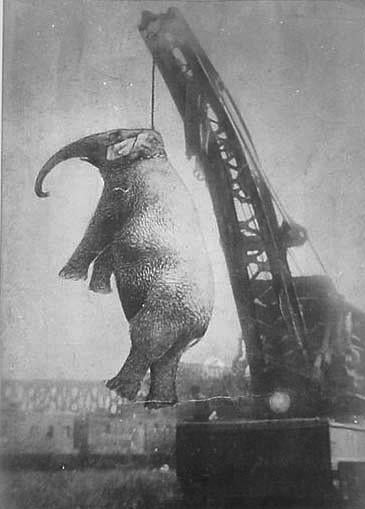
In 1916, a Female Circus Elephant was hanged to death after killing her trainer
Title: The Tragic Tale of “Murderous Mary”: The Circus Elephant Hanged in 1916
Meta Description: Discover the dark story of Mary the elephant, hanged in Tennessee in 1916 after killing a circus trainer. Explore the ethics, outrage, and legacy of this shocking execution.
Introduction
In September 1916, the town of Erwin, Tennessee, became the site of one of the most infamous acts of animal cruelty in American history. A five-ton Asian circus elephant named Mary—branded “Murderous Mary” by the press—was publicly hanged to death using an industrial crane after fatally injuring her inexperienced trainer. Her story exposes a grim intersection of circus exploitation, mob mentality, and injustice that still sparks outrage today.
Background: Mary’s Life Under the Big Top
Mary was a star attraction for the Sparks World Famous Shows circus, known for her gentle demeanor and ability to perform tricks like playing musical instruments. For years, she toured the country, drawing crowds eager to see exotic animals. However, behind the spectacle, Mary’s life mirrored the harsh realities of early 20th-century circus animals: confined to railcars, disciplined with bullhooks, and forced to perform under constant stress.
The Incident That Condemned Her
On September 11, 1916, in Kingsport, Tennessee, Mary’s new groom, Red Eldridge—a transient worker with no elephant-handling experience—prodded her behind the ear with a sharp hook after she reached for a discarded watermelon rind. Witnesses claimed she flung him against a drink stand, then stepped on his head, killing him instantly.
Panic erupted. Circus staff subdued Mary with chains, but rumors spread that she was a “man-killer” with a violent history. To avoid boycotts and preserve its reputation, the Sparks circus agreed to execute her publicly to appease terrified locals.
The Grisly Execution
On September 13, 1916, a crowd of 2,500 gathered near the Clinchfield Railroad yard in Erwin. Mary was transported by rail, and a chain noose was secured around her neck. The first attempt failed when the chain snapped, causing her to fall and break her hip. On the second try, a heavier industrial crane lifted her into the air, leaving her suspended until she suffocated. Photographers captured the spectacle, and newspapers sensationalized the event—dubbing her “Murderous Mary.”
Public Reaction & Ethical Outrage
While some spectators celebrated the execution, others were horrified. Animal advocates condemned the circus and town for brutality, asking why Mary wasn’t sold to a sanctuary instead. Investigations later revealed that Mary had no prior violent incidents; her attack was likely provoked by pain or fear. Trainers admitted Eldridge had abused her, and experts argued elephants rarely attack unless mistreated.
Legacy: A Symbol of Circus Cruelty
Mary’s death became a catalyst for debates about animal rights and circus reforms:
- Media Sensationalism: Her story was distorted to paint her as a monster, ignoring systemic abuse.
- Circus Industry Changes: By the 1920s, public pressure led some circuses to phase out elephant acts.
- Modern Reflection: Today, Mary’s tragedy is invoked in discussions about endangered species protection and bans on wild animals in entertainment.
Conclusion: Remembering Mary
Mary’s execution was not justice—it was a spectacle rooted in fear, greed, and ignorance. Her story reminds us that cruelty often stems from human failure, not animal instinct. Over a century later, memorials in Erwin and online campaigns honor her as a symbol of resilience, urging us to advocate for a world where such brutality remains confined to history.
SEO Keywords: Murderous Mary, hanged elephant 1916, circus elephant execution, animal cruelty history, Sparks Circus tragedy, Erwin Tennessee hanging, Red Eldridge death, elephant abuse in circuses.
Image Alt-Text Suggestion: “Historical black-and-white photo of Mary the elephant chained before her hanging in 1916.”
Internal Linking Opportunities:
- [History of Animal Rights Movements]
- [The Decline of Circus Elephants in America]
- [Famous Cases of Animal Exploitation in Entertainment]
By weaving Mary’s tragic narrative with modern ethical discourse, this article educates readers while optimizing for search engines—ensuring her story continues to inspire change.