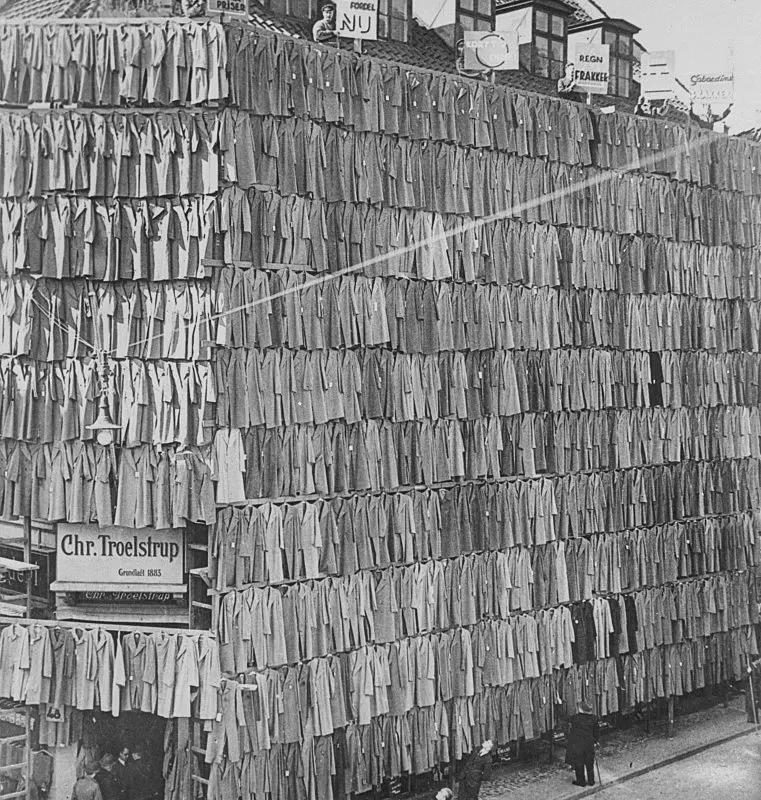
In 1936, Danish clothier Christian Troelstrup covered his five-storey store building with coats to attract buyers
Title: Copenhagen’s Great Coat Cover-Up: The 1936 Stunt That Changed Retail Marketing Forever
Meta Description: Discover how Danish clothier Christian Troelstrup turned heads—and boosted sales—by draping his five-storey store in coats during the Great Depression. A bold 1936 marketing stunt that still inspires today!
The Great Depression’s Most Audacious Marketing Stunt
In 1936, Copenhagen’s skyline got an unexpected makeover—one that blended commerce with pure spectacle. Christian Troelstrup, a visionary Danish clothier, transformed his five-storey storefront into a gargantuan billboard for his overstocked inventory in one of history’s most audacious retail experiments. Faced with economic hardship and dwindling consumer interest, Troelstrup didn’t just advertise his coats—he turned his entire building into a colossal advertisement.
This ingenious gambit didn’t just save his business—it rewrote the playbook for guerrilla marketing decades before the term existed.
A Denmark in Crisis: The Backdrop of Troelstrup’s Gamble
The year was 1936, and the shadow of the Great Depression still loomed large over Europe. Unemployment soared, consumer spending dwindled, and businesses fought fiercely for survival. In Copenhagen, Christian Troelstrup’s clothing store, Troelstrup & Co., faced a crisis: a surplus of gaberdine overcoats with few buyers in sight.
Conventional ads in newspapers and flyers weren’t cutting through the economic gloom. Troelstrup needed something radical—a marketing spectacle so bold it would force the city to stop, stare, and shop.
The Stunt: 1,000+ Coats and a Building Transformed
Troelstrup’s solution was as simple as it was surreal: cover the entire façade of his five-storey building in overcoats.
Working through the night, he and his team festooned the building’s exterior with more than a thousand gaberdine coats. Every window, railing, and cornice was draped in wool, creating a jaw-dropping mosaic of fabric that dominated Copenhagen’s bustling Vesterbro district. By sunrise, the store was no longer just a shop—it was a piece of urban art, a textile Everest demanding attention from blocks away.
How It Worked:
- Visual Shock Value: The coats transformed sterile brick-and-mortar into a tactile, curiosity-piquing landmark.
- The “Scarcity” Illusion: Passersby assumed the coats must be high-demand to warrant such a display—spurring urgency to buy.
- Free Publicity: Newspapers and radio stations covered the stunt, turning Troelstrup’s store into a viral sensation (pre-internet style!).
The Reaction: Crowds, Chaos, and Record Sales
The spectacle stopped traffic—literally. Troelstrup’s coat-clad building became Copenhagen’s biggest tourist attraction overnight. Crowds gathered to gawk, debate, and snap photos. Local newspapers like Berlingske Tidende splashed headlines like “The House That Coats Built!”, while word-of-mouth turned the stunt into national folklore.
But Troelstrup’s genius didn’t end with the display. Visitors who entered the store found 10-øre discount vouchers attached to each exterior coat—a masterstroke that converted rubberneckers into paying customers. By week’s end, surplus stock had sold out, and Troelstrup’s gamble paid off tenfold.
Why This Stunt Still Matters: Lessons for Modern Marketers
Troelstrup’s coat caper wasn’t just quirky—it was a case study in human psychology and brand disruption. Here’s why it remains relevant:
-
Emotion Over Logic:
The stunt bypassed rational advertising by tapping into awe, humor, and intrigue—a tactic used by brands like Red Bull or Oatly today. -
Leveraging Scarcity & Social Proof:
By presenting coats as “too popular to store indoors,” Troelstrup exploited FOMO (Fear of Missing Out) long before digital marketers coined the term. -
Blurring Ads and Art:
Modern experiential campaigns (see: Gucci’s “ArtWall” or Burberry’s rain-simulating runway) owe a debt to Troelstrup’s fusion of utility and creativity.
Legacy of the Coat-Clad Building: Where Is Troelstrup Now?
While Troelstrup & Co. eventually faded into history, its founder’s marketing bravado lives on. The 1936 stunt is still cited in retail textbooks and TED Talks on disruptive advertising. Remarkably, the building itself—located at Vesterbrogade 11 in Copenhagen—still stands, though its walls now host boutiques instead of coats.
Conclusion: Dare to Be Bold Like Troelstrup
Christian Troelstrup proved that creativity could outshine even the bleakest economic forecasts. In an age of digital overload, his story reminds us that the boldest marketing isn’t about algorithms—it’s about imagination, audacity, and a willingness to turn your weaknesses into a canvas.
So, next time your business faces a challenge, ask yourself: What would Troelstrup do? Maybe it’s time to drape your office in post-its, fill a lobby with balloons, or—who knows—cover a skyscraper in scarves. After all, history rewards the bold.
CTA: Feeling inspired? Share this story with a marketer who needs a creative jolt!
Keywords for SEO:
Christian Troelstrup 1936, Copenhagen coat stunt, guerrilla marketing history, retail advertising creativity, Great Depression marketing, Danish clothier, Troelstrup & Co., experiential marketing examples, retail spectacle, Vesterbro historical events.