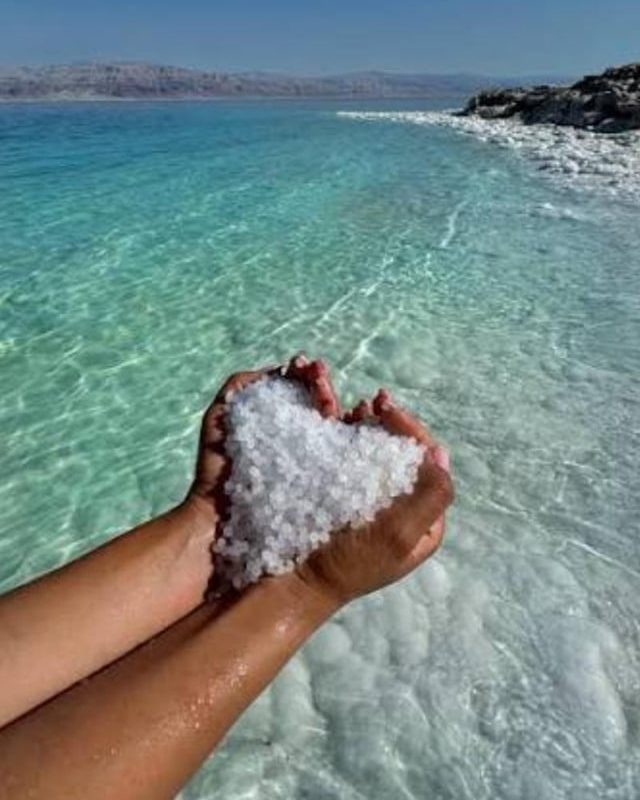
In the Dead Sea, there is an entire beach full of round salt pearls that look like white sand.
Mysterious “Salt Pearls Beach”: The Dead Sea’s Enchanting Shore of White Crystal Spheres
The Dead Sea—a place of legend and extremes—holds a secret that baffles scientists and delights travelers. Along its shores, particularly near Ein Bokek on the Israeli side, lies a surreal beach scattered with millions of round, pearl-like salt crystals. At first glance, they look like fine white sand, but underfoot, these orb-shaped jewels create a shimmering, ethereal landscape unlike anywhere else on Earth.
What Are These “Salt Pearls”?
Unlike typical jagged salt formations, these spherical crystals form through a unique natural alchemy:
- Supersaturated Salinity: The Dead Sea’s water is 34% salt—nearly 10x saltier than the ocean. As water evaporates, sodium chloride crystallizes aggressively.
- Wave Action: Gentle waves act like a natural rock tumbler, rolling newly formed salt crystals along the shoreline. Over time, this smoothes them into perfectly rounded white pearls (1–5mm in diameter).
- Mineral Mix: Combined with trace minerals like magnesium and calcium, the crystals gain their pearly luster.
Why This Phenomenon is Rare
While salt crystals form worldwide, the Dead Sea’s low elevation (-430m) and extreme climate create the perfect storm:
- Rapid evaporation under relentless sun
- Minimal rainfall to dissolve crystals
- Mineral-rich mud that stabilizes the shoreline
This results in endless stretches of “salt sand” that literally sparkle underfoot as they reflect sunlight.
A Visitor’s Guide to the Salt Pearl Beaches
📍 Where to Find Them:
The most accessible spot is Ein Bokek Beach, a resort area with lifeguard supervision. The southern shores near Neot HaKikar also hold hidden stretches.
🚫 Important Warnings:
- DO NOT SWIM in areas with dense salt pearls submerged offshore—they can create hazardous, shallow banks.
- Avoid rubbing eyes if you touch the salt crystals; rinse skin thoroughly afterward.
- Wear waterproof sandals—the crystals can be sharp underfoot when dry.
🌅 Best Time to Visit:
Visit early morning or sunset when the low-angle light makes the “pearls” glow. Winter (Nov–Feb) is ideal—evaporation peaks, revealing more crystals.
Scientific Significance & Threats
These salt pearls aren’t just beautiful—they’re indicators of environmental crisis:
- Shrinking Waters: As the Dead Sea recedes ~1m/year, new salt formations expand alarmingly.
- Human Impact: Dams on the Jordan River and mineral extraction plants accelerate evaporation.
- Fragile Ecosystem: The pearls’ formation depends on precise conditions disrupted by climate change.
Photography Tips & Etiquette
- Macro Magic: Zoom in on individual “pearls” against dark Dead Sea mud for surreal contrast.
- Golden Hour: Capture the crystals shimmering like diamond dust at sunrise.
- Leave No Trace: Collecting salt pearls is discouraged—they’re part of a delicate, vanishing habitat.
Final Thought:
The Dead Sea’s salt pearls are nature’s fleeting masterpiece—a glittering reminder of Earth’s beauty and fragility. Visit soon, but tread lightly. As environmentalist Alon Tal warns: “This wonder may not last our lifetimes if the sea dies.”
Explore Responsibly:
Check guided eco-tours from Tamar Regional Council for ethical access to hidden pearl beaches.
🔍 SEO Keywords:
Dead Sea salt pearls, White sand Dead Sea, Round salt crystals beach, Ein Bokek salt formations, Unique Dead Sea beaches, Salt phenomenon Israel/Jordan, Dead Sea environmental crisis, Rare natural wonders.
(Image suggestion: A close-up of salt pearls contrasted against the Dead Sea’s turquoise water, with Jordan’s mountains in the background.)
💬 Have you seen the Dead Sea’s salt pearls? Share your experience below! 👇