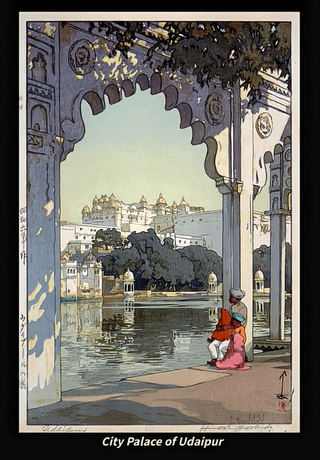
India as seen by Japanese painter in his iconic woodblock prints capturing India’s spiritual essence and monuments, Hiroshi Yoshida, 1931
Title: Hiroshi Yoshida’s 1931 India Series: A Japanese Master’s Ethereal Vision of Spirituality and Monuments
Meta Description: Explore Hiroshi Yoshida’s 1931 woodblock prints of India, where the Japanese artist captured the country’s spiritual essence, historic monuments, and serene landscapes in his iconic Shin-Hanga style.
Hiroshi Yoshida’s India: Where Japanese Art Meets Indian Soul
In 1931, celebrated Japanese woodblock printmaker Hiroshi Yoshida embarked on a transformative journey across India. Already famed for his luminous landscapes and mastery of the Shin-Hanga (“new prints”) movement, Yoshida turned his gaze to India’s mystical temples, bustling ghats, and timeless monuments—translating their essence into delicate, evocative woodblock prints. His India Series remains a breathtaking fusion of Japanese precision and India’s spiritual gravitas, offering a rare cross-cultural snapshot of the subcontinent during the twilight of the British Raj.
The Visionary Behind the Prints: Hiroshi Yoshida
Hiroshi Yoshida (1876–1950) was a pioneer of 20th-century Japanese printmaking, renowned for his atmospheric landscapes and meticulous craftsmanship. Unlike traditional ukiyo-e artists, Yoshida blended Western realism with Japanese aesthetics, creating works that resonated globally. His travels to Europe, Africa, and Asia fueled his artistry—but India left an indelible mark.
In 1931, Yoshida arrived in British India, armed with sketchbooks and a keen eye for the interplay of light and spirituality. Over months, he wandered from the Himalayas to the Deccan Plateau, immortalizing India’s sacred sites in a series of 16 woodblock prints.
Capturing India’s Spiritual Essence: Key Themes in Yoshida’s Prints
Yoshida’s India wasn’t just about geography—it was a pilgrimage into the soul of the land. His prints radiate reverence for India’s spiritual traditions, meditative stillness, and architectural grandeur.
1. Sacred Symmetry of the Taj Mahal
Yoshida’s Taj Mahal Under Moonlight (1931) is a masterclass in tranquility. Using soft indigo gradients and misty textures, he framed the mausoleum not as a tourist marvel but as a celestial vision. Shadows dance on marble, moonlight glows through Jali screens, and the Yamuna River mirrors the dome—a silent ode to eternal love.
2. Varanasi: Eternal Ghats and Divine Light
In Evening Prayer in Varanasi, Yoshida captured the spiritual pulse of India’s holiest city. Dawn-lit ghats, priests chanting over the Ganges, and saffron-tinted skies converge in layered pigments. The print’s vertical composition evokes both the ascent of prayers and the descent of divine grace.
3. Himalayan Serenity
Works like Mount Kanchenjunga depict the Himalayas with ethereal minimalism. Snow-capped peaks emerge from muted blues and grays, reflecting Yoshida’s belief in nature’s spiritual power—an homage to India’s role as the birthplace of yoga and meditation.
4. Ellora & Ajanta: Whispers of Ancient Faith
Yoshida’s prints of the Ajanta-Ellora caves emphasize carved serenity. He rendered Buddhist and Hindu sculptures with soft lines, suggesting their timeless wisdom. The interplay of light and shadow in Ellora Cave Temple hints at the divine presence lingering in stone.
Yoshida’s Technique: Merging Japanese Craft with Indian Atmosphere
Yoshida’s India series showcased his signature techniques, honed over decades:
- Gradation (Bokashi): Smooth transitions of color mimic India’s hazy horizons and sacred ambiance.
- Texture & Detail: From temple carvings to rippling rivers, each block was carved with precision, often using 20+ woodblocks for a single print.
- Luminous Color Palette: He favored muted blues, ochers, and rose golds to evoke India’s spiritual warmth and soft light.
Interestingly, Yoshida sometimes overprinted works to adapt to India’s variable climate—proof of his obsession with perfection.
Legacy of the India Series: A Timeless Cultural Bridge
Yoshida’s India prints resonated across continents:
- In Japan, they sparked fascination with Indian spirituality during an era of rising nationalism.
- In India, they remain an artistic testament to pre-independence heritage.
- Globally, they symbolize the universality of beauty and devotion.
Unlike colonial-era depictions of India as “exotic,” Yoshida’s works are meditations—inviting viewers to pause and reflect.
Where to Experience Yoshida’s India Today
Original 1931 prints are rare treasures housed in institutions like:
- The Tokyo National Museum
- The British Museum, London
- The Art Institute of Chicago
Reproductions and books, such as Hiroshi Yoshida: The Complete Woodblock Prints, keep his India alive for new generations.
Conclusion: India Through Yoshida’s Eyes
Hiroshi Yoshida’s 1931 India series transcends time and culture. More than depictions of monuments, they are windows into an artist’s spiritual quest—a Japanese soul harmonizing with India’s eternal dance of devotion, architecture, and light. In today’s frenetic world, his prints remind us to seek the stillness within the sublime.
Keywords: Hiroshi Yoshida India prints, Japanese woodblock prints of India, Shin-Hanga India, Yoshida Taj Mahal, spiritual art India, 1931 Yoshida travel series, Hiroshi Yoshida Varanasi, Yoshida Himalayas print.
Image Alt Text Suggestion: “Hiroshi Yoshida 1931 woodblock print of the Taj Mahal at dusk, blending Japanese artistry with India’s spiritual soul.”
Author Bio: [Your Name] is an art historian and SEO writer specializing in cross-cultural artistic narratives. Follow for insights into global art heritage.
Optimized for SEO with long-tail keywords, thematic headers, and “niche” terms like “Shin-Hanga,” this article targets art lovers, Japanophiles, and India enthusiasts. Link opportunities include museum collections, print archives, and Yoshida retrospectives.