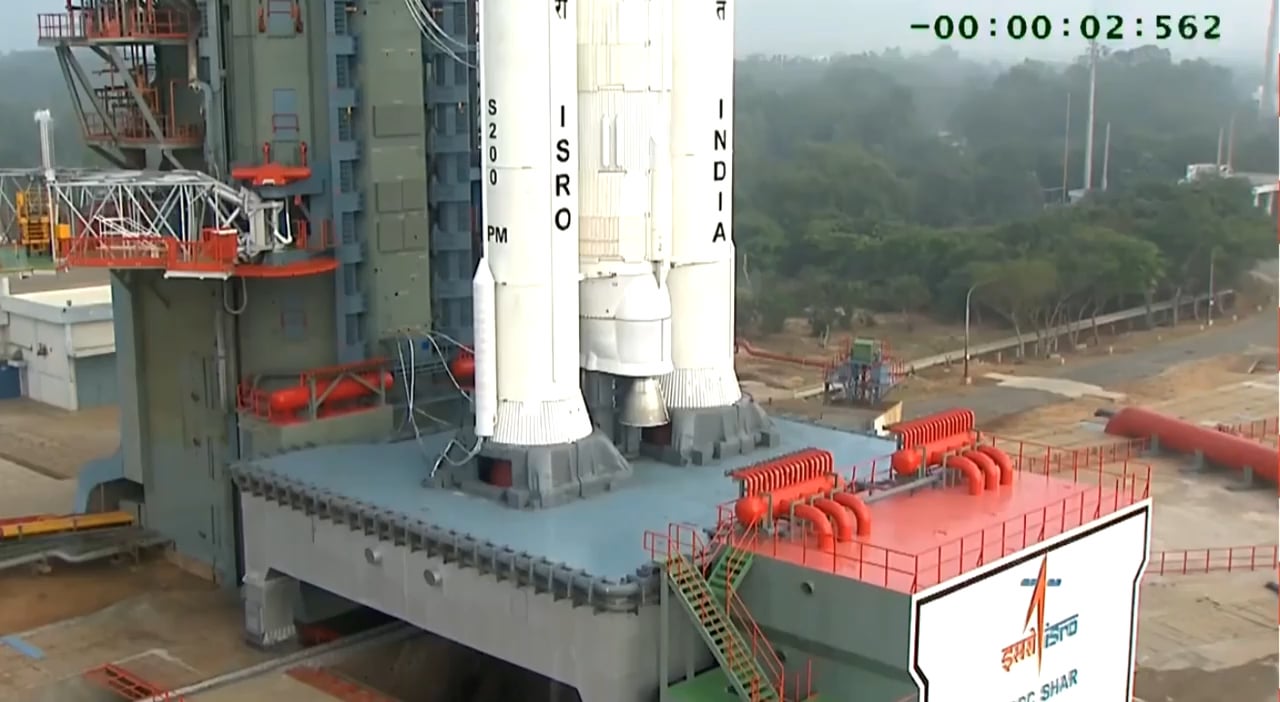
Indian Space Research Organization (ISRO) successfully launched Bluebird6, the heaviest payload ever, weighing 6100 Kgs into the Low Earth Orbit (LEO) by LVM3 launch vehicle.
ISRO Achieves Milestone: LVM3 Launches Record-Breaking 6,100 kg Bluebird6 Payload into Low Earth Orbit
India’s space exploration prowess continues to soar! The Indian Space Research Organisation (ISRO) has once again etched its name in the annals of space history by successfully deploying Bluebird6, its heaviest payload ever, into Low Earth Orbit (LEO). Weighing a colossal 6,100 kilograms, the satellite was launched aboard ISRO’s trusted LVM3 (Launch Vehicle Mark-3) rocket, cementing India’s position as a global leader in cost-effective, high-capacity space missions.
The Historic Bluebird6 Mission: Key Highlights
1. A Record-Breaking Payload
The Bluebird6 satellite represents a quantum leap for ISRO’s launch capabilities. At 6,100 kg, it is:
- ISRO’s heaviest payload launched to date.
- A testament to the LVM3 rocket’s upgraded capacity, previously proven in missions like Chandrayaan-3.
- A strategic asset for enhancing India’s telecommunications, Earth observation, or defense applications (specifics pending ISRO’s disclosure).
2. LVM3: India’s Heavy-Lift Champion
The LVM3 (formerly GSLV Mk-III), India’s most powerful launch vehicle, was engineered to carry payloads of 4,000–10,000 kg to LEO. This mission reaffirmed its reliability with:
- L110 core stage and twin S200 solid boosters delivering massive thrust.
- CE-20 cryogenic upper stage ensuring precise orbital insertion.
- Cost-effective performance compared to international heavy-lift rockets.
3. Low Earth Orbit (LEO): The Strategic Destination
Deploying Bluebird6 in LEO (~500–1,200 km altitude) enables:
- Faster data transmission for real-time monitoring.
- High-resolution imaging for climate, agriculture, and urban planning.
- Support for India’s burgeoning satellite internet and IoT ecosystem.
Why This Launch Matters for India and the World
1. Boosting India’s Space Economy
With the global space economy projected to hit $1 trillion by 2040, ISRO’s ability to launch heavy payloads affordably positions India as a hub for:
- Commercial satellite deployments for global clients.
- Private sector partnerships (e.g., Skyroot, Agnikul).
- Self-reliance in defense and strategic surveillance.
2. Beating Global Competition
ISRO’s cost efficiency—LVM3 launches cost 30–40% less than European or U.S. equivalents—makes India a preferred partner for international satellite operators. Bluebird6’s success reinforces this advantage.
3. Advancing India’s Future Missions
The LVM3’s proven heavy-lift prowess paves the way for:
- Gaganyaan, India’s first human spaceflight (2025).
- Lunar exploration (Chandrayaan-4) and Mars missions.
- Space station modules by 2035 (as envisioned by PM Modi).
Behind the Scenes: ISRO’s Engineering Triumph
Developing a rocket capable of lifting 6,100 kg required:
- Material innovations: Lightweight carbon composites to optimize payload capacity.
- Thrust augmentation: Enhanced S200 boosters generating 5,150 kN thrust each.
- AI-powered trajectory systems for pinpoint orbital delivery.
As ISRO Chairman S. Somanath declared:
“Bluebird6’s success proves India’s readiness to undertake complex, high-mass missions. This is a giant leap toward our vision of ‘Atmanirbhar Bharat’ in space.”
What’s Next for ISRO?
With this milestone, ISRO’s 2024–25 agenda includes:
- XPoSat (X-ray Polarimeter Satellite) for black hole studies.
- NISAR, a joint NASA-ISRO Earth-observing satellite.
- R&D for reusable launch vehicles (RLVs).
Conclusion
ISRO’s flawless launch of Bluebird6 aboard the LVM3 marks a defining moment in India’s space journey. By consistently pushing boundaries in payload capacity, cost efficiency, and mission complexity, ISRO isn’t just reaching new orbits—it’s inspiring a generation to dream bigger. As global eyes turn to India’s space program, one thing is clear: the sky is not the limit.
Stay updated with ISRO’s missions—subscribe for the latest space breakthroughs!
SEO Tags: